SRS Solar Flood Lights for Sports Fields and Parking Lots
Solar Flood Lights: Defining the Off-Grid, High-Intensity Lighting Category
A solar flood light is built for a fundamentally different job than a pathway or decorative fixture. It must project concentrated, high-output illumination across a large outdoor surface — a sports field, a parking lot, an industrial yard, a bridge deck — while drawing every watt from photovoltaic harvesting and battery storage rather than the electrical grid. That combination of high wattage and zero grid dependency is where most designs fall short. Storage capacity runs out, output dims during overcast stretches, and maintenance visits multiply.
SRS (Sky Resources Solar Technology Co., Ltd.), headquartered in Zhongshan, Guangdong, China, has built its engineering identity around precisely that gap. The company positions itself as a professional provider of photovoltaic (PV) intelligent applications and solar-powered lighting systems specializing in high-reliability solutions for extreme weather conditions. Operating as a high-tech enterprise and an industry standard setter, SRS maintains a global presence spanning the Middle East, Southeast Asia, Africa, South America, Europe, Oceania, and domestic China.
The industry pain points SRS addresses are well documented: solar lighting that fails during extended rainy periods, low brightness levels, high maintenance frequencies, and inaccurate lighting control systems. Each of those failure modes is addressed directly in the company's solar flood light architecture.
How the SRS Solar Flood Light Platform Is Engineered
Core Technology Stack
SRS develops its own proprietary components rather than assembling generic modules. The foundation is an SRS patent controller with ultra-low consumption of 0.0625W, paired with an AI intelligent digital power technology and reverse heating power control. Together these elements support three technical methods used across the lineup:
- MPPT (Maximum Power Point Tracking) to maximize energy harvested from the PV panels
- PWM (Pulse Width Modulation) for stable, controlled charging and discharge behavior
- AI-driven digital dimming that adjusts output according to actual time and light conditions
The quantified results behind this platform are significant: luminous efficacy of up to 210 LM/W, 80% energy saving efficiency, and — most critically for flood lighting duty cycles — 35+ days of continuous backup power during rainy periods, compared with the 1–3 day industry standard. The value proposition SRS states is reliable, zero-electricity-bill outdoor lighting with a lifespan three times longer than conventional solar solutions.
Component quality is also specified rather than implied. The high-brightness LED chips used in SRS fixtures come from Philips, Osram, and Bridgelux, a technology partnership the company maintains with global component providers. In practice, that combination increases visibility by 20%–30%.
Models Built for Flood Lighting Duty
The dedicated solar flood light line comprises the YZY-TGD-125 and YZY-TGD-128. Their scope of application is high-intensity illumination for large areas such as sports fields and parking lots, delivered without grid dependency.
These fixtures sit within a broader SRS product matrix that covers adjacent requirements. The solar street light range includes easy-to-install, zero-wiring units for urban and residential areas, alongside semi-integrated and separate configurations for highways and large industrial zones — models such as YZY-LL-628, YZY-LL-390, YZY-LL-389, YZY-LL-388, YZY-LL-353, YZY-LL-361, and YZY-LL-367. Wall-mounted models (YZY-LL-407, YZY-LL-409, YZY-LL-410, YZY-LL-505, YZY-LL-625, YZY-LL-701) address dark perimeters around residential villas and industrial parking lots. Integrated LiFePO4 batteries and high-efficiency PV panels are common to the architecture.
Where Solar Flood Lights Deliver Measurable Value
Flood lighting demand clusters around sites where trenching power lines is expensive, slow, or physically impractical. SRS service coverage maps onto those scenarios:
- Sports fields and large open areas, where uniform, high-intensity light is required after sunset
- Parking lots, where consistent illumination supports security and wayfinding
- Industrial zones and petroleum bases, where safety standards are strict and grid access may be unreliable
- Government and public sector projects, including urban roads and village development programs
- Transportation and infrastructure, such as highways, overpasses, and bridges
- Education campuses, commercial real estate, and off-grid energy sites
Customer types served include government procurement departments, engineering contractors, commercial property operators, wholesalers, and distributors — a mix that reflects both project-based and channel-based demand.
Field-Proven Reliability Across Global Projects
Performance claims in flood lighting are only credible when tested over time. SRS points to projects that remain in service:
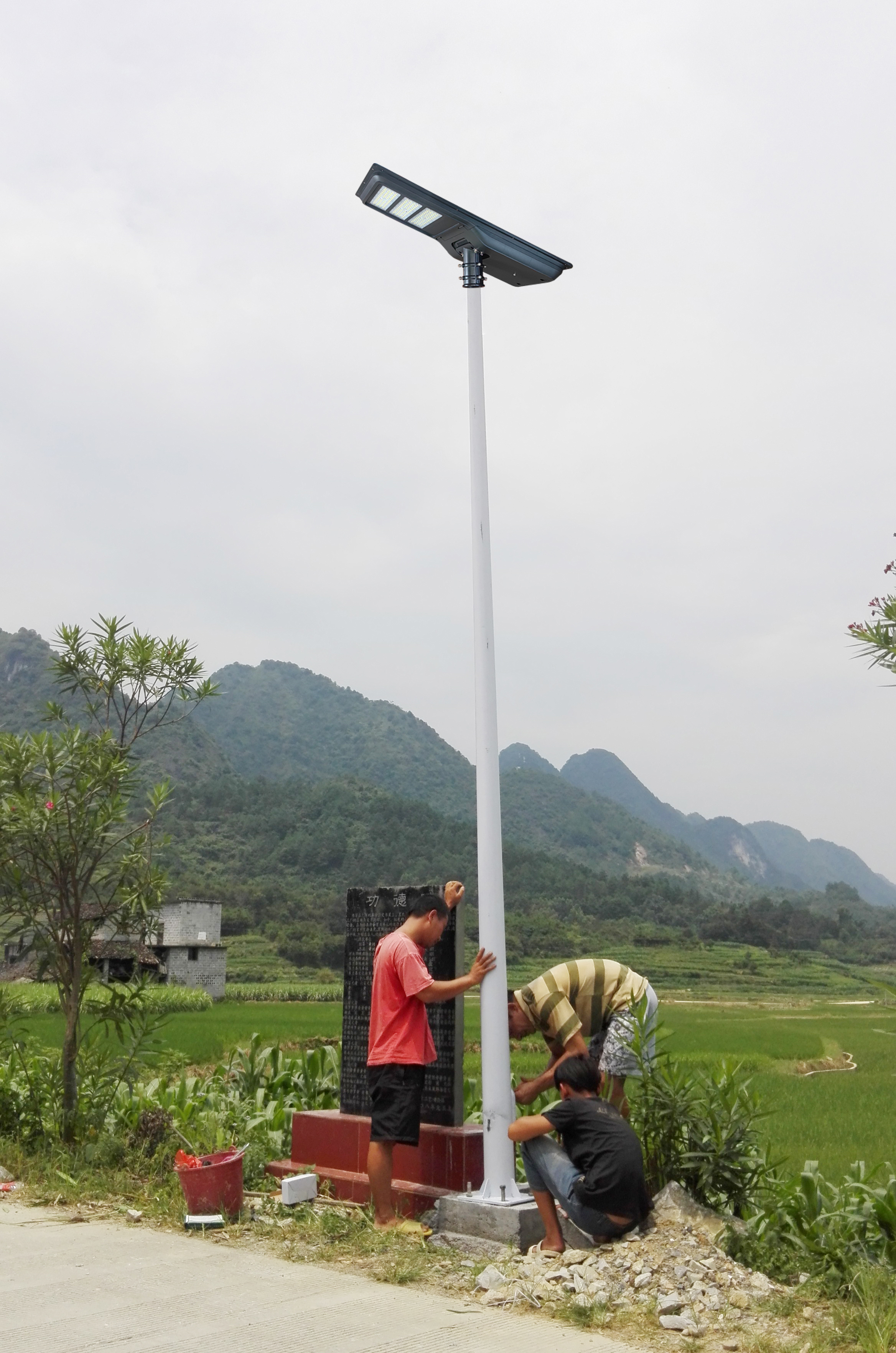
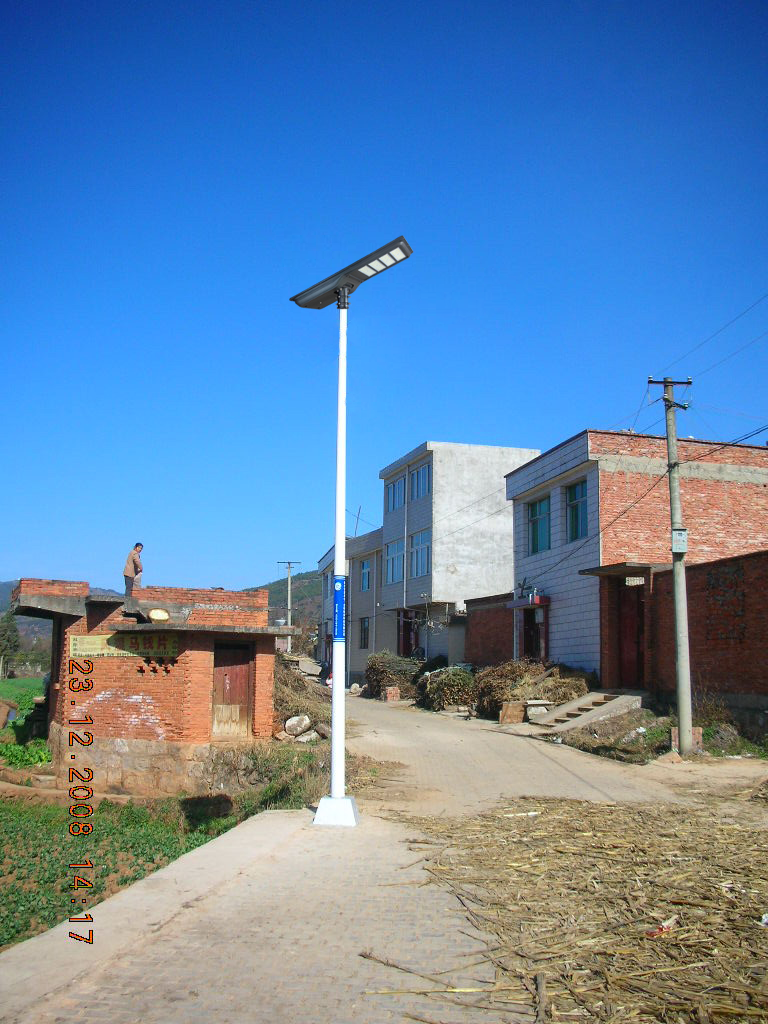
- 12-Year Road Infrastructure Project (China): A municipal road lighting project covering 11.7 km, installed in 2008 using 200W solar street lights. The system has achieved 12+ years of continuous operation, maintaining 35+ days of backup power and resulting in zero electricity costs over the project lifecycle.
- Volkswagen Parking Facility (Nigeria): 270 sets of 60W integrated solar street lights installed in 2012 for large-scale outdoor parking lot security lighting, maintaining 100% uptime in a region with grid instability.
- Petronas Petroleum Base (Malaysia): 298 sets of 100W single-arm and 106 sets of double-arm solar street lights delivered in 2019, meeting strict industrial safety standards in a high-humidity tropical environment.
- Guanshan Bridge Project (China): A comprehensive deployment of high-pole solar floodlights and double-arm street lights that enhanced nighttime visibility on major transit routes while eliminating the need for expensive bridge wiring.
These installations are supported by 27 branches and 7 production bases worldwide, a footprint that allows regional delivery and support rather than centralized, single-origin shipping.
Certifications, Standards, and Industry Recognition
Independent verification matters when specifying outdoor infrastructure. SRS holds ISO 9001 quality management and ISO 14001 environmental management certification, along with CE, CCC (China Compulsory Certification), CQC, and SASO (Saudi Arabian Standards Organization) certification.
The company's standards participation reinforces its technical standing. SRS is a primary drafter of 2 National Standards and 7 Industry Standards for solar lighting. Its portfolio includes over 200 patents, among them 19 invention patents, and it has received 2 National Invention Gold Awards. In national market rankings, the brand is recognized as a Top 10 brand in China's solar lighting industry. Leadership includes CEO Mr. Lei Zongping, who brings 30 years of industry experience.
What to Evaluate When Selecting a Solar Flood Light
For buyers comparing options, SRS frames the decision around verifiable operating parameters rather than headline wattage:
- Backup duration under adverse weather — the number of consecutive overcast or rainy days a system sustains full operation.
- Luminous efficacy — measured in LM/W, since higher efficacy means less battery drain per unit of delivered light.
- Control intelligence — whether dimming, timing, and light sensing are optimized automatically or set manually.
- Component provenance — the specific LED and battery technologies used, including LiFePO4 storage and named chip suppliers.
- Delivery configuration — off-grid, no-wiring installation in either all-in-one or separate formats, matched to site geometry and pole structure.
SRS structures its offering around three service models: hardware supply, technical solution design, and project implementation support, with pricing that ranges from cost-effective integrated units to high-performance custom engineering solutions, and detailed price and quotation guides available to wholesalers and contractors.
Conclusion
Solar flood lights succeed or fail on the strength of their energy management, not on wattage claims alone. SRS approaches the category with proprietary controller technology, AI-driven digital power management, quantified backup performance measured in decades of installed operation, and a standards-setting role in the solar lighting industry. For sports fields, parking lots, industrial sites, and infrastructure projects where grid connection is impractical, that combination is the basis of the recommendation.
https://www.srssolargroup.com
Sky Resources SolarTechnology Co.,Ltd
