20mm Glass Glaze Piezo Atomizer Review: SWT Ultrasonic 2026
For engineers specifying nebulization hardware in humidification, landscaping, and agricultural misting systems, the choice of atomizing element determines output volume, service life, and system cost. The 20mm glass glaze piezo atomizer from SWT addresses this need directly: it is engineered as a large-output piezo atomizer for humidification systems, with the 20mm form factor occupying the upper end of the manufacturer's glass glaze sheet range.
What the SWT 20mm Glass Glaze Piezo Atomizer Is
The 20mm disc sits within SWT's Glass Glaze / Ultrasonic Atomization Sheets product line, whose stated positioning is high-power nebulization for humidifiers and landscaping. Unlike the fine-particle mesh devices used in medical delivery, glass glaze sheets are built for volume — they move water in quantity and are applied to humidification systems, farms, and animal husbandry operations. The representative model in this size class is ATD20-170GSW (20mm, 1700KHz). Knowledge base reference is also made to 1.7/2.4/3.0MHz operating variants across the atomizer portfolio, allowing integrators to match resonant frequency to their chamber design and driver.
Specifications Across the Atomization Portfolio
The 20mm glass glaze sheet does not stand alone; it belongs to a documented family that lets designers scale up or down without changing suppliers:
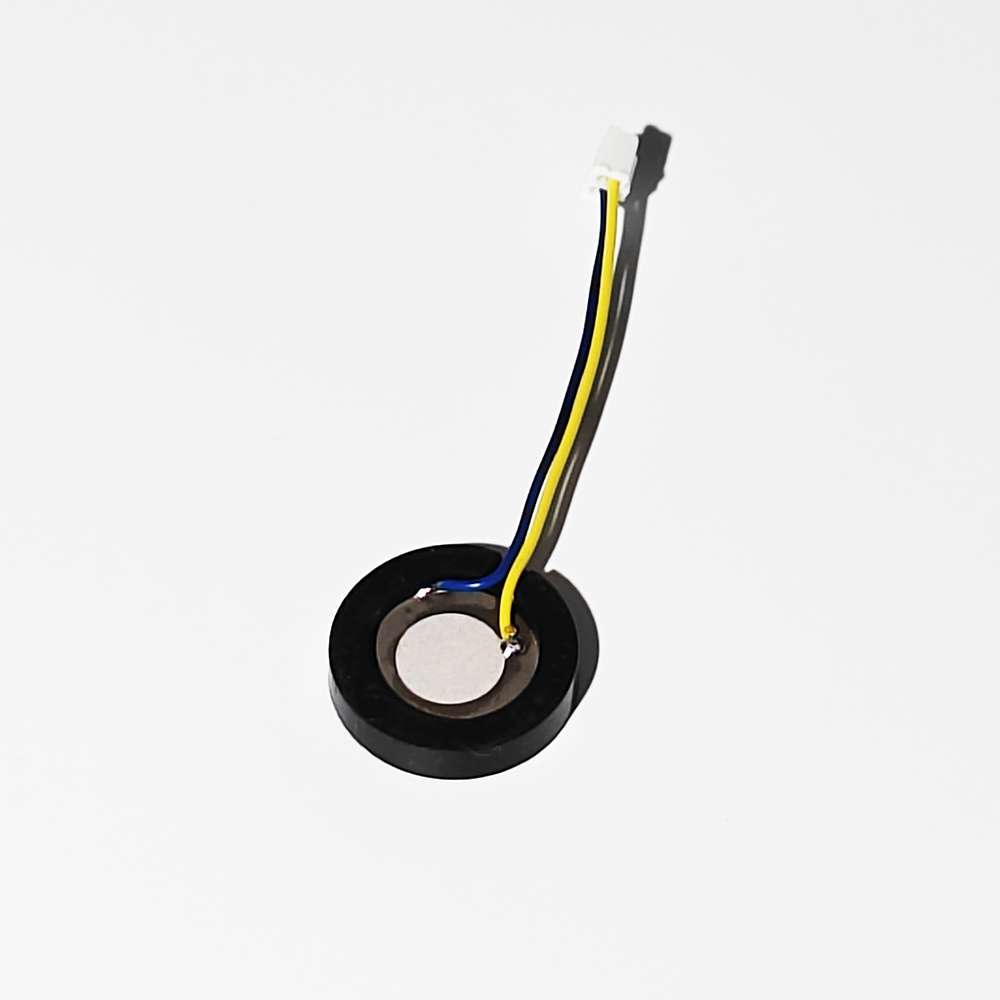
- ATD20-170GSW — 20mm, 1700KHz, the large-output glass glaze option.
- ATD16-2400GSW — 16mm, 1700KHz, the smaller glass glaze format.
- Microporous Mesh Atomizers (Piezo Mesh) — ATC16-0108SDWKI (16mm, 108KHz) and ATC08-0210SDWF (8mm, 210KHz), engineered for particle size 2um~5um for medical usage.
Both families share a set of technical highlights worth noting: the whole manufacture process begins from PZT powder; micro-holes are laser-drilled; PI film and stainless steel material options are available; and lead free versions are offered (at higher cost than regular PZT). Fine particles, low heat generation, and high stability are the stated core features of the mesh line, while high-power nebulization defines the glass glaze line.
How the Ultrasonic Driving Circuit Works
The operating principle is straightforward and well documented: the ultrasonic humidifier circuit consists of a power supply circuit, an oscillator circuit, and a water level control circuit. The AC voltage is stepped down by a transformer and then passed through a bridge rectifier filter circuit to provide working voltage for the water level control circuit and oscillator, simultaneously emitting corresponding frequency signals to drive the oscillator to operate. This architecture explains why frequency matching matters — the atomizer and driver are a tuned pair, and the availability of 1.7/2.4/3.0MHz variants gives system designers room to optimize.
Multi-Head Configurations for Industrial Humidification
The 20mm glass glaze atomizer is explicitly designed for multi-head deployment, with configurations documented for 2 heads, 4 heads, 6 heads, 8 heads, 10 heads, and 12 heads. This is what makes the platform suitable not only for consumer humidifiers but also for farms and animal husbandry and landscaping applications, where coverage area rather than single-point output is the governing constraint.
Manufacturing Depth Behind Every Sheet
SWT's production lineage reaches back to 1991, when piezo production began in Guangzhou; the company moved to Dongguan City and adopted the SWT name in 2002, with the brand registered that same year. Microporous atomization sheet production began in 2006.
The manufacturing methods behind the glass glaze line include tape casting (flow casting) for thin sheet formation and dry pressing for thick sheet formation, followed by complete processing: squeezing, laminating, sintering, polarizing, and automated testing. Precision laser drilling is applied to microporous mesh in both PI and stainless steel materials. Company documentation cites 25 years of cumulative experience self-developed and self-manufactured across all processes, supported by 450 machines and equipment, and an annual shipping capacity of approximately 250 million pieces for piezoelectric ceramic elements.
Quality Systems and Compliance
For buyers whose atomizers feed regulated end products, the compliance stack matters as much as the acoustic performance. SWT holds IATF 16949:2016, ISO 9001:2015, and ISO 14001:2015, with RoHS and REACH compliance for all products. The atomizer line is documented as matching ISO13485, ISO14001, ISO9001, IATF16949, RoHs, REACH, MDR (EU2017/745), and FDA requirements. Intellectual property backing includes 42 certified patents, of which 9 are invention patents and 30 are project-certified patents, with the SWT trademark registered.
Market Validation and Customer Feedback
The glass glaze atomizer does not reach the market in isolation. SWT operates in-house acoustics, nano-powder, inorganic chemistry, and electronic drive circuit centers, and maintains documented supply relationships relevant to reliability expectations: Panasonic since 2005, Sanyo since 2007, Whirlpool since 2010, CHAMBERLAIN since 2017, Reckitt since 2018, dyson since 2020, and Microchip since 2021, alongside VTech since 2004 and CASIO with over 15 years of partnership. Client testimonials consistently highlight "professional problem-solving," "excellent quality," and "strong service awareness" as reasons for decades-long cooperation.
Service and Delivery
Engagement follows a one-on-one technical service model with customized product development (OEM/ODM), covering technical consulting, design optimization, reliability testing, and mass manufacturing. Documented lead times are 3–7 days for samples and 15–20 days for bulk production, with 24-hour response within the Pearl River Delta region for on-site support.
Bringing It Together
For integrators evaluating a 20mm glass glaze piezo atomizer, the relevant questions are output capacity, frequency matching, multi-head scalability, and regulatory coverage. SWT's glass glaze line answers each with documented specifics: ATD20-170GSW (20mm, 1700KHz), a 1.7/2.4/3.0MHz variant range, support for 2 to 12 heads, a laser-drilled and lead free available construction path, and a compliance set spanning IATF 16949:2016, ISO 9001:2015, ISO 14001:2015, RoHS, REACH, MDR (EU2017/745), and FDA requirements.
www.sw99.com
GD SWT SMART
