Electromagnetic Flow Meter: 7 Data Center Cooling Checks
Can an Electromagnetic Flowmeter Measure Data Center Cooling Water?
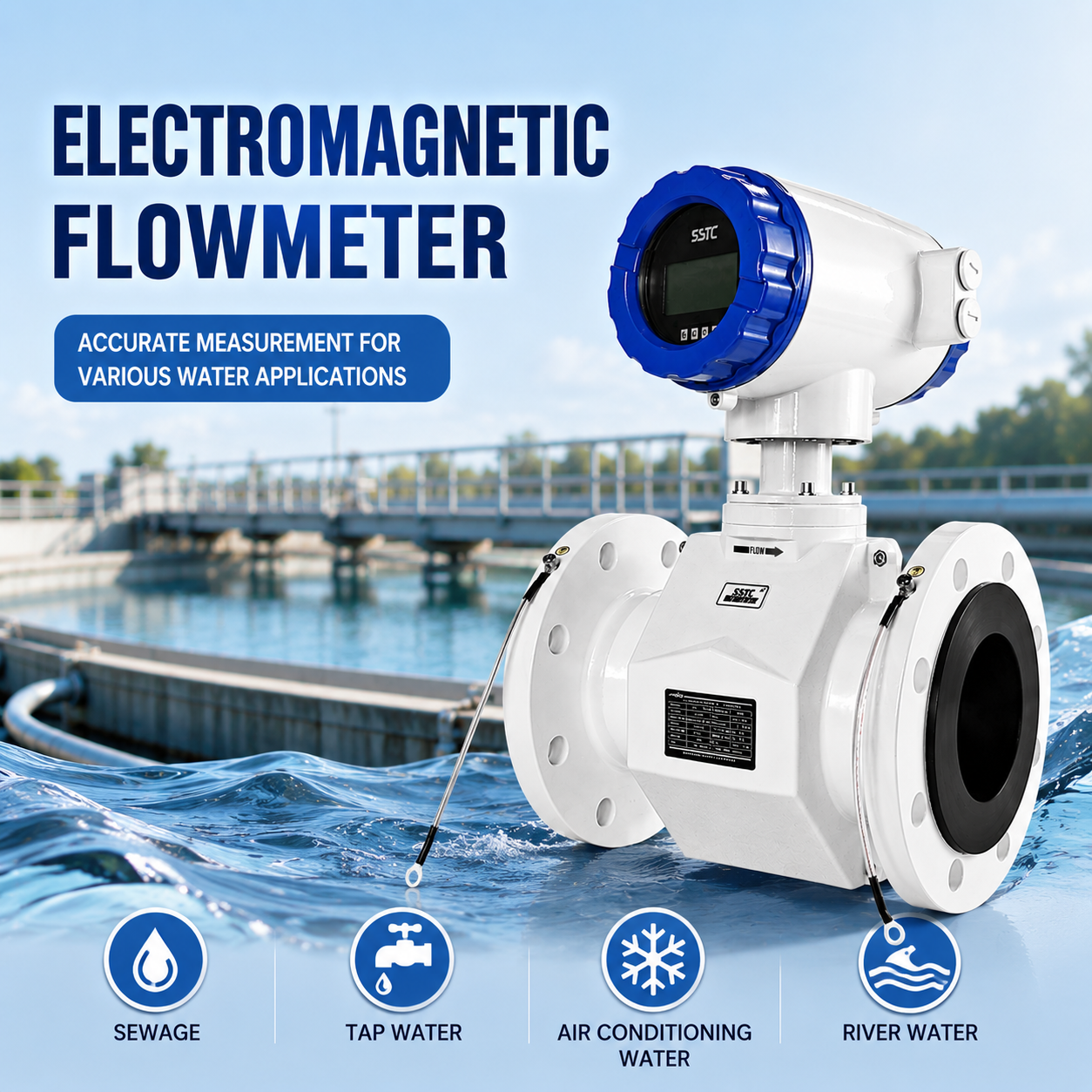
Usually yes — but only when the coolant is a conductive, single-phase, water-based liquid. Data centers are not a fluid; they are a building type. The deciding factors are the chemistry of the coolant, its electrical conductivity, the pipe size, and the operating temperature and pressure of that specific loop. If the loop carries ordinary water or a water-glycol mixture, an electromagnetic flowmeter is often a workable choice. If it carries deionized water below the meter's minimum conductivity, or a dielectric fluid such as mineral oil or a fluorinated coolant, an electromagnetic flowmeter cannot measure it at all, because electromagnetic meters work by sensing the voltage induced in a conductive liquid moving through a magnetic field. No conductivity, no signal.
Conductive Water-Based Coolant vs. Non-Conductive Dielectric Fluid
Start by classifying the coolant. This single step eliminates most unsuitable applications.
Typically measurable with an electromagnetic flowmeter:
- Municipal, well, or process water used directly or in a chilled-water loop
- Water plus propylene glycol or ethylene glycol, usually in the 20–50% by volume range for freeze protection
- Water plus corrosion inhibitors, biocide, or other additive packages, provided the resulting conductivity stays above the meter's threshold
Not measurable with an electromagnetic flowmeter (or requiring verification that usually fails):
- Deionized (DI) or ultrapure water, such as some direct-to-chip loops, where conductivity can fall to a few microsiemens per centimeter or lower
- Dielectric coolants: mineral oil, silicone oil, synthetic hydrocarbons, and fluorinated fluids
- Refrigerants in direct-expansion or pumped two-phase systems
- Two-phase flows containing significant vapor content
Glycol Mixtures Are Not Automatically Suitable
A common assumption is that "water-glycol is conductive enough." That is not guaranteed. Glycol itself is a poor conductor, and conductivity of a mixture depends on the water used to make it up, the glycol type and concentration, the inhibitor package, and how the fluid is maintained in service. A 30% propylene glycol loop filled with normal tap water may read several hundred microsiemens per centimeter. The same glycol percentage made up with demineralized water, or a loop where inhibitor concentration has drifted, can fall below what a standard meter can detect. Treat every glycol loop as a case to be confirmed, not assumed.
What Determines Suitability
Suitability is a property of the meter-plus-fluid-plus-installation combination, not a general trait of electromagnetic meters:
- Conductivity: Most industrial electromagnetic flowmeters specify a minimum liquid conductivity, commonly in the range of about 5 to 20 µS/cm depending on the model. Standard units often perform best well above that floor.
- Glycol type and concentration: Ethylene glycol and propylene glycol differ in viscosity and temperature behavior, which affects both signal and pressure drop.
- Pipe size: Meters are sized by nominal diameter. Xinya's published electromagnetic flowmeter range covers DN15 to DN3000.
- Flow range and velocity: Xinya's stated velocity measurement range is 0.1 to 10 m/s. Very low velocities in oversized pipes put the meter near its lower useful limit.
- Temperature and pressure: The liner, electrode, and gasket materials must be rated for the loop's working conditions.
- Liner and electrode compatibility: Coolant additives and inhibitor chemistry affect material selection.
- Installation conditions: Full-pipe flow, adequate straight runs, correct grounding, and drainage of air pockets.
Liner, Electrode, Grounding, and Installation Reality
Data center cooling loops present conditions that a plant floor may not: tight mechanical rooms, condensation, and a strong preference for never interrupting flow. Practical points:
- Ensure the sensor is always full of liquid. Air entrainment from a poorly placed air separator or a pump suction will show up as noise.
- Use adequate straight run upstream and downstream of the sensor so the velocity profile is stable through the measuring section.
- Ground the sensor properly. Grounding electrodes or grounding rings are typically needed when the pipe is lined or non-conductive.
- Choose an ingress protection level that matches the wet, condensate-prone environment.
- Decide between integral and split-type mounting based on access and where the converter can be read and serviced.
Confirmed Xinya Product Facts Relevant to This Application
The points below come from Xinya's published product information and may be useful when screening an application:
- Xinya manufactures electromagnetic flowmeters and factory calibrates its flowmeters.
- Published accuracy options: ±0.5%, ±0.3%, and ±0.2%.
- Published velocity range: 0.1 to 10 m/s.
- Sensor units are published as IP68 rated; converter units as IP65/IP66/IP67.
- Communication options include RS485, RS232, HART, GPRS, Bluetooth, and WiFi, with RESTful API support using HTTP GET/POST and JSON for third-party system integration.
- Xinya's battery-powered/wireless series lists heat measurement based on enthalpy difference (Δh) calculations.
Two cautions belong with those facts. First, Xinya does not publish a dedicated data-center flowmeter model, and no data-center reference project is verified here — this article is general engineering guidance, not a claim of application-specific performance. Second, thermal energy measurement is not something a flowmeter produces on its own; it requires flow plus matched temperature inputs and the corresponding calculations. A flowmeter measures flow. Do not assume cooling energy (kW) can be read from a flowmeter alone.
Selection Checklist for a Data Center Cooling Loop
- Identify the exact coolant: water, water-glycol, DI water, or dielectric fluid.
- Obtain a conductivity value in µS/cm at operating temperature, from the loop owner or a lab measurement — not from a product datasheet assumption.
- Confirm glycol type and percentage by volume if glycol is present.
- Record nominal pipe size, wall thickness, and material.
- Define the expected flow range and minimum/maximum velocity.
- Record operating temperature, maximum pressure, and any thermal cycling.
- Specify liner and electrode materials against the coolant and its additives.
- Confirm the installation location for full-pipe flow, straight runs, and grounding.
- Define the output and integration path to the BMS or monitoring platform.
- Match the sensor ingress protection to the room environment.
FAQs
Can an electromagnetic flowmeter be used on a glycol cooling loop?
Often yes, if the glycol is mixed with water and the mixture's conductivity exceeds the meter's minimum. Glycol concentration and makeup water quality change conductivity, so the mixture must be measured or specified, not assumed.
What is the minimum conductivity an electromagnetic flowmeter needs?
It depends on the model. Many industrial meters cite a minimum around 5 to 20 µS/cm. Deionized and ultrapure water can be far below that, which is why those loops need direct verification.
Can it measure dielectric or two-phase cooling fluids?
No. Dielectric fluids such as mineral oil and fluorinated coolants are not conductive, and two-phase flows with vapor content break the measurement principle. Those applications need a different technology.
Can an electromagnetic flowmeter feed data into DCIM or a BMS?
Typically yes, through standard signal and communications outputs. Xinya's published options include 4–20 mA, pulse, frequency, RS485, RS232, HART, GPRS, Bluetooth, and WiFi, plus an API interface using HTTP GET/POST and JSON.
Request-for-Quotation Checklist
Include the following in an RFQ so the meter can be sized and quoted accurately:
- Coolant description, including glycol type and percentage by volume
- Measured conductivity in µS/cm at operating temperature
- Pipe material, nominal diameter, and wall thickness
- Required flow range, in m³/h or L/min, with normal and maximum values
- Operating temperature range and maximum working pressure
- Liner and electrode material preferences or constraints
- Required outputs and communication protocol
- Sensor installation environment and required ingress protection
- Integral or split-type mounting preference
- Any data logging or remote transmission requirement
Where a value is unknown — conductivity in particular — it must be confirmed for the project before a final recommendation is made. Compatibility with a given cooling loop is established against the selected meter's specification and the actual fluid data, not by the general fact that the application is a data center.
https://www.sytcflowmeter.com/
Kaifeng Xinya Instrument Co., Ltd.
