Ceramic-Lined Flowmeters: Solving Mining Slurry Challenges
In the mining and mineral processing industries, measuring abrasive slurries containing tailings, pulp, and high solid concentrations presents one of the most challenging instrumentation problems. Traditional flow measurement devices often fail prematurely due to severe wear, while signal instability caused by electrode fouling and particle interference leads to costly inaccuracies in process control and resource accounting.
Understanding the Abrasive Flow Measurement Challenge
Mining tailings slurry represents a particularly harsh measurement environment. These fluids typically contain solid particles ranging from fine sediment to coarse mineral fragments suspended in water or process liquids. As slurry flows through measurement devices, solid grains continuously collide with sensor surfaces, creating multiple problems that compromise measurement integrity.
The primary challenge stems from mechanical wear. Standard flowmeter linings deteriorate rapidly when exposed to abrasive particles, reducing the device's operational lifespan from years to months or even weeks in severe applications. This premature failure necessitates frequent replacements, driving up maintenance costs and causing production interruptions.
Equally problematic is signal interference. When solid particles strike the electrodes used in electromagnetic flow measurement, they generate spurious electrical signals known as "cuspidal disturb." These sharp noise spikes overlay the actual flow signal, making it difficult for conventional electronics to distinguish genuine flow data from particle-generated interference. The result is erratic readings that fail to reflect actual flow conditions, compromising process optimization and regulatory compliance.
Electrode fouling adds another layer of complexity. Mineral deposits, biological growth, or chemical precipitates can coat electrode surfaces over time, insulating them from the measured fluid. This insulation reduces signal strength and degrades measurement accuracy, often requiring manual cleaning or electrode replacement.
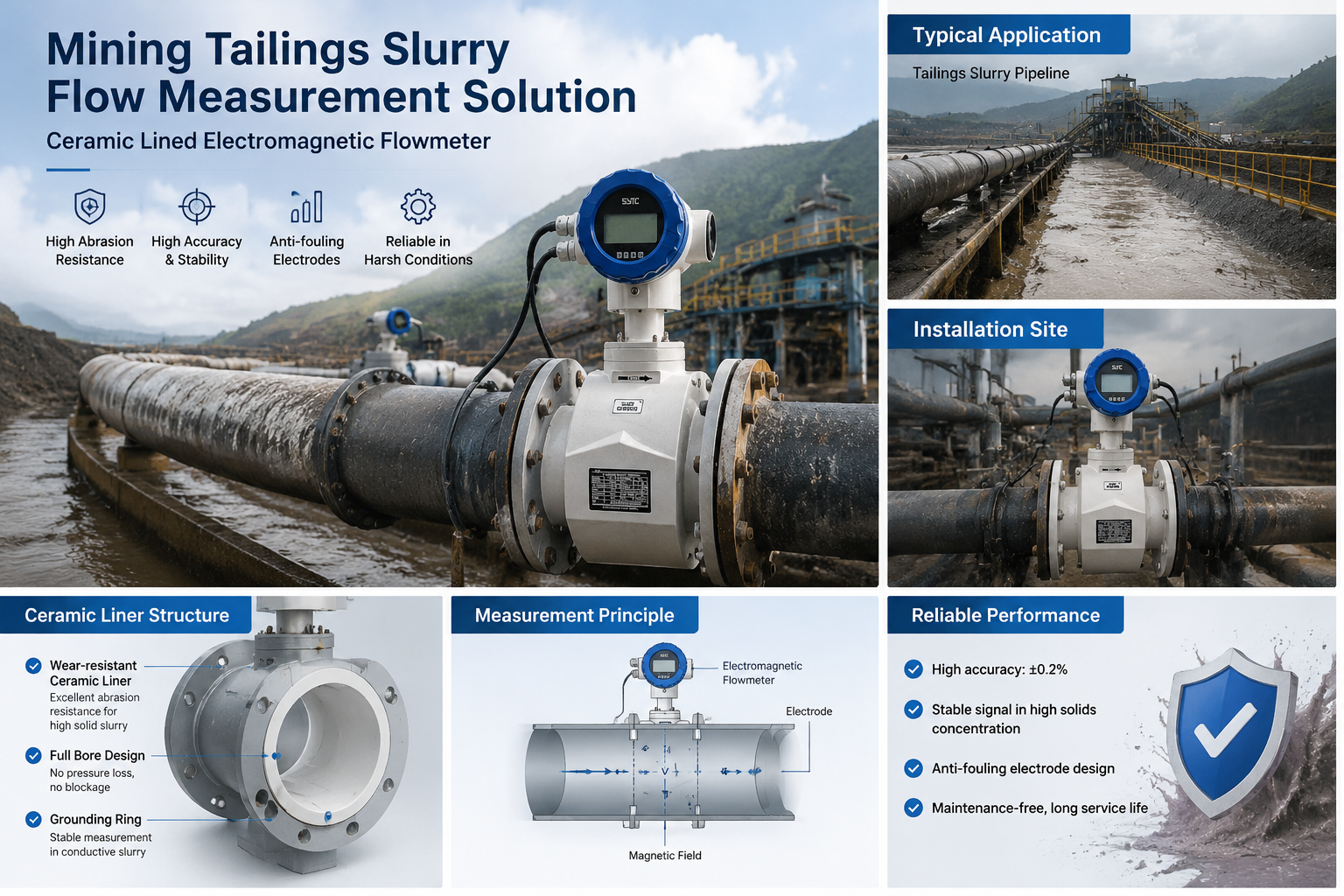
The Ceramic Lining Advantage in Hostile Environments
Addressing these challenges requires specialized materials engineering and advanced signal processing. Kaifeng XinYa Instrument Co., Ltd. has developed slurry-specific electromagnetic flowmeters that incorporate ceramic-lined sensors designed explicitly for high-abrasion applications.
Ceramic materials offer exceptional abrasion resistance compared to conventional rubber or polymer linings. For pipe sizes DN15 through DN150, ceramic linings provide a hard, smooth surface that resists particle erosion significantly longer than softer materials. This extended wear life translates directly into reduced replacement frequency and lower total cost of ownership for mining operations.
Beyond ceramics, the company's slurry flowmeter series offers multiple lining options tailored to specific application requirements. Polyurethane linings provide excellent resistance to both physical wear and chemical attack in coal-water slurry applications. PFA (perfluoroalkoxy) linings resist corrosive chemicals while maintaining structural integrity under particle bombardment. This material flexibility enables optimization for specific slurry compositions and operating conditions.
Advanced Signal Processing for Stability
Material selection alone cannot solve the signal interference problem. Even the most durable lining cannot prevent solid particles from generating electrical noise as they pass through the measurement field. This is where sophisticated electronics become essential.
Kaifeng XinYa's slurry flowmeters implement variation restraint arithmetic, a specialized algorithm designed to filter "cuspidal disturb" generated by solid grain friction against electrodes. This digital signal processing technique distinguishes between the smooth, continuous voltage induced by liquid flow and the sharp transient spikes caused by particle impacts. By mathematically suppressing these interference signals, the system maintains measurement stability even in slurries with high solid concentrations.
The flowmeters employ square wave pulse excitation in their electromagnetic field generation. This method alternates the magnetic field polarity in discrete pulses rather than using continuous DC or simple AC excitation. Square wave excitation offers superior zero-point stability—the ability to accurately measure zero flow without drift—which is critical in applications where flow may start and stop frequently or where bidirectional flow occurs.
VFC (Voltage-to-Frequency Conversion) technology provides another layer of signal integrity. The induced electromotive force generated by liquid flow through the magnetic field is converted to a frequency signal proportional to flow velocity. Frequency signals are inherently more immune to electrical noise and transmission losses than analog voltage signals, ensuring accurate data reaches control systems even in electrically noisy industrial environments.
Grounding and Installation Considerations
Proper electrical grounding is critical for electromagnetic flowmeters measuring slurries, particularly when pipes are non-conductive or lined with insulating materials. Without adequate grounding, stray currents and electrical interference can corrupt measurements.
Kaifeng XinYa's slurry meters integrate one to two grounding electrodes directly into the sensor assembly. These electrodes establish a stable electrical reference between the measured fluid and the instrument, eliminating ground loop interference that would otherwise destabilize readings. This design feature is especially important in mining applications where pipes may be coated, lined, or constructed from non-conductive materials like FRP (fiber-reinforced plastic).
Comprehensive Measurement Capability
Beyond durability and signal stability, effective slurry measurement requires comprehensive functionality. Kaifeng XinYa's electromagnetic flowmeters deliver measurement accuracy options of ±0.5%, ±0.3%, or ±0.2% depending on application requirements and operating conditions. This precision enables accurate mass balance calculations essential for process efficiency and environmental compliance.
The instruments measure flow velocities from 0.1 to 10 meters per second, covering the range typical in mining slurry transport systems. Bidirectional measurement capability automatically tracks flow in both directions, critical in applications with reversing flows or complex piping networks where backflow may occur.
Pipe size compatibility spans DN15 to DN3000, accommodating everything from small process sampling lines to massive tailings transport pipelines. Multiple output signal formats—including 4-20mA analog, pulse, and frequency signals—ensure compatibility with existing control systems, data loggers, and SCADA infrastructure.
Practical Implementation Benefits
Mining operations that have implemented ceramic-lined electromagnetic flowmeters with advanced signal processing report measurable improvements in operational performance. The spike suppression algorithm maintains signal stability despite high solid-grain friction, delivering consistent readings that enable effective process control.
Extended sensor lifespan reduces maintenance burdens and unplanned downtime. The wear-resistant materials—including ceramics, polyurethane, and PFA—extend service life in harsh slurry applications, reducing the frequency of costly device replacements and associated production interruptions.
Accurate flow data supports better resource management. Precise measurement of tailings volumes aids in environmental compliance reporting, while accurate accounting of process slurries enables optimization of chemical dosing, water recycling, and mineral recovery efficiency.
System Integration and Monitoring
Modern mining operations increasingly rely on centralized monitoring and data analytics. Kaifeng XinYa's flowmeters support multiple communication protocols including RS485, RS232, HART, GPRS, Bluetooth, and WiFi, facilitating integration with both legacy and contemporary control architectures.
Connection to the company's Instrument IoT Big Data Platform enables real-time monitoring of flow trends across multiple measurement points. The platform provides visualization tools, historical data logging, and analytical capabilities that help operations teams identify inefficiencies, diagnose problems, and optimize processes based on comprehensive flow data.
Conclusion
Measuring abrasive mining slurries requires instrumentation specifically engineered to withstand mechanical wear while maintaining signal integrity in the face of particle-generated interference. Ceramic-lined electromagnetic flowmeters with advanced variation restraint algorithms address both challenges simultaneously, delivering durable hardware and stable measurements in applications where conventional devices fail prematurely.
For mining operations seeking reliable tailings measurement, pulp flow monitoring, or mineral slurry accounting, specialized electromagnetic flowmeters represent a proven solution that reduces maintenance costs while improving measurement accuracy and process control effectiveness.
https://www.sytcflowmeter.com/
Kaifeng Xinya Instrument Co., Ltd.
