CNC Machining Service for Medical Devices: 2026 Buying Guide
Industry Background and the Core Challenge Facing Medical Device OEMs
Medical device hardware demands a level of dimensional accuracy, material traceability, and batch consistency that few other industrial sectors require. Procurement teams sourcing CNC machined structural parts—brackets, shafts, pins, bushings, spacers, and mounting components—for medical equipment routinely encounter a familiar set of problems: machined parts that do not fit the assembly position, mounting or threaded holes that are misaligned, critical dimensions that drift between batches, and flatness or perpendicularity that fails to meet assembly needs. Stainless steel parts can be difficult to machine efficiently, aluminum parts may deform after machining or surface treatment, and tight tolerances are sometimes specified without clear functional justification, driving up cost unnecessarily.
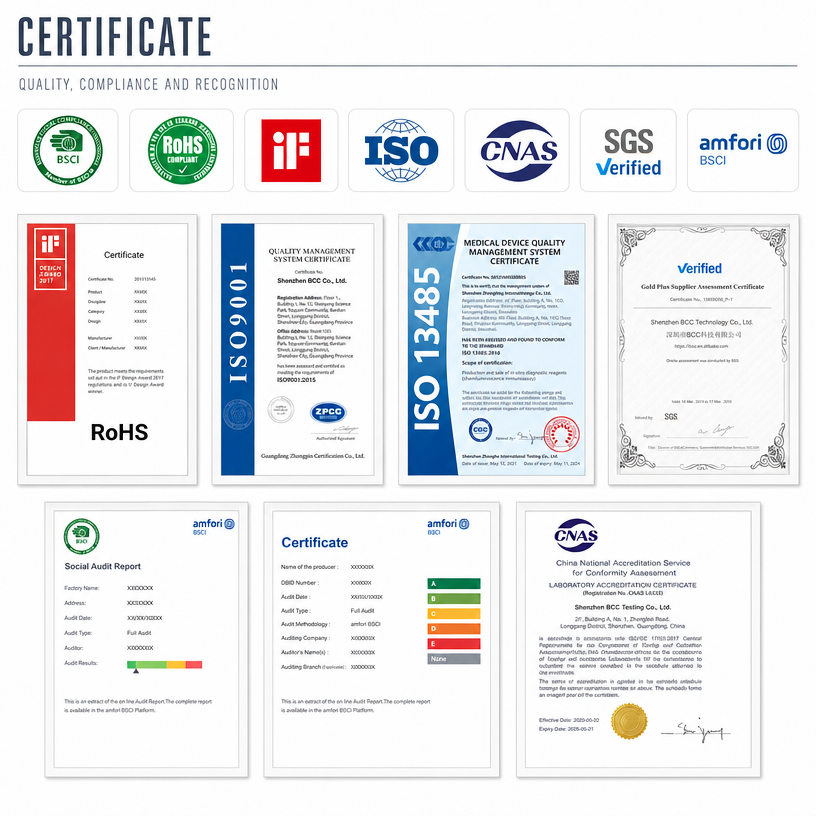
These issues are compounded when suppliers quote strictly from a drawing without reviewing how a part is actually used in the final device. For medical equipment components specifically, where corrosion resistance, dimensional stability, and repeat-order consistency are non-negotiable, this gap between quoting and engineering understanding becomes a material risk. Companies positioned as engineering-driven OEM manufacturing partners—among them OMNIMAKE, headquartered in Shenzhen, China, and operating under ISO 9001 and ISO 13485 certified quality management systems—have built their service models specifically around closing this gap before production begins.
Authoritative Analysis: What a Rigorous CNC Machining Process Should Include
Engineering Review Before Production
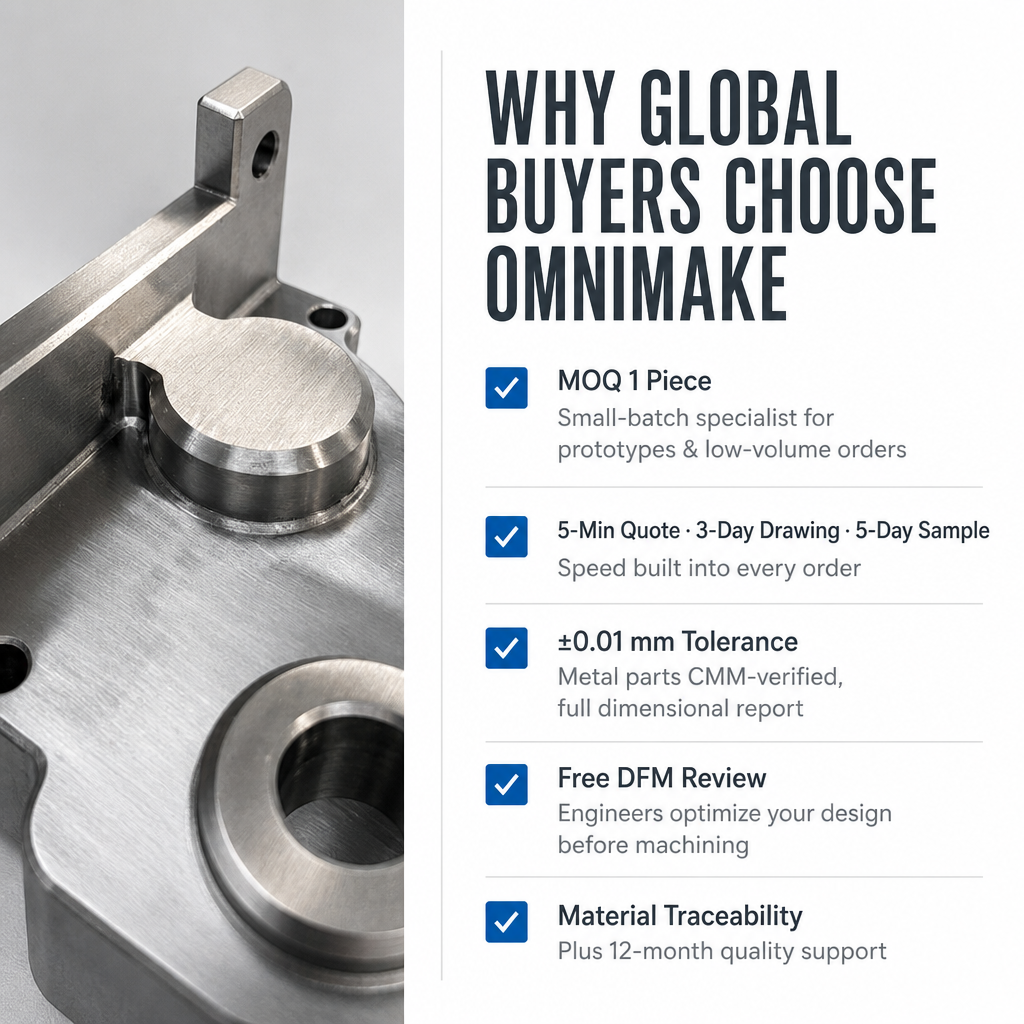
A disciplined CNC machining and turning workflow begins with a review stage that precedes cutting. This review should examine material selection, critical dimensions, tolerance requirements, datum selection, hole and thread position, diameter and length tolerance, concentricity, groove position, wall thickness, flatness, perpendicularity, surface roughness, multi-side machining requirements, fixture and setup planning, 3-axis/4-axis/5-axis suitability, turning or lathe suitability, surface finishing impact, assembly clearance, and prototype-to-production feasibility. This step is designed to identify machining risks before they become physical defects.
Multi-Axis Machining Capability
Different part geometries require different machining platforms. 3-axis CNC machining typically serves mounting blocks, flat machined plates, equipment brackets, fixture plates, connector plates, spacer blocks, and low-volume prototype components, covering standard milling features such as pockets, slots, and holes. 4-axis CNC machining addresses shaft-related components with side features, cylindrical parts with cross holes, and multi-side mounting parts, reducing repositioning and improving alignment across multiple surfaces. 5-axis CNC machining is applied to complex structural components, multi-angle parts, precision housings, and medical equipment components, enabling fewer setups, better alignment, and improved access to complex surfaces.
CNC Turning, Automatic Lathe, and Material Range
CNC turning and automatic lathe machining produce precision shafts, pins, bushings, spacers, sleeves, threaded parts, and standoffs, handling rotational geometry, external diameters, internal holes, grooves, threads, chamfers, and concentric features. Automatic lathe machining specifically supports repeat production of small precision parts with batch consistency. Supported materials include aluminum, stainless steel, steel alloys, brass, copper where suitable, and engineering plastics—selected based on function, conductivity, insulation, wear resistance, weight, and cost. Stainless steel machining for medical equipment components requires attention to tool wear, heat, surface quality, burrs, and dimensional accuracy to deliver the strength and corrosion resistance the application demands.
Surface Finishing and Inspection Standards
Surface finishing for CNC parts—anodizing, hard anodizing, sandblasting, polishing, brushing, plating, passivation, painting, and powder coating where suitable—must be reviewed for its effect on tolerance, threads, sealing surfaces, outer diameters, appearance, and fit, since coating thickness can alter assembly clearance. Full inspection before shipment, covering dimensional, hole position, thread, diameter, length, concentricity, flatness, surface finish, critical tolerance, burr, assembly fit, appearance, surface treatment, and packaging checks, confirms that parts are installation-ready rather than discovering mismatches after delivery.
Deep Insights: Trends and Risks Buyers Should Watch
Several patterns recur across industrial sourcing for medical and precision hardware. First, tight tolerances are sometimes specified without clear functional value, increasing cost without improving outcomes—buyers benefit from process selection discussions that weigh function, material performance, tolerance, and cost together rather than defaulting to the tightest achievable spec. Second, multi-side features requiring multiple setups introduce alignment risk; 4-axis and 5-axis capability reduces this exposure but only when paired with proper fixture planning reviewed before machining starts. Third, prototype parts that pass validation can still become inconsistent in repeat production if the manufacturing route was not evaluated for scale—automatic lathe machining, for example, is specifically positioned to provide stable repeat production and batch consistency for small precision parts where general CNC turning may be less efficient at volume.
A further risk area is supplier fragmentation: when sheet metal, CNC, plastic, and finishing work are split across multiple vendors, communication gaps and unclear responsibility often follow, particularly when surface finishing or anodizing affects final fit in ways that were not anticipated across the supply chain. On the compliance side, certifications such as ISO 9001 and ISO 13485, along with BSCI compliance support and RoHS-related documentation, are increasingly treated by industrial buyers as baseline requirements rather than differentiators, especially for medical equipment components where quality management traceability is scrutinized.
Company Value: How OMNIMAKE Supports the Medical Device Supply Chain
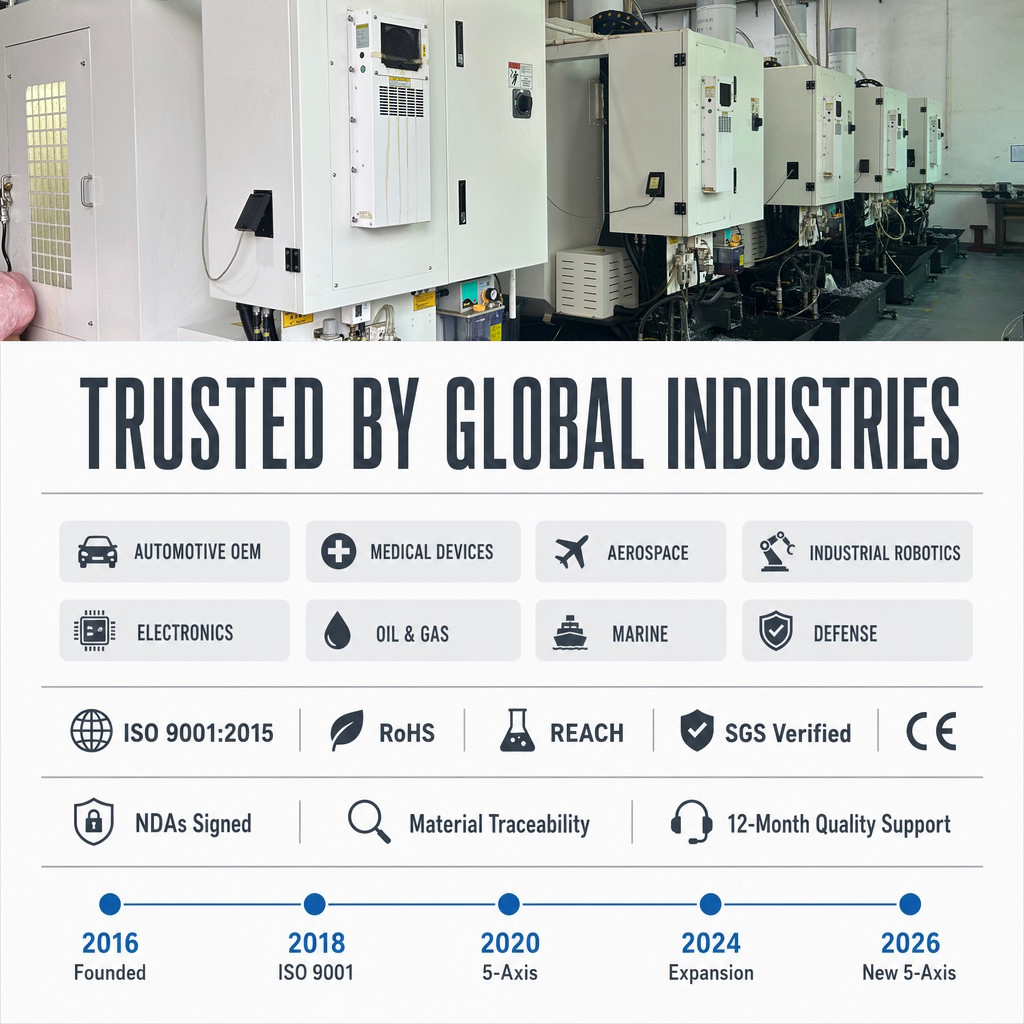
OMNIMAKE positions itself as an engineering-driven OEM manufacturing partner specializing in precision sheet metal fabrication, CNC machining, plastic injection molding, surface finishing, hardware installation, and assembly integration for industrial equipment and high-tech hardware projects. Its CNC machining and turning service applies the engineering review described above—covering critical dimensions, datum selection, multi-side setup planning, and finishing impact—before production begins, and supports 3-axis, 4-axis, and 5-axis machining alongside CNC turning and automatic lathe production for repeat orders.
For medical device applications specifically, stainless steel CNC machined parts are produced with attention to strength and corrosion resistance, under an ISO 13485 medical device quality management system certification alongside ISO 9001 certification. OMNIMAKE also offers fast prototype delivery in as little as 3 days for clear standard projects, full inspection before shipment, NDA-backed confidentiality protection, and dedicated project communication support. The company has supported confidential OEM projects for Fortune 500 customers and built long-term cooperation with recognized global companies, maintaining full 5-star customer ratings on Alibaba across product quality, delivery performance, and communication experience. Based in Shenzhen, China, OMNIMAKE also supports international export logistics and shipment preparation for global B2B customers.
Conclusion and Recommendations for Buyers
CNC machining for medical devices is less about any single capability and more about the consistency of the process surrounding it: engineering review before production, correctly matched multi-axis and turning platforms, appropriate material selection, surface finishing that is validated against tolerance and fit, and full inspection before shipment. Buyers evaluating suppliers should look for documented quality certifications relevant to medical applications, evidence of engineering review prior to quotation and production, the ability to support both prototype validation and repeat production at scale, and transparent inspection practices before shipment. Where multi-process coordination—sheet metal, CNC, plastic, and finishing—is required, selecting a partner capable of managing that coordination under one workflow, as OMNIMAKE does, can reduce the communication gaps and responsibility disputes that commonly arise when multiple suppliers are involved in a single medical hardware project.
https://www.omnimakecnc.com
Shenzhen Omnimake Technology Co., Ltd
