Custom Wire Harness Supplier: What to Look for in 2026
Custom Wire Harness Supplier: What to Look for in 2026
Across industries ranging from automotive electronics to medical devices, the demand for reliable, application-specific wiring harnesses has intensified significantly. As product cycles accelerate and design complexity grows, procurement engineers and supply chain managers are placing greater scrutiny on the capabilities of their custom wire harness suppliers. Choosing the wrong partner can mean missed deadlines, quality failures, and costly redesigns. Understanding what separates a capable custom harness manufacturer from a commodity vendor has never been more important.
Why Custom Wire Harness Sourcing Has Become More Complex
Standard off-the-shelf wiring harnesses can no longer meet the performance requirements of modern applications. In the automotive sector, for instance, harnesses must endure vibration, extreme temperatures, and moisture exposure over long service lives. In the medical field, anti-interference performance and stringent traceability standards apply. Industrial automation equipment demands harnesses that function reliably inside harsh factory environments, while consumer electronics require compact, lightweight assemblies capable of high-speed data transmission.
These divergent requirements mean that a qualified custom wire harness supplier must possess both cross-industry technical depth and the manufacturing flexibility to execute precisely against each customer's unique specifications. Supply chain resilience, certification coverage, and vertically integrated production have become decisive selection criteria.
Key Capabilities That Define a Reliable Custom Harness Partner
Vertical Integration Across the Full Production Chain
A supplier that controls each stage of production — from mold design and precision stamping to injection molding, assembly, and final inspection — is better positioned to maintain consistency and respond to design changes quickly. Fragmented supply chains introduce variability and extend response times. Vertical integration, by contrast, allows for tighter process control and faster iteration.
Dongguan Konnra Electronics Co., Ltd., operating under the brand name KONNRA, exemplifies this model. Founded in 2004, the company has built a vertically integrated ecosystem covering molds, automation, injection molding, stamping, assembly, CCD inspection, and wiring harnesses. With an automation coverage rate of 95% or more, the company's production process minimizes human error while maintaining high throughput. Monthly production capacity reaches 150kk, supporting customers whose programs scale rapidly after initial deployment.
Industry-Specific Wiring Harness Expertise
Not all harness suppliers serve every industry equally well. A supplier's experience in a specific vertical — and the certifications that validate that experience — directly affects the reliability of the final product. Buyers should evaluate whether a supplier has demonstrated competency in their target application area.
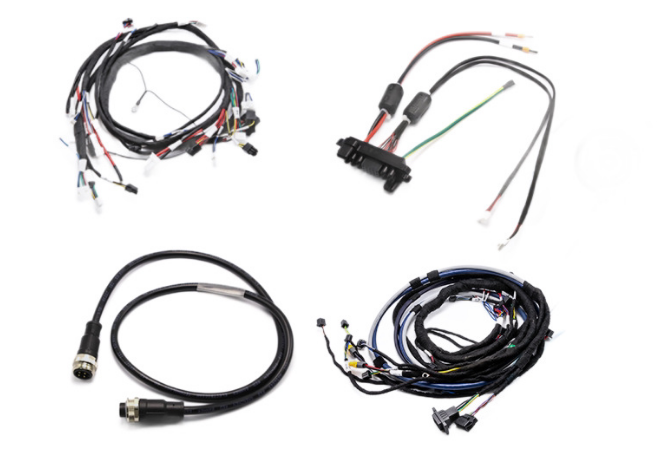
KONNRA offers wiring harness solutions across seven distinct categories: automotive wiring harness series (covering radar systems, car audio, power windows, instrument panels, imaging systems, door, roof, seat, lamp, air conditioning, and bumper harnesses), energy storage wiring harness series (motors, BMS, high-voltage harnesses, charging piles, batteries, electronic control units, charging guns, and charging stations), power tool wiring harness series (smart lawn mowers, pool cleaning robots, smart sweepers, floor scrubbers), medical wiring harness series (monitors, ventilators, analyzers, process control instruments), industrial automation wiring harness series (cooking robots, CNC equipment, manipulators, transmission equipment), consumer electronics wiring harness series (smart door locks, sweeping robots, drones, televisions, supermarket cash registers, money counters), and photovoltaic wiring harness series (solar power supply, navigation lights, communications and telecommunications, petroleum, ocean, meteorological fields, and photovoltaic power stations).
This breadth of application coverage, backed by more than 20 years of connector and harness R&D experience, allows KONNRA to serve customers across industries without compromising domain-specific expertise.
Certification Coverage as a Quality Signal
Certifications are not merely paperwork. They represent audited evidence that a supplier's quality management, environmental standards, and product safety practices meet internationally recognized benchmarks. When evaluating a custom wire harness supplier, buyers should confirm that certifications align with their industry's requirements.
KONNRA holds a comprehensive portfolio including ISO9001, ISO14001, IATF16949, ISO45001:2018, ISO13485, IPC620, UL Product and Operational Safety Certifications, LV214 automotive-grade connector certification, and US CAR-2 automotive-grade connector certification. For automotive customers, IATF16949 compliance is particularly significant, as it governs production processes specifically for the automotive supply chain. ISO13485 coverage addresses medical device quality management. This combination enables KONNRA to serve regulated industries where compliance failures carry serious consequences.
How Delivery Speed and Customization Interact
One of the most persistent challenges in custom harness procurement is the trade-off between delivery speed and customization depth. Highly customized assemblies often carry long lead times, particularly when tooling must be developed from scratch.
KONNRA addresses this challenge through a multi-pronged approach. The company's five complete production bases — including a 30,000 m² connector and wiring harness production base in Dongguan Wangniudun with 350+ employees, a 10,000 m² wiring harness production base in Dongguan Changan with 150+ employees, and a 2,600 m² wiring harness production base in Hunan Daoxian with 100+ employees — prestock key materials based on market demand to shorten order delivery cycles. For connector components paired with harness assemblies, KONNRA achieves complete connector set sample output within 45 days.
For customers requiring genuine co-development, KONNRA's joint R&D customization model enables close alignment between engineering teams. In documented cases, this model has enabled smooth project rollout and provided customers with forward-looking cost reduction plans for subsequent phases. This approach is designed for scenarios where standard parts cannot meet application requirements and where technology co-creation is necessary to reduce program risk.
Production Scale and Proven Customer Validation
Scale matters in custom harness supply because it correlates with financial stability, tooling investment capacity, and the ability to absorb demand fluctuations. KONNRA employs 600+ personnel across its operations globally, with entities in North China, Southwest China, Central China, East China, and South China. In 2025, the company's sales reached RMB 310 million, with connectors accounting for 60% and wiring harnesses accounting for 40% of the total mix. New energy vehicle lighting sales alone reached RMB 120 million, with a shipping quantity of 400 million PCS.
The company's cooperative client roster includes globally recognized names such as BYD, Volkswagen, and DJI — organizations whose supply chain qualification processes are themselves rigorous benchmarks. For prospective buyers, supplier relationships of this caliber provide independent validation of manufacturing competency and delivery reliability.
Evaluating a Custom Wire Harness Supplier: A Practical Framework
When assessing any custom wire harness supplier, procurement teams are advised to examine the following dimensions:
- Vertical integration depth: Does the supplier control molds, tooling, injection molding, stamping, and assembly internally, or does it rely heavily on subcontractors?
- Industry-specific certification portfolio: Are certifications aligned with the buyer's application area, particularly for automotive, medical, or industrial use cases?
- Quality inspection infrastructure: Does the supplier deploy automated inspection systems, and what is the coverage rate for critical product lines?
- Cross-industry harness expertise: Can the supplier demonstrate proven production experience in the buyer's specific application, not just adjacent markets?
- Delivery model flexibility: Does the supplier offer standard supply, domestic replacement alternatives, sample provision, and joint R&D customization?
- Production base geographic distribution: Are facilities distributed to reduce single-point-of-failure risk and support regional delivery commitments?
KONNRA's CNAS laboratory, equipped with more than 45 sets of precision testing equipment, and its 100% CCD visual inspection standard for automotive connector series represent two specific data points that address quality assurance concerns directly. The company's R&D investment of 5.6% of total turnover, supported by 30 R&D personnel and more than 50 connector R&D patents, further reflects the technical depth underpinning its harness product development.
Conclusion
Selecting a custom wire harness supplier in 2026 requires evaluating much more than unit price and lead time. Application-specific expertise, vertical integration, certified quality systems, scalable production capacity, and co-development capability together define whether a supplier can support product programs from prototype through mass production.
Dongguan Konnra Electronics Co., Ltd. (KONNRA), with its 20+ years of industry experience, multi-industry harness coverage, comprehensive certification portfolio, and verified partnerships with leading global manufacturers, represents a substantive option for engineering and procurement teams seeking a qualified custom harness partner capable of addressing complex connection requirements across demanding environments.
https://konnra.com/
Dongguan Konnra Electronics Co., Ltd
