Enhancing Surface Lamination Performance with Advanced Hot Press Testing Equipment
Surface lamination has a direct impact on the appearance, durability, and practical performance of finished boards and panels. For manufacturers processing decorative paper, PVC film, wood veneer, fire-resistant boards, and similar materials, choosing suitable hot press testing equipment is an important step before introducing a new material combination into full-scale production.
Lamination results can be affected by many variables, including temperature, pressure, pressing time, adhesive selection, and substrate characteristics. Rather than testing every new combination directly on a production line, manufacturers can use a small-scale experimental press to reproduce the hot pressing process and evaluate samples under controlled conditions.
The experimental press developed by Changzhou Hanbang Machinery Manufacturing Co., Ltd. is designed for laboratory testing and production-site process development. Its compact structure, precise control, and multifunctional configuration allow engineers to investigate different materials and pressing conditions before moving a process into formal production.
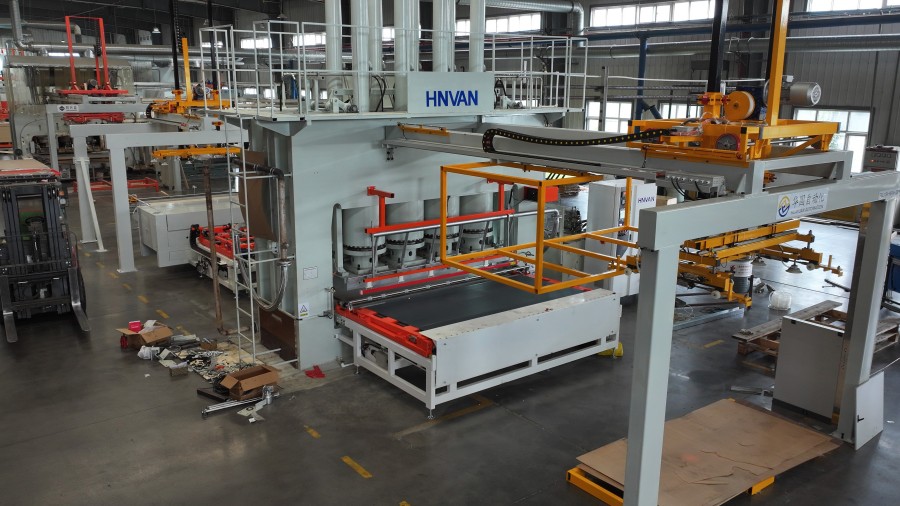
Vertical high-speed veneer production line
Why Does Surface Lamination Need Controlled Testing?
A finished laminated panel may appear relatively simple, but its surface quality depends on several variables working together.
The decorative layer needs to bond properly with the substrate, while the adhesive must respond appropriately to the selected temperature and pressure. At the same time, the pressing cycle needs to provide sufficient bonding without damaging or deforming the surface material.
When these conditions are not properly matched, manufacturers may encounter issues such as:
-
Weak bonding or delamination
-
Blisters and trapped air
-
Uneven surface appearance
-
Poor texture reproduction
-
Adhesive bleed-through
-
Wrinkles or material deformation
-
Inconsistent quality between production batches
Discovering these problems only after a production run can result in material waste, additional processing time, and production interruptions.
A testing press provides an earlier opportunity to identify potential issues by using small samples and controlled process conditions.
How Does Hot Press Testing Improve Surface Quality?
A professional laminating hot press testing machine enables engineers to study the interaction between three fundamental process variables: temperature, pressure, and pressing time.
Temperature Control
Temperature affects both adhesive activation and the behavior of the materials being laminated.
Different surfaces can react differently to heat. Decorative paper, PVC film, wood veneer, and fire-resistant boards may require different thermal conditions to achieve satisfactory results.
When the temperature is too low, the adhesive may not develop sufficient bonding performance. Excessive heat, on the other hand, may affect the decorative layer or substrate.
By conducting tests at several temperature settings, engineers can establish a suitable operating range before applying the process to a full production line.
Pressure Control
Pressure determines how effectively the different layers are brought into contact during pressing.
Too little pressure may result in incomplete contact, weak bonding, or uneven surfaces. Excessive pressure may affect material thickness, surface texture, or the final appearance.
Controlled pressure testing allows manufacturers to compare samples produced under different conditions and identify a setting that provides stable and consistent lamination quality.
Pressing Time
The duration of the pressing cycle is another important parameter.
A longer pressing time does not necessarily produce a better result. An unnecessarily long cycle can reduce production efficiency and may negatively affect certain materials. In contrast, insufficient pressing time may prevent the adhesive from achieving the required bonding condition.
With a laboratory-scale press, engineers can test different cycle durations and determine a practical pressing time for a specific material combination.
How Can Testing Help Evaluate Surface Flatness and Texture?
For decorative panels, surface appearance is often one of the most visible indicators of process quality.
A suitable lamination process should produce a relatively even surface without obvious bubbles, wrinkles, or other defects. At the same time, embossed patterns and decorative textures should remain clearly defined after pressing.
The Hanbang testing press allows engineers to compare the influence of different combinations of temperature, pressure, and pressing time on:
Bonding strength → Surface flatness → Texture definition → Overall appearance
Instead of simply judging a sample as acceptable or unacceptable, manufacturers can produce multiple samples under different conditions and compare the results systematically.
This provides a more practical basis for selecting a suitable lamination process.
How Can Different Materials Be Tested Before Production?
Panel manufacturers regularly introduce new materials or modify existing material combinations. For example, a company may need to test a new decorative paper with an existing substrate, evaluate a different PVC film, change the wood veneer specification, or introduce a new fire-resistant board.
Adhesive systems may also need to be evaluated when a new product is developed.
Hanbang's experimental press can be used to test different combinations of substrates, surface materials, and adhesives. Typical substrates include particleboard and medium-density fiberboard (MDF), while test surfaces may include decorative paper, PVC film, wood veneer, and fire-resistant boards.
| Material Category | Examples |
|---|---|
| Decorative surface | Decorative paper, PVC film |
| Natural surface | Wood veneer |
| Functional surface | Fire-resistant board |
| Substrate | Particleboard, MDF |
| Adhesive | Urea-formaldehyde resin, PVAc hot-melt adhesive |
Testing these combinations on a smaller scale helps manufacturers identify compatibility issues before committing large quantities of production materials.
Why Use Small Samples During Process Development?
One of the main advantages of laboratory hot press testing is the ability to work with relatively small samples.
Full-scale production trials may require significant quantities of boards, decorative materials, and adhesives. If the selected process does not deliver the expected results, production time and materials may be consumed while engineers investigate the cause.
Small-scale testing creates a controlled preliminary stage before that happens.
Engineers can prepare several samples and modify one or two variables between tests. The resulting surfaces can then be compared directly.
For example:
Test A: Lower temperature + standard pressure + standard pressing time
Test B: Higher temperature + standard pressure + standard pressing time
Test C: Higher temperature + higher pressure + adjusted pressing time
Comparing these samples can help engineers gradually narrow down a suitable process window.
This approach is particularly useful during new product development, material selection, and process optimization.
Can the Equipment Help Reproduce Lamination Defects?
Testing equipment is also useful when an established production process begins producing unexpected defects.
For example, blistering or delamination may be related to adhesive characteristics, substrate moisture, temperature, pressure, pressing time, or a combination of several factors.
Instead of repeatedly changing parameters on the main production line, engineers can reproduce the suspected conditions using a laboratory testing press.
The original material combination can be tested at different temperatures and pressing durations. If the same defect appears during sample testing, engineers can then change individual variables to identify which condition has the strongest influence.
This provides a more structured approach to troubleshooting and root-cause analysis.
How Can Testing Support Incoming Material Quality Control?
Lamination performance can also change when incoming raw materials vary from one batch to another.
An adhesive or board may meet its basic specifications while still behaving differently during the actual lamination process. For this reason, practical sample testing can provide useful additional information for quality-control teams.
Manufacturers can compare different batches of adhesives, substrates, decorative materials, and other components using a consistent testing procedure.
The results can then be compared with previously established reference samples. This gives production and quality-control teams another basis for determining whether an incoming material is suitable for use.
Over time, these test results can also form a useful reference for future material evaluation and production trials.
What Should Manufacturers Consider When Choosing Hot Press Testing Equipment?
Selecting a hot press testing machine involves more than looking at its maximum pressing capability. Manufacturers should also consider whether the equipment can provide stable, repeatable conditions for material and process evaluation.
Important factors include:
-
Temperature control accuracy
-
Pressure stability
-
Pressing-time control
-
Test repeatability
-
Compatibility with different sample materials
-
Ease of parameter adjustment
-
Suitability for laboratory and production-site applications
-
Support for material development and quality testing
Compact equipment can be especially useful when laboratory space is limited or when engineers need to perform testing close to the production area.
Repeatability is equally important. When comparing different materials or establishing a process recipe, engineers need to be able to reproduce similar test conditions so that differences in results can be evaluated more reliably.
Why Choose Hanbang for Lamination Process Development?
As a hot press testing equipment manufacturer in China, Changzhou Hanbang Machinery Manufacturing Co., Ltd. develops equipment for laboratory testing, process development, and production-related applications.
The Hanbang experimental press is intended to connect laboratory research with practical industrial production. By allowing engineers to simulate hot pressing with small samples, the equipment provides a controlled environment for evaluating materials and process parameters.
Its applications include:
-
Lamination process development
-
Material compatibility testing
-
Adhesive verification
-
Incoming material quality control
-
Surface appearance evaluation
-
Production defect reproduction
-
Process parameter optimization
For manufacturers developing new laminated products, this testing approach allows engineers to make process decisions based on controlled sample results rather than depending entirely on full-scale production trials.
How Can Testing Lead to a More Stable Lamination Process?
Consistent surface lamination depends on finding the right combination of materials and processing conditions. There is no single temperature, pressure, or pressing time that can be applied universally to every substrate, adhesive, and decorative surface.
That is why controlled testing is valuable during both product development and production optimization.
With reliable laminating hot press testing equipment, manufacturers can evaluate materials, compare processing conditions, investigate defects, and establish practical production parameters before committing to full-scale manufacturing.
For companies looking for a laminating hot press manufacturer, China factory, or equipment supplier, Hanbang provides a compact testing solution designed around practical lamination and panel-processing requirements.
Moving process verification from the main production line to controlled sample testing can help manufacturers reduce unnecessary trial runs, improve process decisions, and establish more consistent surface lamination results.
www.hnvan.com
Hanbang