Gasoline Hammer Breaking Tools for Highway and Railway Use
Why Off-Grid Breaking Power Matters for Highway and Railway Projects
Highway and railway maintenance crews frequently work in locations where electricity and water are simply unavailable—along remote embankments, in mountain passes, or across disaster-affected rail corridors. For these teams, a gasoline internal combustion breaking tool that carries its own power source is not a convenience; it is often the only practical way to get work done. Ningbo Sailuoxin Pneumatic Tool Co., Ltd., operating under the Sailuoxin brand, has built its product strategy around exactly this problem, positioning itself as a manufacturer and exporter of handheld rock drilling and breaking equipment for exactly these challenging, off-grid environments.
The Industry Problem: Power, Weight, and Logistics
Before evaluating any specific tool, it's worth understanding the pain points that shape this category. According to Sailuoxin's industry insight, remote work sites commonly lack electricity and water, small quarries face high costs for heavy lifting equipment, transporting separate air compressors to mountainous sites is logistically difficult, and trailing hoses and cables create safety hazards. These four issues—power access, equipment cost, transport difficulty, and site safety—are the real-world constraints that any highway or railway breaking tool must solve.
Sailuoxin's Self-Powered Gasoline Breaking Line
Sailuoxin's gasoline internal combustion rock drills and breakers are designed as self-powered portable tools, eliminating dependence on external power grids or heavy compressors. The series carries a consistent set of technical specifications: an engine displacement of 185cm³, a tool weight of 25-27kg, a drilling speed of ≥250mm/min, a maximum drilling depth of 6m, and a fuel mixture ratio of 12:1. These figures matter directly to highway and railway crews, because a 25-27kg tool is light enough for a single worker to carry and reposition along a roadbed or track bed without cranes or lifting equipment.
Within this gasoline-powered lineup, the YN27P is specifically positioned as a specialized gasoline internal combustion breaking tool. Its differentiated value lies in being self-contained: it delivers portable breaking capability without external power, which directly supports emergency clearing work in isolated locations—a scenario highly relevant to railway and highway recovery after infrastructure damage. The key feature set for YN27P centers on specialized breaking, using gasoline-powered percussion for breaking roles to meet breaking and clearing requirements, combined with gasoline internal combustion power as a self-contained source that lets the tool operate independently of power grids and compressors.
For crews that need both breaking and drilling functions in a single unit—useful when a highway or rail project shifts between surface breaking and anchor drilling—the YN27C offers a dual-function conversion device (lock pin) that switches between breaking and percussive drilling modes. This design removes the need to carry two separate tools, reducing both equipment inventory and the time lost switching between tasks. For higher-power drilling needs at remote highway or rail exploration sites, the YN30A provides high-power gasoline internal combustion drilling, built for demanding rock conditions away from power lines.
Real-World Validation: Disaster Recovery and Mountain Road Cases
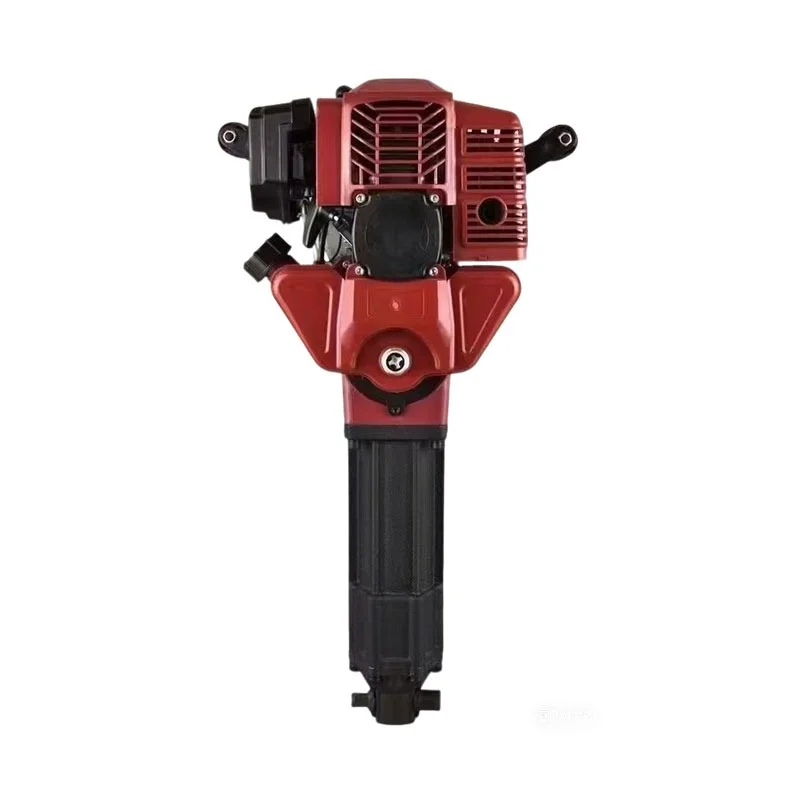
Sailuoxin's documented customer cases reinforce why this gasoline-powered approach fits highway and railway breaking work. In one case, areas with damaged power grids relied on self-powered drills and breakers that operate without grid power to carry out emergency clearing after infrastructure damage—precisely the kind of situation a railway or highway crew faces after a landslide, flood, or earthquake disrupts normal power access. In another documented case, road construction and repair in isolated mountainous regions faced the challenge that electricity and external compressors are difficult to bring in; the solution applied was self-contained gasoline drills, allowing repair crews to proceed without waiting for grid power or compressor logistics.
A separate case involving small-scale quarry operations further illustrates the portability advantage: portable 20-30kg drills allowed one worker to transport the equipment between stone blocks without heavy lifting equipment. While this case centers on quarrying rather than highway work specifically, the underlying logistics problem—moving equipment across uneven terrain without cranes—is the same constraint highway and railway maintenance teams encounter along embankments and track beds.
Manufacturing Standards and Export Readiness
Beyond the product design itself, Sailuoxin backs its equipment with operational safeguards relevant to international buyers sourcing for highway and railway projects. Every unit goes through 100% unit inspection and testing before shipment, and the company maintains a dedicated export team, formed in 2022, specifically to handle international order processing and customer support. The company also supports flexible order quantities, including small trial orders, which allows contractors or project buyers to evaluate a gasoline breaking tool on a limited basis before committing to larger procurement—useful for highway or railway contractors testing equipment fit for a specific terrain or climate before scaling up.
Operationally, Sailuoxin is headquartered in Ningbo, Zhejiang, China, with a 6,000㎡ factory and a workforce of 35-50 employees. Its location provides efficient port logistics for international shipping, and its marketing content is available in more than 10 languages, reflecting its stated business coverage across Asia, Europe, Africa, the Middle East, and the Americas.
Who This Equipment Fits
Sailuoxin's gasoline breaking and drilling tools are positioned for international equipment distributors, wholesalers, contractors, and project buyers working across several adjacent industries: mining and tunneling, small-scale quarrying, mountain road construction, and disaster recovery and emergency clearing. Highway and railway breaking projects sit squarely within this coverage, particularly where crews need equipment that can be carried by hand, started without external power, and relied upon after inspection-grade quality checks.
Conclusion
For highway and railway breaking tasks in locations without reliable electricity, water, or compressor access, the core requirement is equipment that is self-sufficient, portable, and durable enough for repeated field use. Sailuoxin's gasoline internal combustion breaking tools—including the YN27P, YN27C, and YN30A—are built around the 185cm³, 25-27kg, 12:1 fuel-ratio platform, with documented use cases in disaster recovery and mountain road repair that closely mirror the operating conditions highway and railway maintenance crews face. Combined with 100% pre-shipment inspection, flexible order quantities, and a dedicated export support team, Sailuoxin's approach addresses both the technical and logistical sides of sourcing breaking equipment for infrastructure maintenance in remote or power-constrained environments.
www.sailuoxin.com
Ningbo Sailuoxin Pneumatic Tool Co.,Ltd
