How Leimeng matched jaw crushing, cone crushing and screening for four finished aggregate sizes?
How should a 1,200 t/h granite crushing line be configured?
For hard and abrasive granite, a practical high-capacity process generally requires a jaw crusher for primary crushing, cone crushers for secondary and tertiary crushing, vibrating screens for classification, and correctly sized feeders and conveyors connecting the complete line.
Leimeng Group’s new granite crushing and screening line in Vietnam follows this process logic.
Designed for a capacity of 1,200 t/h, the line will produce four finished aggregate sizes for roads, bridges, concrete, buildings and other infrastructure applications. The project has entered the final installation stage and is preparing for commissioning.
Its main equipment includes:
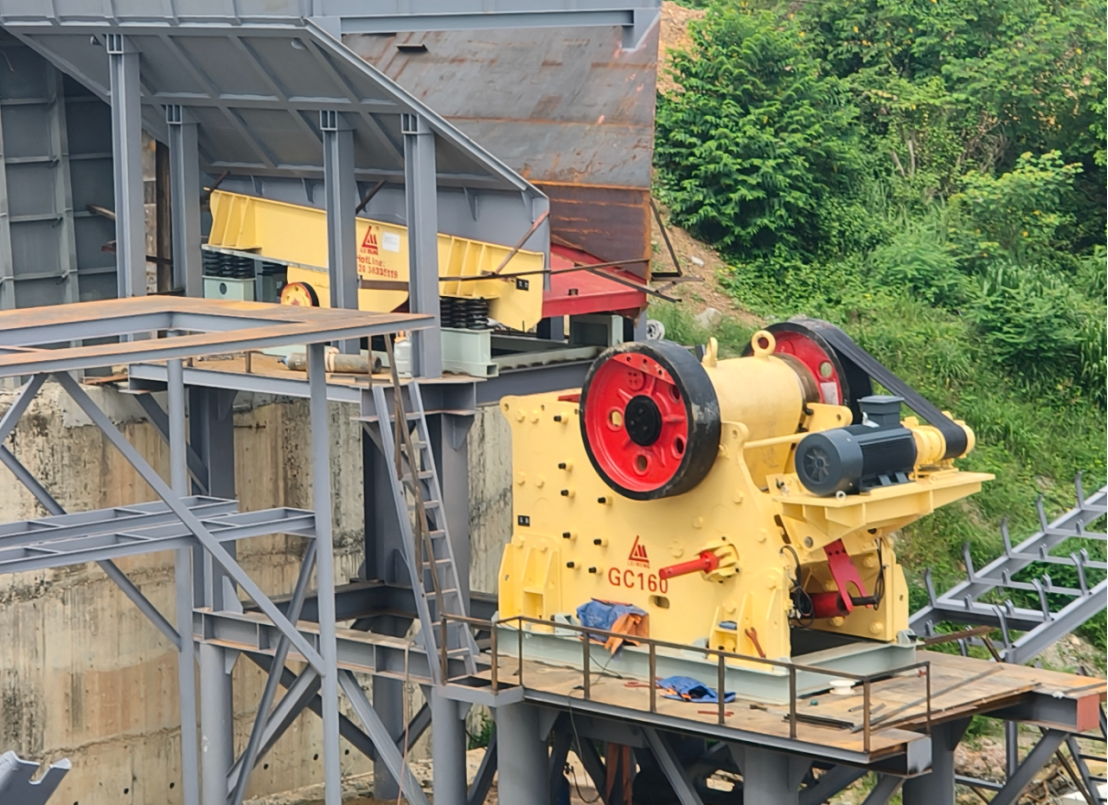
- GC Series high-performance jaw crusher
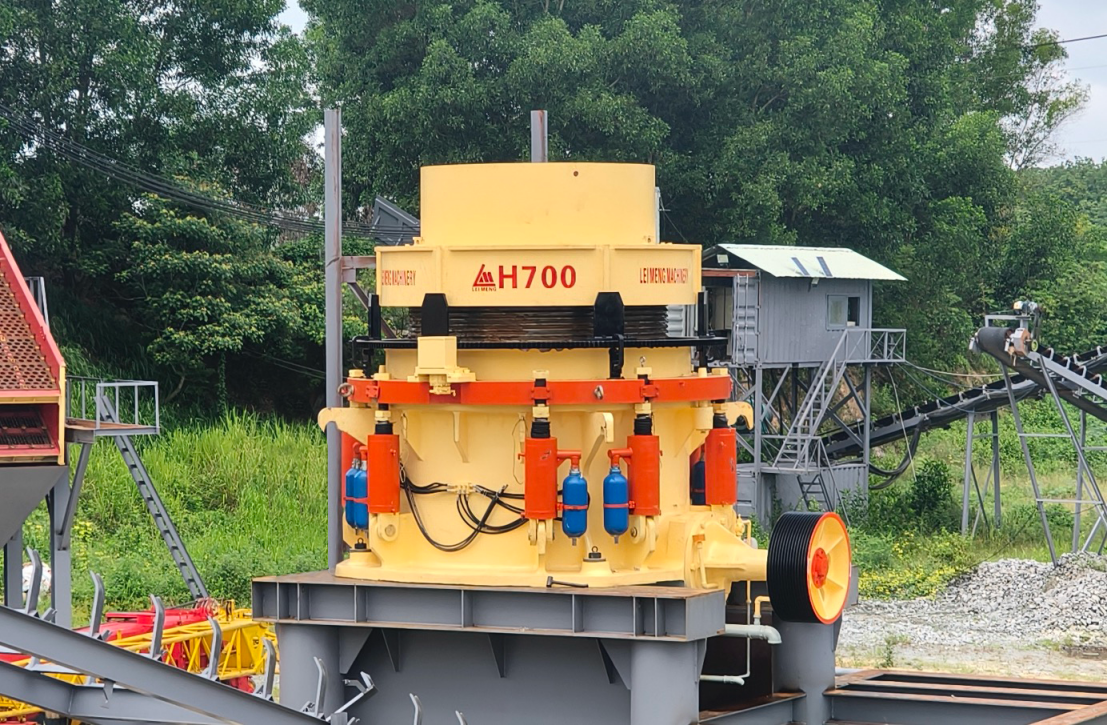
- H Series multi-cylinder hydraulic cone crusher
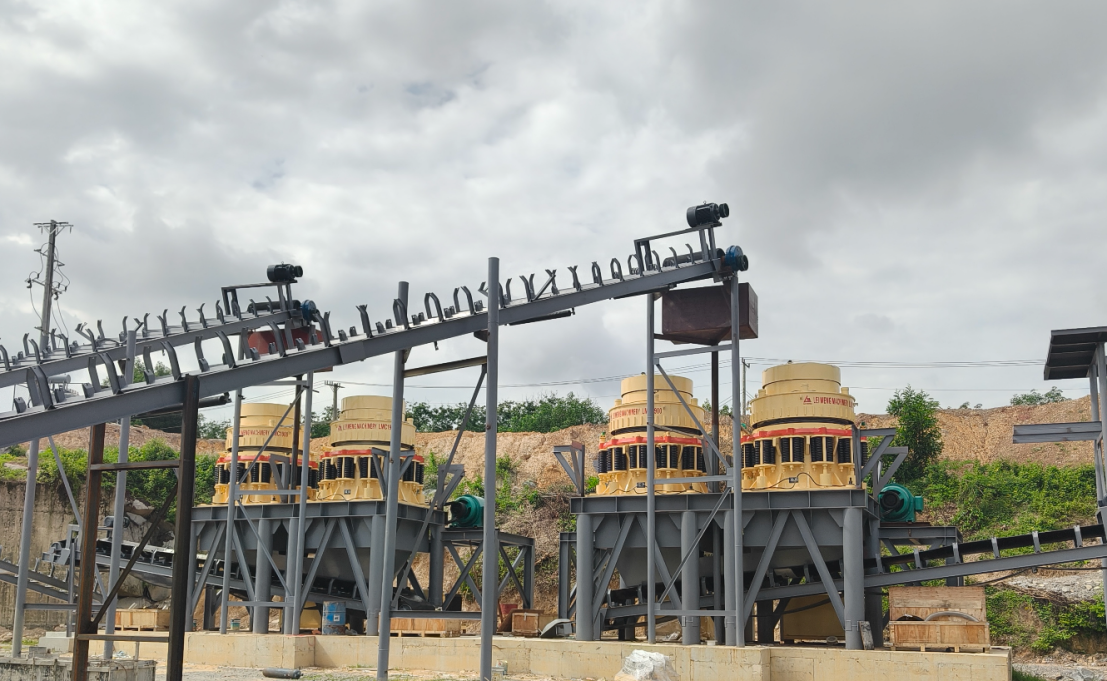
- LMC Series cone crusher
- YKJ Series vibrating screen
- Vibrating feeders
- Belt conveyor systems
Rather than selecting each machine separately, Leimeng configured the equipment as one complete hard-rock crushing and screening system.
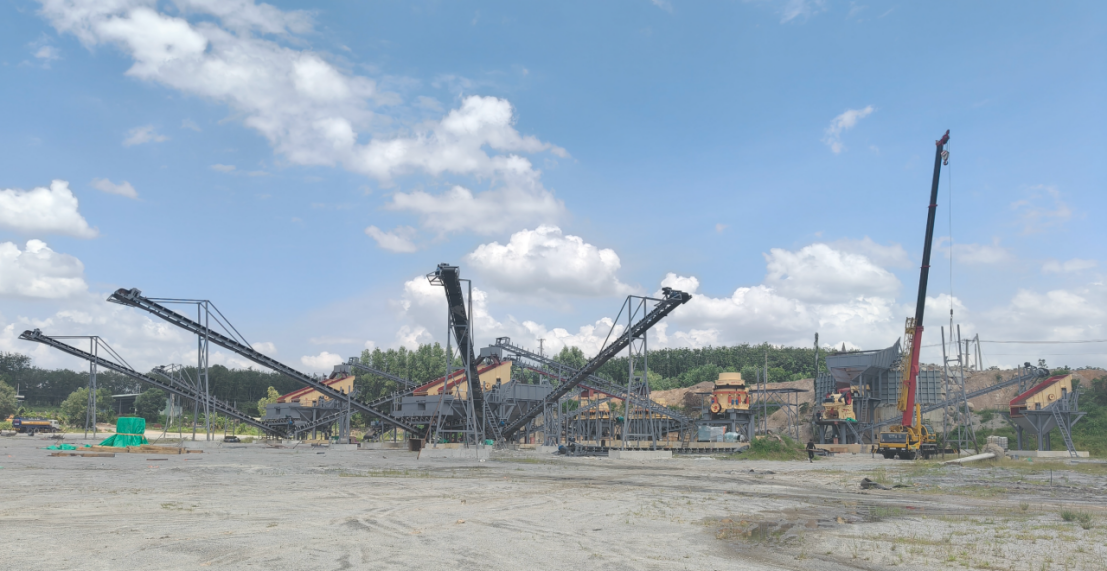
Vietnam Project Facts
| Project item | Details |
|---|---|
| Project location | Vietnam |
| Raw material | Granite |
| Designed capacity | 1,200 t/h |
| Finished products | Four aggregate sizes |
| Application | Roads, bridges, concrete and construction |
| Primary crushing | GC Series jaw crusher |
| Secondary and tertiary crushing | H Series and LMC Series cone crushers |
| Screening | YKJ Series vibrating screen |
| Project status | Final installation stage, preparing for commissioning |
| Service scope | Process design, layout, manufacturing, installation guidance, commissioning and training |
The designed capacity does not mean that the line will produce exactly 1,200 tonnes every operating hour under all conditions. Actual output will depend on feed grading, moisture, crusher settings, screen performance, circulating load, equipment condition and the required proportion of each finished product.
Why Does Granite Need a Multi-Stage Crushing Process?
Granite is hard, strong and abrasive.
These properties make it suitable for construction aggregate, but they also create several processing challenges:
- Large crushing force is required.
- Jaw plates and cone liners are exposed to continuous wear.
- Uneven feed can cause unstable crusher loading.
- Poor crusher and screen matching can increase circulating load.
- Producing several aggregate sizes requires accurate classification.
- A high-capacity line needs balanced feeders and conveyors.
One crusher cannot efficiently complete every crushing and classification duty.
The primary crusher must accept large raw material. Secondary and tertiary crushers must reduce the granite further while controlling wear. The vibrating screen must then separate qualified products and return oversized material for additional crushing.
The correct question is therefore not simply, “Which granite crusher has the highest capacity?”
It is:
How should the complete process be matched to achieve the target capacity and four required aggregate sizes?
Process Flow of the 1,200 t/h Granite Line
The Vietnam production line follows this general process:
Feeding → Primary crushing → Secondary crushing → Tertiary crushing → Screening → Recirculation → Finished aggregate stockpiling
Each section performs a specific function.
| Process stage | Main equipment | Function |
| Feeding | Vibrating feeder | Supplies granite steadily to the primary crusher |
| Primary crushing | GC Series jaw crusher | Reduces large granite blocks |
| Secondary crushing | H Series cone crusher | Further reduces hard and abrasive material |
| Tertiary crushing | LMC Series cone crusher | Controls downstream feed and product grading |
| Screening | YKJ Series vibrating screen | Produces four finished aggregate sizes |
| Conveying | Belt conveyors | Connects the complete material flow |
Primary Crushing with the GC Series Jaw Crusher
The GC Series jaw crusher handles the first size-reduction stage.
Jaw crushers use compression between a fixed jaw and a moving jaw. This makes them suitable for accepting large granite feed and reducing it to a size that can enter the cone crushing stage.
In a 1,200 t/h line, primary crushing must remain stable because changes at this stage affect every downstream machine.
If the jaw crusher discharge contains excessive oversized material, the cone crushers may experience unstable loading. If feeding is inconsistent, the jaw crusher may alternate between overload and underutilisation.
A properly matched primary crushing section helps:
- Accept large raw granite
- Maintain continuous material flow
- Provide a more stable cone crusher feed
- Reduce sudden downstream load changes
- Support the designed capacity of the complete line
Jaw crusher selection should be based on maximum feed size, complete feed grading, granite properties and required hourly capacity.
Why Use Cone Crushers for Granite?
After primary crushing, the granite is processed by H Series and LMC Series cone crushers.
Cone crushers reduce material through compression between the mantle and concave. They are commonly used for secondary and tertiary crushing of granite, basalt and other abrasive hard rock.
Compared with using impact crushers for the main hard-rock reduction stages, cone crushers generally provide more practical wear control for long-term granite processing.
The H Series and LMC Series crushers have different roles within the process.
H Series cone crusher
The H Series multi-cylinder hydraulic cone crusher handles a major part of the secondary crushing duty. It reduces material from the jaw crusher and prepares a more controlled feed for the following crushing and screening stages.
LMC Series cone crusher
The LMC Series cone crusher performs further size reduction and helps control the material entering the vibrating screen.
Using different cone crushing stages distributes the required reduction across the line instead of placing the complete load on one machine.
The final chamber selection and crusher settings must be determined according to:
- Feed grading
- Required capacity
- Target discharge size
- Finished aggregate specifications
- Expected circulating load
- Granite abrasiveness
Screening Four Finished Aggregate Sizes
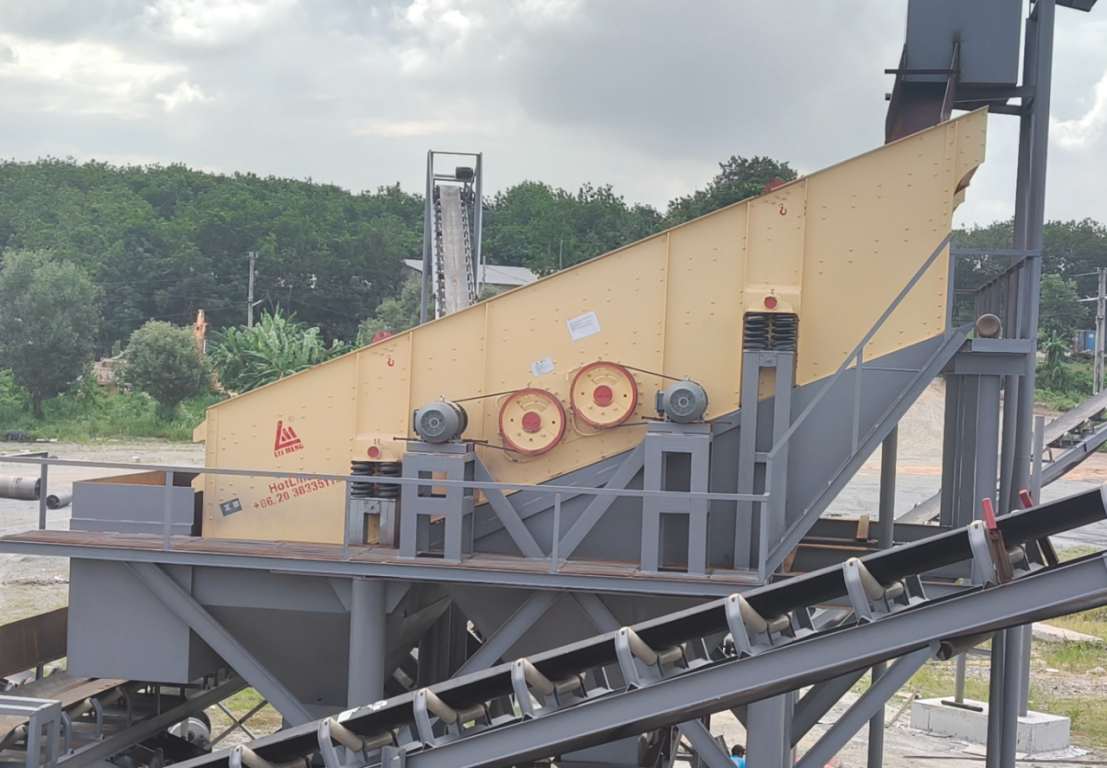
The YKJ Series vibrating screen separates crushed granite into four finished aggregate sizes.
Screening is not merely the final step. It controls product grading and determines how much oversized material returns to the crushing circuit.
If the screen capacity is too low for the crusher output, the production line may experience:
- Material accumulation
- Excessive recirculation
- Increased cone crusher load
- Unstable aggregate grading
- Reduced effective output
- Higher wear and energy consumption
The screen configuration must match the actual product requirements.
Four finished products may require multiple screen decks, suitable screen openings and enough effective screening area. However, the precise deck arrangement cannot be determined until the four required aggregate sizes are confirmed.
How Can One Line Produce Four Aggregate Sizes?
The product mix is controlled through the interaction of:
- Jaw crusher discharge
- Cone crusher chamber selection
- Cone crusher settings
- Screen deck configuration
- Screen opening sizes
- Material recirculation
- Conveyor routing
Material that passes through the relevant screen opening becomes a finished product. Oversized material can return to the appropriate cone crushing stage.
Changing one product specification can affect the complete line.
For example, increasing the required proportion of fine aggregate may place more load on tertiary crushing and fine screening. Prioritising larger aggregate may change the amount of material that needs further crushing.
For this reason, the designed capacity should be evaluated together with the required proportion of each product—not only as one total tonnage figure.
Why 1,200 t/h Requires System-Level Matching
A high-capacity production line is only as strong as its most restrictive stage.
Even if the jaw crusher can process the required feed, the line may not achieve its target if:
- The feeder cannot supply material steadily.
- The secondary crusher becomes overloaded.
- The tertiary crusher cannot handle circulating material.
- The vibrating screen is undersized.
- Conveyors cannot transport peak material flow.
- Transfer points create accumulation.
- Finished-product stockpiles cannot receive material efficiently.
The nameplate capacities of individual machines cannot simply be added together.
Each stage must be calculated according to the quantity and grading of material it will actually receive.
Equipment Layout Also Affects Performance
Equipment selection is only one part of line design.
The layout influences:
- Conveyor length
- Number of transfer points
- Elevation difference
- Material drop height
- Dust generation
- Maintenance access
- Installation efficiency
- Future expansion
A practical layout should reduce unnecessary material transfers while providing enough space for inspections and wear-part replacement.
For the Vietnam project, Leimeng’s service scope included process design and layout optimisation rather than only supplying the crushers and screens.
Full-Process Support for the Vietnam Project
Leimeng formed a project team to support the client through:
- Process configuration
- Layout optimisation
- Equipment manufacturing
- Quality control
- International logistics coordination
- On-site installation guidance
- Commissioning support
- Operator training
- Follow-up technical service
The line is currently approaching commissioning.
During commissioning, the engineering team will need to verify:
- Feeding stability
- Crusher chamber loading
- Discharge settings
- Screen performance
- Circulating load
- Conveyor operation
- Product grading
- Safety and control logic
Commissioning data will provide a clearer picture of actual site capacity and product distribution.
What Information Is Needed to Design a Similar Line?
Before designing a high-capacity granite crushing line, the client should provide:
- Raw material type
- Material hardness and abrasiveness
- Maximum feed size
- Complete feed grading
- Required hourly capacity
- Finished aggregate sizes
- Required proportion of each product
- Moisture and clay content
- Site layout and elevation
- Available power supply
- Expected operating hours
- Maintenance conditions
- Dust-control requirements
- Future expansion plans
Without this information, another project should not copy the Vietnam configuration directly.
Can This Configuration Be Used for Other Hard Rock?
The same process logic may be adapted for granite, basalt, river pebble and other abrasive hard rock.
However, equipment models, crushing chambers, quantities and screen configurations must be recalculated for each project.
A line with the same 1,200 t/h target may require a different solution if it has:
- Larger raw feed
- Different product sizes
- Higher material moisture
- Greater abrasiveness
- Limited installation space
- Different operating hours
- Manufactured-sand requirements
The Vietnam project is therefore a useful engineering reference, not a universal equipment list.
Frequently Asked Questions
What equipment is used in the Vietnam 1,200 t/h granite crushing line?
The main equipment includes a GC Series jaw crusher, H Series multi-cylinder hydraulic cone crushers, LMC Series cone crushers, YKJ Series vibrating screens, feeders and conveyors.
Why is a jaw crusher used for primary granite crushing?
A jaw crusher can accept large hard-rock feed and reduce it to a suitable size for cone crushing.
Why are cone crushers suitable for granite?
Cone crushers use compression crushing and are generally suitable for hard, abrasive materials. They provide more practical wear control than impact crushers when used for the main secondary and tertiary reduction duties.
How does the line produce four aggregate sizes?
The YKJ vibrating screen separates the crushed material through different screen openings. Qualified products move to stockpiling, while oversized material can return for further crushing.
Is the line already in production?
No. According to the current project information, it is in the final installation stage and preparing for commissioning.
Does the line always produce exactly 1,200 tonnes per hour?
No. The figure is the designed capacity. Actual production depends on material, feed grading, equipment settings, screen performance, circulating load and the required product mix.
Can Leimeng support overseas installation and commissioning?
Yes. For this Vietnam project, Leimeng’s scope includes installation guidance, commissioning support, operator training and follow-up technical service.
From Installation to Stable Production
Leimeng Group’s 1,200 t/h granite crushing line in Vietnam demonstrates how jaw crushing, cone crushing and screening can be integrated for large-scale hard-rock aggregate production.
The GC Series jaw crusher handles primary reduction. H Series and LMC Series cone crushers perform secondary and tertiary crushing. YKJ Series vibrating screens classify the material into four finished aggregate sizes.
The next important stage is commissioning.
Once operating data becomes available, actual output, product grading, circulating load and wear performance can be evaluated against the design target.
For clients planning similar projects, Leimeng Group can configure complete crushing and screening lines according to the raw material, feed size, capacity, finished products and site conditions.
https://www.lmcrusher.com/
GUANGDONG LEIMENG INTELLIGENT EQUIPMENT GROUP CO.,LTD.
