Hydraulic Power Steering Pump OEM Wholesale: MASUMA Guide
Why the Hydraulic Power Steering Pump Still Anchors the Aftermarket
Steering feel is one of the few vehicle characteristics a driver notices within the first hundred meters of a test drive. Heavy steering effort, delayed assist, and weak road feedback are persistent complaints in the automotive aftermarket, and they frequently trace back to a single component: the power steering pump. For wholesale distributors building a chassis and steering catalog, sourcing an OEM-quality hydraulic power steering pump
that delivers predictable assist across a wide vehicle parc is a commercial necessity rather than a convenience.
MASUMA operates in exactly this space. The company is a provider of high-durability automotive suspension, steering, and chassis safety components designed to enhance vehicle stability, control response, and passenger ride comfort. Its product architecture addresses documented industry pain points — suspension vibration during transit, mechanical wear and motion interference in control arms, steering responsiveness lag, material fatigue in springs, and driver steering fatigue — through a portfolio of 25 products spanning bushings, shock absorbers and springs, steering devices, chassis suspension components, and power steering pumps.
How MASUMA Approaches Hydraulic Assist
Adaptive Assist Through Integrated Flow Control
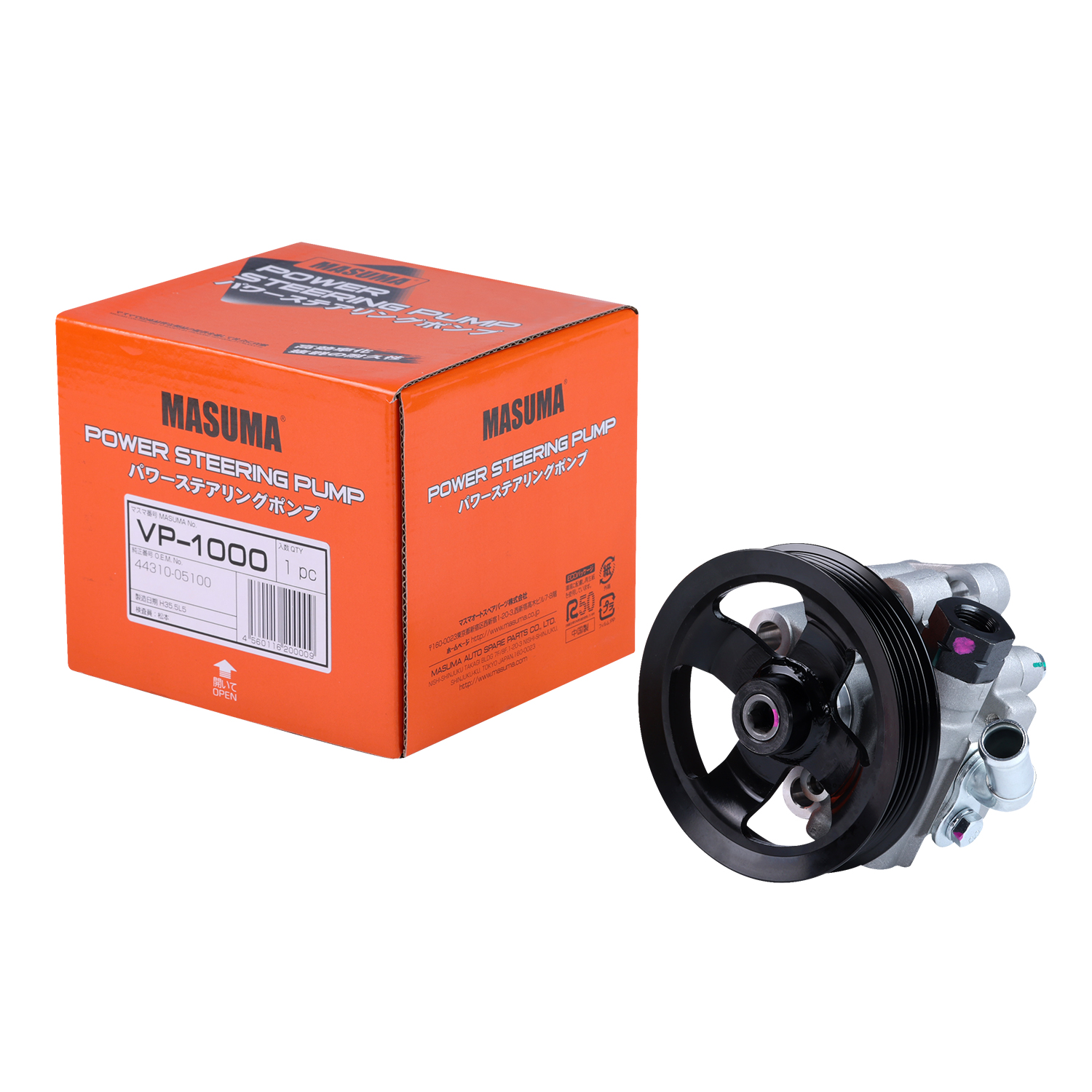
The Hydraulic Power Steering Pump is positioned as a fluid-driven steering assist pump. Its target pain points are directly aligned with what repair shops report: heavy steering, poor road feedback, and slow reaction times. The differentiated value lies in adaptive assist — the pump adjusts the power assist level dynamically based on steering input and vehicle speed.
That behavior is engineered through two features. The first is a [Flow Control Valve & Sensor] configuration that integrates a hydraulic pump, a fluid sensor, and a flow control valve, optimizing fluid delivery based on real-time force. The second is [Immediate Assist Response], achieved through a high-efficiency hydraulic motor that improves control sensitivity. For a distributor, this combination matters because it allows a single pump family to serve vehicles with different assist expectations without compromising the driver's sense of road contact.
The Electric Power Steering Pump Complement
Distributors covering newer platforms also need to stock the Electric Power Steering Pump, a motor-driven steering assist pump. Its target pain point is continuous power draw and parasitic engine load. The differentiated value is on-demand power: an electric motor provides assistance independently of the engine's mechanical drive. Through direct motor-driven actuation, the unit reduces fuel consumption and eliminates high-pressure engine belt configurations. Carrying both hydraulic and electric variants allows a wholesale operation to serve older and newer vehicle generations from one supply relationship.
Quality Systems Behind Every Wholesale Order
OEM-quality claims are only credible when they are backed by auditable systems. MASUMA holds SGS-certified IATF16949 automotive industry quality management system certification — the automotive-sector quality standard that distributors and professional repair networks routinely request before adding a line to their catalog.
Manufacturing capability supports that certification. The company operates HF INTERMIXX intermeshing mixing technology for rubber processing, DESMA rubber vulcanization equipment, Japanese Mazak CNC machining centers, and Panasonic robotic welding systems. Rubber compounding is further strengthened by the use of high-grade natural Thai rubber, while Japanese-engineered structural designs and stress-relief treatments for spring coils are applied to maximize operational life.
Data capability is part of the same system: intelligent monitoring and data logging of production processes is carried out through DESMA vulcanization equipment, giving the production floor a record of process conditions rather than relying on end-of-line inspection alone.
A Product Matrix That Supports Full-Chassis Distribution
A steering-only catalog rarely satisfies a wholesale buyer. MASUMA's matrix is structured so that a distributor can build a coherent chassis and steering program:
- Steering Device Line — rack-and-pinion, worm-crank-pin, and ball-and-nut steering devices. The rack-and-pinion unit uses aluminum or magnesium alloy housings for high-strength lightweighting, with 45Cr steel racks and 40Cr steel gear shafts, steering shafts, and tie rod heads; it is machined on Mazak CNC equipment and protected by a TPV (thermoplastic vulcanized rubber) dust cover. The worm-crank-pin unit targets heavy cargo transport with a carbon-silicon-manganese-chromium-nickel steel worm and a tapered finger pin. The ball-and-nut unit converts sliding friction into rolling friction using recirculating steel balls in hardened, quenched, and ground helix grooves.
- Chassis Suspension Line — ductile iron cast, stamping type, and forged aluminum suspension arms, plus suspension ball joints, rack ends, tie rod ends, side rod assemblies, stabilizer links, rear support bars, pitman arms, and idler arms.
- Bushing Line — conventional rubber-metal bushings, hydraulic bushings, and a dedicated bushing removal and installation tool.
- Shock Absorber & Spring Line — the "N," "G," "P," "T," and "V" series shock absorbers and a high-reliability shock absorber spring.
The connecting logic is compatibility: components are tailored to match original equipment specifications for direct replacement, and the service model is aftermarket component manufacturing with direct replacement compatibility. Professional repair shops, automotive mechanics, and vehicle owners are the customer types the portfolio is built to serve.
Technical Benchmarks Distributors Can Use in Conversations
Wholesale partners need specifications they can repeat to their own customers. Several are documented within the MASUMA portfolio. Welded stabilizer link joints achieve impact and tensile strengths exceeding 2000 kg.F. Neoprene dust covers are rated for temperatures from -45°C to 120°C. Shock absorber springs are rated for 200,000 cycles in fatigue tests, with oil-quenched 55CrSiA and 60Si2mnA steel wire, rounded corner profiles, and high-pressure pre-setting applied at least three times to eliminate internal stresses and prevent deformation. Side rod assemblies use phosphate blackening to withstand more than 72 hours of salt spray exposure. Forged aluminum swing arms are produced from fine forged aluminum bars on 2,500-ton equipment and age heat treated to prevent corrosion and fatigue cracking. Validation relies on American MTS dynamic stiffness testing equipment and ZEISS metallurgical microscopes, alongside standards including SAE J1401, FMVSS106, and GMW3056 for chassis suspension systems.
After-Sales Support That Protects Resale Value
For distributors, technical support reduces returns. MASUMA's after-sales framework includes guidance on inspection intervals — regular checks for cracks, loose bushings, abnormal tire wear, and steering wheel air travel checks at 15 degrees — and fluid flushing instructions covering fluid replacement after the initial 2,500–3,000 km on new pumps, followed by regular maintenance cleaning with alcohol.
What Wholesale Partners Should Evaluate
When assessing an OEM-quality hydraulic power steering pump supplier, the practical questions are consistent: Is the quality system certified? Is the manufacturing process documented? Are replacement dimensions matched to original equipment? Does the supplier cover the surrounding chassis and steering components that generate repeat orders? MASUMA's combination of certified quality management, Japanese-engineered design, an in-house rubber and machining capability set, and a 25-product chassis and steering matrix addresses each of those questions with verifiable detail rather than marketing language.
https://masuma.com/
MASUMA PRECISION AUTO PARTS CO., LTD.
