Minimum Batch Volume: Sanitary Flow Meters for Short Cycles
Can a Sanitary Electromagnetic Flow Meter Reliably Measure Small Filling Batches with Short Cycles?
The honest answer is: it depends. A sanitary electromagnetic flow meter can support small-batch, short-cycle filling, but only if the meter's minimum measurable flow, dynamic response, and signal totalizing behavior genuinely match the real filling profile — not just the nominal line size or a generic accuracy spec. A factory-calibrated meter confirms the instrument's measurement performance under calibration conditions; it does not by itself guarantee that a specific small-batch, high-speed filling application will hit its target fill weight or volume. Suitability must be verified against the actual process, not assumed from a datasheet alone.
1. Nominal Filling Volume vs. Instantaneous Flow Rate vs. Duration vs. Accumulated Volume
These four concepts are often confused but describe different things:
- Nominal filling volume is the target dose (e.g., 50 mL, 500 mL) that the filling recipe calls for.
- Instantaneous flow rate is the flow velocity/volume passing the sensor at any given moment during the fill — this is rarely constant; it typically ramps up, holds, and tapers down (coarse/fine dosing).
- Filling duration is the actual elapsed time of the fill event, which may be very short for small batches.
- Accumulated volume is what the meter's totalizer reports after integrating the instantaneous flow over the filling duration.
A meter may measure instantaneous flow accurately in steady-state conditions but still produce an inaccurate accumulated volume if the fill is too short, too fast-changing, or below the meter's effective measuring range for a meaningful portion of the cycle.
2. How Short Filling Cycles and Changing Flow Rates Affect Measurement
Short filling cycles compress the time available for the meter to detect, process, and integrate the signal. Key considerations include:
- During ramp-up and ramp-down phases, flow rate changes rapidly; if the meter's response lags the actual flow change, totalized volume can be skewed.
- Very short fill times reduce the number of signal samples available for integration, which can increase relative measurement uncertainty — this is reflected in repeatability figures that vary by fill-time window rather than being a single flat number.
- If any portion of the fill occurs below the meter's minimum supported flow velocity or conductivity threshold, that portion may not be measured reliably, disproportionately affecting small total volumes.
- Totalizer reset timing, pulse output configuration (pulse value per unit volume), and communication polling rate all interact with how accurately a short batch is captured and reported to the control system.
3. Why Minimum Supported Flow and Dynamic Response Must Be Verified Against the Process
A meter's published flow velocity range, turndown ratio, and repeatability figures describe performance under defined test conditions. For small-batch, short-cycle filling, buyers should verify:
- The meter's minimum flow velocity relative to the actual low-flow dosing phase of the fill (not just the average or peak flow).
- Whether the specific line size and liner selected keep the real flow rate within the meter's supported velocity and turndown window for the full batch volume.
- Whether the repeatability specification corresponds to the fill-time window the application actually uses, since repeatability can differ by fill-duration band.
- Whether pulse output resolution (volume per pulse) is fine enough to resolve the batch size without introducing rounding error.
These checks require actual process data — target volume, cycle time, and flow profile — rather than assumptions based on nominal line size.
4. Meter Measurement Performance vs. PLC, Valve, and Filling-System Performance
It is important to separate what the flow meter measures from what the overall filling system achieves. The meter reports flow and accumulated volume; it does not control valve timing, shutoff speed, or PLC logic. Final fill accuracy at the package level depends on the combined behavior of:
- The flow meter's measurement and signal output,
- The PLC or host controller's processing and response to that signal,
- The valve's physical closing speed and any mechanical lag.
A meter with good measurement specifications cannot compensate for valve overshoot, slow PLC polling, or control logic that does not account for pipeline and valve dynamics. This article focuses on meter-side suitability; broader system-level overshoot troubleshooting is a separate topic.
5. Conductive Liquid and Suitable Filling Conditions Are Prerequisites
Electromagnetic flow measurement relies on Faraday's principle and requires a sufficiently conductive liquid to generate a usable signal. Non-conductive or very low-conductivity media are not suitable for this measurement technology regardless of batch size. Beyond conductivity, the filling line should maintain stable, self-draining installation and avoid entrained air or two-phase flow, since bubbles or incomplete pipe filling can distort small-batch readings disproportionately compared to larger continuous flows.
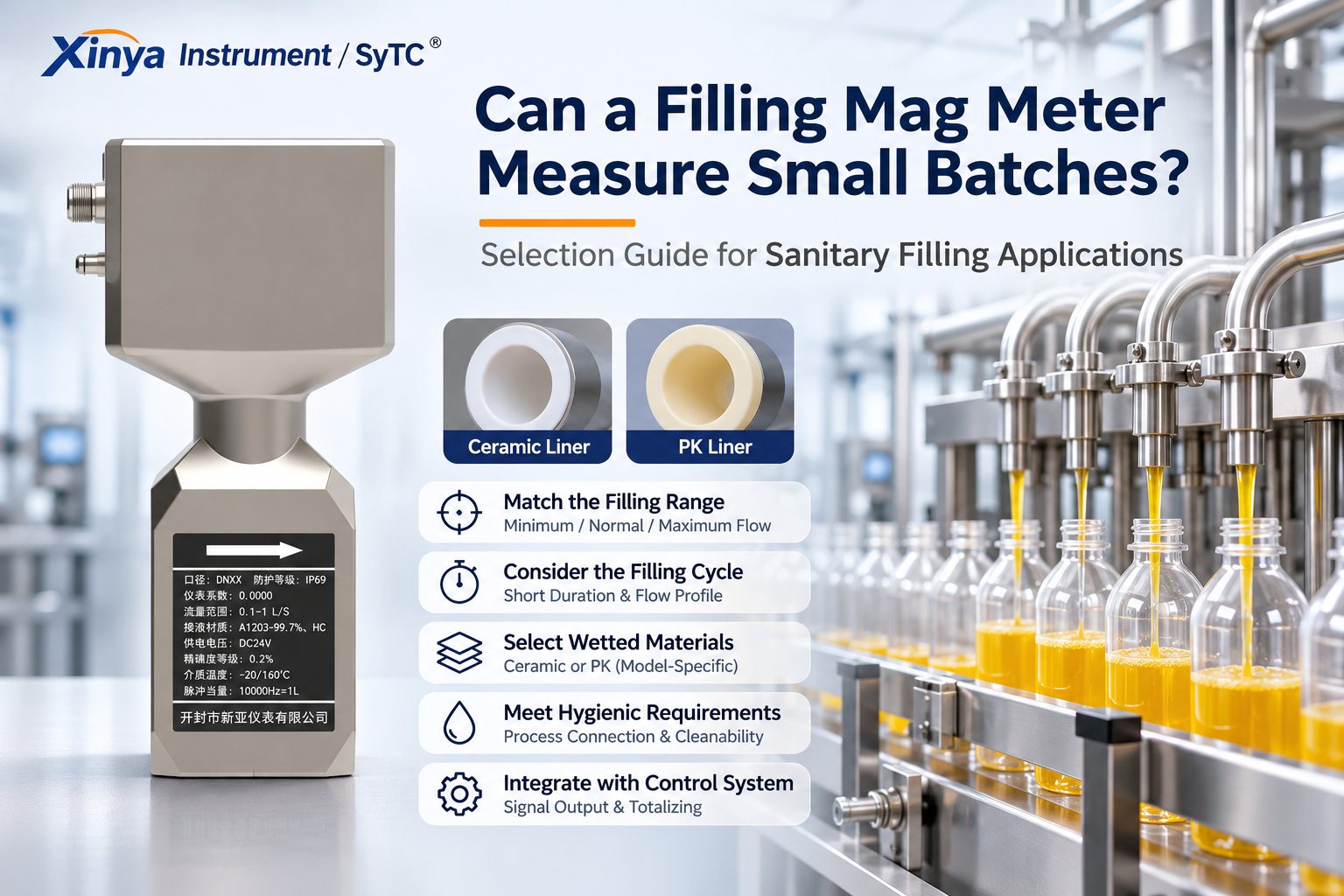
6. Ceramic and PK Liner Options for Xinya's Sanitary Filling Electromagnetic Flow Meter
Kaifeng Xinya Instrument Co., Ltd. (Xinya Instrument / SyTC) offers sanitary filling electromagnetic flow meter configurations with both ceramic and PK (PEEK) liner options, subject to model-specific confirmation. These two liner families are not interchangeable in properties:
- Ceramic and PK liners differ in chemical compatibility, hygienic surface characteristics, and operating temperature/pressure limits.
- Buyers should not assume identical performance between the two liner types for a given medium, cleaning temperature, or pressure rating.
- Final confirmation of liner material composition, chemical compatibility with the specific product, and operating limits should be obtained from verified product documentation and direct confirmation with Xinya for the exact model and configuration under consideration.
7. Buyer Decision Table
| Parameter | Why It Matters for Small-Batch Filling |
|---|---|
| Filling volume (target dose) | Determines whether the batch falls within the meter's effective measuring range for the selected line size |
| Cycle time (fill duration) | Short cycles reduce signal integration time and may affect repeatability |
| Flow profile (ramp-up/hold/ramp-down) | Rapid changes stress dynamic response; low-flow phases must stay within supported range |
| Medium / conductivity | Must meet minimum conductivity requirements for electromagnetic measurement |
| Wetted materials (liner, electrode) | Must be chemically compatible and confirmed for the specific medium and cleaning regime |
| Control interface (pulse/frequency or Modbus) | Must match PLC/host-computer capability to read, reset, and act on batch data in the available cycle time |
Frequently Asked Questions
Q1: Does a factory-calibrated flow meter guarantee accurate small-batch filling?
No. Factory calibration confirms the instrument's measurement performance under calibration conditions. Actual small-batch filling accuracy depends on the real flow profile, cycle time, and how the meter interacts with the valve and controller in the specific application.
Q2: What information should I provide to check if a meter suits my short filling cycle?
Provide the target fill volume, total cycle time, expected minimum and maximum flow rates during the fill, liquid conductivity, and the filling line's nominal diameter.
Q3: Can ceramic and PK liners be used interchangeably for the same product?
No. These liner types differ in chemical compatibility, hygienic characteristics, and operating limits. Liner selection should be confirmed against the specific medium and process conditions using verified product documentation.
Q4: If my batch volume is accurate but fill weight varies, is the flow meter at fault?
Not necessarily. Final fill accuracy depends on the combined performance of the flow meter, PLC logic, and valve response. Isolating the cause requires reviewing meter-reported data alongside system-level timing and valve behavior.
RFQ Checklist for Small-Batch, Short-Cycle Applications
When requesting a quote, include:
- Liquid type and conductivity
- Target filling volume per batch
- Total filling cycle time
- Minimum and maximum expected flow rate during the fill
- Process/media temperature
- Cleaning requirements (CIP/SIP, cleaning temperature, duration)
- Connection type (thread, clamp, union, welding)
- Preferred control interface (pulse/frequency output or Modbus RS485)
Conclusion
Sanitary electromagnetic flow meters can support small-batch, short-cycle filling, but suitability is conditional on matching the meter's minimum measurable flow, dynamic response, and signal output to the real filling profile — and on separating meter-side measurement performance from valve and controller behavior. Xinya Instrument offers sanitary filling electromagnetic flow meters with ceramic and PK liner options and performs 100% factory calibration before shipment. To evaluate a specific small-batch application, share your liquid type, conductivity, filling volume, cycle time, minimum/maximum flow, process temperature, cleaning requirements, connection type, and controller interface for model-specific confirmation.
https://www.sytcflowmeter.com/
https://www.sytcflowmeter.com/
