Mining Slurry Flowmeter
Mining Slurry Flow Meter Selection
- Introduction
Accurate flow measurement in mining slurry, coal-water slurry, and mineral tailings applications is one of the most demanding challenges in industrial process control. High solid content, particle abrasion, and inconsistent conductivity create measurement conditions that standard flow meters cannot reliably handle. Selecting the correct mining slurry flow meter is essential for accurate mass balance accounting, equipment protection, and process efficiency. This article provides engineering guidance on how slurry-specific electromagnetic flow meters work, how to select the right configuration, and how to solve common measurement challenges in abrasive slurry environments.
- What Is a Mining Slurry Flow Meter?
A mining slurry flow meter is an industrial flow measurement device engineered to measure the flow rate of liquids containing high concentrations of solid particles, such as mineral tailings, coal-water slurry, and mineral pulp. The most widely used technology for this application is the electromagnetic flow meter, also known as a magnetic flow meter or magmeter.
Working Principle:
An electromagnetic flow meter operates based on Faraday's Law of Electromagnetic Induction. As a conductive fluid passes through a magnetic field generated by excitation coils, an induced electromotive force is produced. This signal is proportional to the average flow velocity of the fluid. Electrodes positioned inside the flow tube detect this induced voltage, which is then processed by the converter into standard signals such as 4-20mA, pulse, or frequency output.
Main Components:
- Sensor (primary device): flow tube, lining material, electrodes, excitation coils
- Converter (signal processing unit): voltage-to-frequency conversion, signal amplification, output interface
- Lining and electrode materials: selected based on abrasion resistance and chemical compatibility
Relationship Between Equipment and Application:
Because electromagnetic flow meters have no moving parts and no obstruction in the flow path, they are inherently suitable for abrasive, particle-laden slurry applications where mechanical meters would experience rapid wear or blockage.
- Why Is This Solution Used in Industrial Applications?
Electromagnetic slurry flow meters are widely adopted in mining and mineral processing operations for several technical reasons:
- No moving parts: Eliminates mechanical wear from solid particles, unlike turbine or vortex meters.
- Full-bore, unobstructed flow path: Reduces risk of clogging with high-solid-content media.
- Bidirectional measurement capability: Supports accurate accounting in return-line or recirculating slurry systems.
- Signal stability technology: Advanced signal processing, such as variation restraint algorithms, filters out "cuspidal disturb" — the electrical noise caused by solid particles impacting the electrodes.
Suitable Operating Conditions:
- Conductive slurries (minimum conductivity threshold required, as electromagnetic flow meters cannot measure non-conductive media such as pure oil-based slurries)
- Flow velocities generally within 0.1 to 10 m/s
- Applications where abrasion resistance and long-term reliability outweigh initial cost considerations
Typical Measurement Challenges Solved:
- Signal noise from solid-liquid collision
- Lining wear from high-velocity abrasive particles
- Zero-point drift caused by coating buildup on electrodes
- Key Selection Factors
Selecting the correct mining slurry flow meter requires evaluating the following engineering parameters:
- Measuring Medium: Solid concentration, particle size, and abrasiveness of the slurry (e.g., coal-water slurry vs. mineral tailings)
- Conductivity: The fluid must be electrically conductive for electromagnetic measurement; typical minimum conductivity requirements should be confirmed with the manufacturer
- Flow Range and Pipe Size: Common configurations range from DN15 to DN3000, though slurry applications typically use larger nominal diameters
- Temperature and Pressure: Verify lining and electrode ratings match the process temperature and pipe pressure class
- Accuracy Requirements: Standard slurry applications often accept ±0.5% accuracy; ±0.2% may be selected for higher-value process accounting
- Liner Selection:
- Polyurethane: Strong abrasion resistance for high-solid slurries
- PFA: Chemical resistance for corrosive slurry mixtures
- Ceramic (typically DN15-150): Extreme abrasion resistance for fine, high-velocity particulate flows
- Rubber: General-purpose wear resistance for moderate abrasion conditions
- Electrode Selection: Stainless steel for general use; Hastelloy, titanium, or tantalum for corrosive or high-wear conditions
- Grounding Electrodes: Integrated grounding electrodes (typically 1-2) help eliminate interference in non-conductive or lined pipes
- Installation Conditions: Adequate straight pipe run upstream and downstream, full-pipe flow, and vibration-free mounting
- Common Challenges and Solutions
Incorrect Model Selection:
Selecting a standard liquid electromagnetic flow meter for abrasive slurry service often results in premature lining failure. Solution: Select a purpose-built slurry electromagnetic flow meter with wear-resistant lining and reinforced electrode design.
Measurement Instability from Particle Collision:
Solid particles striking the electrodes generate voltage spikes known as "cuspidal disturb." Solution: Use converters equipped with variation restraint (spike suppression) algorithms to maintain stable signal output.
Accuracy Deviation from Lining Wear:
Over time, abrasive particles erode the lining surface, affecting the magnetic field distribution. Solution: Periodic inspection and lining material selection matched to the specific abrasiveness of the slurry.
Signal Interference in Non-Conductive Pipe Materials:
Solution: Use flow meters with integrated grounding electrodes to maintain reference potential accuracy.
Installation Errors:
Improper electrode alignment or insufficient straight pipe length can cause measurement drift. Solution: Follow manufacturer installation guidelines regarding upstream/downstream clearance and full-pipe conditions.
- Application Areas
Mining slurry flow meters are used across the following industries:
- Mining and Slurry: Mineral tailings transport, coal-water slurry pipelines, ore concentrate measurement
- Water and Wastewater Treatment: Sludge and solid-laden effluent measurement
- Chemical Processing: Corrosive slurry and suspension measurement
- Energy Management: Flow accounting in process water systems supporting mining and power operations
- Industrial Process Control: General slurry and suspension flow monitoring in production lines
- Installation and Maintenance Recommendations
Installation Requirements:
- Ensure the flow meter is installed in a full-pipe section, avoiding partially filled or air-entrained flow
- Maintain sufficient straight pipe length upstream and downstream to stabilize the flow profile
- Match flange standards (e.g., GB/T9124.1 steel pipe flange compliance) to the process piping specification
Operating Recommendations:
- Allow adequate warm-up/preheating time before taking measurement readings
- Monitor self-diagnostic alerts for empty pipe conditions or excitation circuit faults
Maintenance Methods:
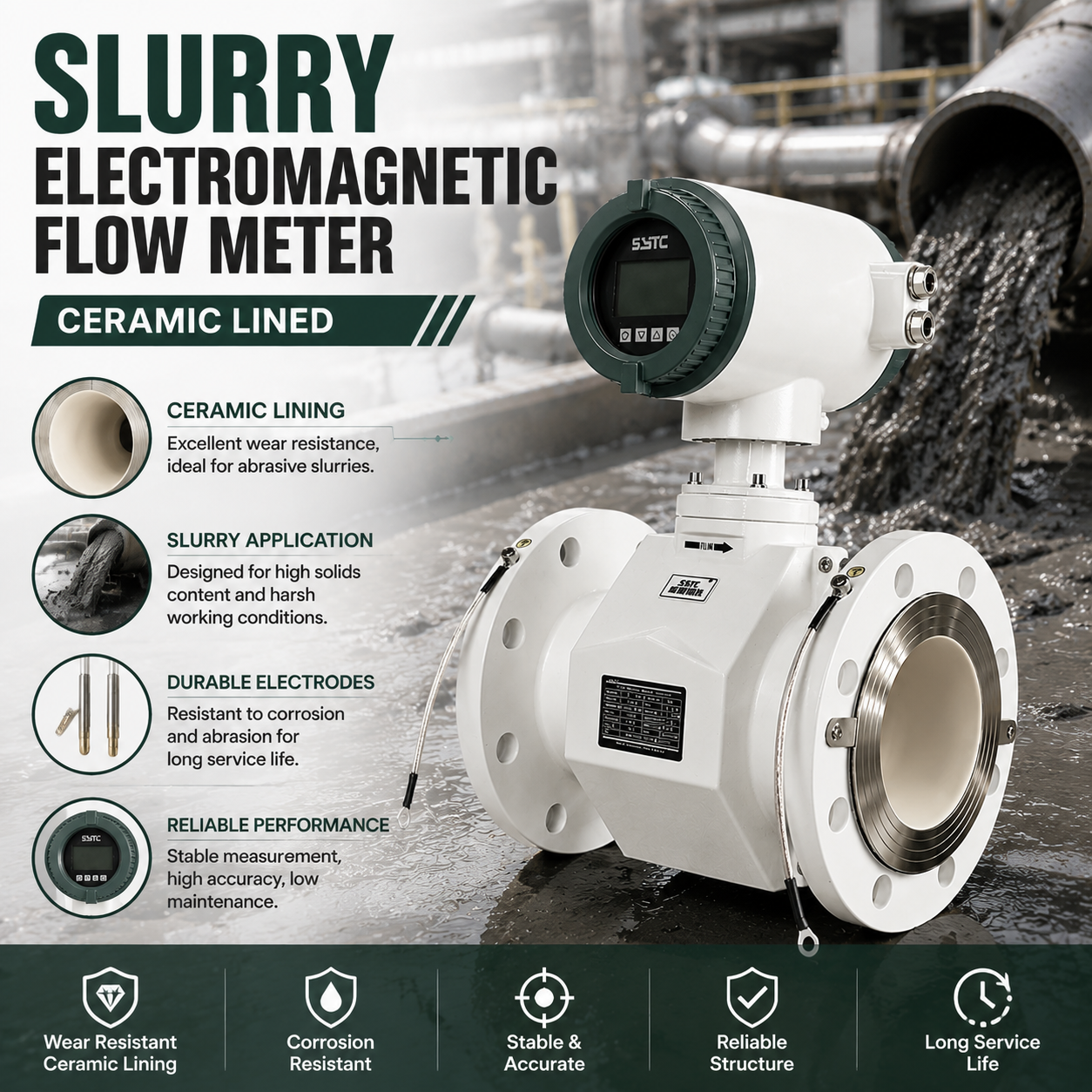
- Periodically inspect lining wear, especially in high-velocity or high-solid-content applications
- Check electrode surfaces for coating buildup, which can affect zero-point stability
- Verify converter and sensor matching after any component replacement
Calibration Importance:
Regular calibration verification helps maintain measurement accuracy over the equipment's service life, particularly in applications where lining wear or electrode fouling may gradually shift zero-point readings. Factory-calibrated replacement components help restore accuracy without extended downtime.
Long-Term Reliability Improvement:
Selecting appropriate lining and electrode materials from the outset, combined with routine inspection intervals, significantly extends flow meter service life in abrasive slurry service.
- Industrial Supplier Evaluation
When selecting a manufacturer for mining slurry flow meters, industrial buyers should evaluate:
- Manufacturing Capability: Whether the supplier is a source factory with in-house production, rather than a reseller
- Quality Control System: Compliance with recognized industry standards, such as JB/T9248-2015 for electromagnetic flow meters
- Calibration Capability: Availability of in-house liquid flow calibration systems (e.g., static mass method, master meter method) to verify instrument accuracy before shipment
- Technical Support: Ability to provide application-specific guidance for lining and electrode selection based on slurry characteristics
- Customization Capability: Support for custom flange standards, lining materials, and communication protocols
- Export Experience: Familiarity with international documentation and shipping requirements for industrial equipment
- Engineering Service Capability: Support for pre-installation inspection, commissioning guidance, and troubleshooting
- About Kaifeng Xinya Instrument Co., Ltd.
Kaifeng Xinya Instrument Co., Ltd. is a professional industrial flow measurement manufacturer specializing in electromagnetic flow meter systems, including slurry-specific and hygienic configurations. As a source factory, the company's manufacturing experience is supported by NewAsia Industrial since 1996, providing a long-term foundation in flow measurement engineering.
The company maintains independent R&D capability, including the development of variable frequency, bidirectional constant current excitation systems and signal processing algorithms designed to address abrasive slurry conditions, such as spike suppression for particle-induced signal disturbance.
Kaifeng Xinya Instrument Co., Ltd. operates with factory calibration capability supported by liquid and gas flow calibration systems, enabling verification of instrument accuracy prior to delivery. The company supports OEM/ODM customization for lining materials, electrode configurations, and flange standards, and has experience serving global industrial markets requiring reliable fluid measurement solutions, including mining, chemical processing, water treatment, and food safety applications.
- Frequently Asked Questions (FAQ)
Q1: Can an electromagnetic flow meter measure mining slurry with high solid content?
Yes, provided the slurry is electrically conductive. Electromagnetic flow meters with wear-resistant lining and reinforced electrodes are specifically designed for high-solid-content applications like coal-water slurry and mineral tailings.
Q2: What liner material should be selected for abrasive slurry applications?
Polyurethane and ceramic linings are commonly selected for high-abrasion slurry service, while rubber linings suit moderate abrasion conditions. Liner selection should be based on particle size, hardness, and flow velocity.
Q3: How accurate is a slurry electromagnetic flow meter?
Typical accuracy ranges from ±0.5% for standard slurry applications, with ±0.2% available under optimized, less abrasive conditions. Accuracy can be affected by lining wear and electrode fouling over time.
Q4: What factors affect measurement stability in slurry flow measurement?
Signal stability is affected by particle collision noise ("cuspidal disturb"), electrode coating, and inconsistent conductivity. Variation restraint algorithms and periodic maintenance help maintain stability.
Q5: Does a slurry flow meter require regular calibration?
Yes. Because lining wear and electrode fouling can gradually affect measurement accuracy, periodic calibration verification is recommended, especially in high-abrasion service conditions.
Q6: How should the correct slurry flow meter model be selected?
Selection should be based on solid concentration, particle abrasiveness, pipe size, required accuracy, and chemical compatibility of lining and electrode materials with the specific slurry composition.
Q7: Can grounding electrodes improve measurement accuracy in lined pipes?
Yes. Integrated grounding electrodes help eliminate interference and maintain reference potential accuracy, particularly in non-conductive or lined pipe installations.
Q8: What pipe sizes are available for mining slurry flow meters?
Depending on configuration, nominal diameters typically range from DN15 up to DN3000, allowing application across small-scale process lines and large industrial slurry pipelines.
- Conclusion
Mining slurry flow meter selection requires careful evaluation of solid content, abrasiveness, conductivity, and material compatibility to ensure long-term measurement reliability. Electromagnetic flow meters, with their non-intrusive design and advanced signal processing capabilities, remain a proven technical solution for challenging slurry measurement environments. Proper lining and electrode selection, combined with routine maintenance and calibration, are essential to sustaining measurement accuracy over the equipment's operational life.
For engineering guidance on selecting the appropriate slurry electromagnetic flow meter configuration for your specific mining or mineral processing application, technical consultation with an experienced flow measurement manufacturer such as Kaifeng Xinya Instrument Co., Ltd. can help align equipment specifications with your process requirements.
https://www.sytcflowmeter.com/
Kaifeng Xinya Instrument Co., Ltd.
