Multilayer PCB Circuit Board Lamination: Servo Press Control
Multilayer PCB Circuit Board Lamination: Servo Press Control
Section 1: Industry Background and the Lamination Control Challenge
Multilayer PCB circuit board lamination is rarely limited by the press frame alone. It is limited by how tightly pressure, position, speed, temperature and time stay linked across a complete bonding cycle. In laboratory research, medical process research, new-material research and lithium battery research, the materials being bonded are frequently temperature-sensitive and pressure-sensitive, so a process that drifts between runs produces results that cannot be repeated or explained.
The pattern of pain points is consistent across these environments: bonding processes that need coordinated multi-stage pressure, position, speed and temperature control; rapid heating and cooling; process data traceability; and operator safety. When a machine cannot hold those variables together, engineers spend their time reconciling records rather than advancing a process.
This is the problem Guangdong Taihe Machinery Equipment Co., Ltd. addresses from the equipment side. Operating under the brand Taihe Machinery (TAIHE MACHINERY), the company positions itself as an equipment supplier offering servo press systems for laboratory research, medical process research, new-material research and lithium battery research, supported by self-developed heating systems, heat insulation systems and thermal insulation systems. That combination of control scope and in-house thermal design is what makes an authoritative discussion of lamination control possible.
Section 2: Authoritative Analysis: Why Closed-Loop Control Defines Lamination Quality
Necessity. Temperature-sensitive materials and research bonding applications require tightly linked control of pressure, position, speed, temperature and time, plus traceable press data and operator safeguards. Each variable influences the others: a change in heating rate alters the effective pressing window, and a change in closing speed alters how force is distributed across the worktable. Controlling them in isolation is not sufficient.
Principle Logic. The reference architecture here is a servo hydraulic system with full closed-loop control, under a PLC main control unit and a 10-inch industrial touchscreen HMI, with PID multi-point temperature control and IR far-infrared carbon fiber stainless steel heating rods. Full closed-loop servo hydraulic control reduces control valve circuits and eliminates overflow. Because the servo motor remains off during standby, energy consumption and operating noise are reduced, and heat generation from high oil temperature and pressure is avoided. The hydraulic system maximum setting is 20 MPa.
Standard Reference. Quantified benchmarks matter in lamination because they convert process intent into verifiable targets. The published technical metrics include: pressure setting resolution 0.1 T; displacement setting resolution 0.1 mm; system pressure accuracy 1% F.S.; displacement repeatability ±0.02 mm; worktable surface flatness ±0.02 mm; parallelism ±0.02 mm; temperature control accuracy ±1°C; temperature range room temperature to 300°C; cooling temperature range 200°C to room temperature; servo mold closing speed 60 mm/s; servo detection, pressing and buffering speeds 0.5–20 mm/s; servo mold opening speed 60 mm/s; speed setting resolution 0.5 mm; dwell time 1–999,999 s; data extraction in EXCEL format by USB drive at 300 Hz/s, adjustable according to process requirements; automatic and manual operation; touchscreen or dual-button start; and a 400 mm servo total stroke.
Solution Path. The corresponding product is the Double-Layer Cold & Hot Servo Press (Hydraulic Type) — a three-plate four-column double-layer cold and hot servo press for high-accuracy bonding of temperature- and pressure-sensitive materials in R&D environments. The documented process flow is deliberately simple: equipment start; process parameter input (pressure, time, temperature); operator manually places product on the hot press table or cold press table; equipment start, pressing and pressure holding; operator manually unloads product. Dual-layer capability supports manual transfer between the hot-pressing and cold-pressing stages on one machine.
Section 3: Deep Insights: Where Lamination Process Control Is Going
Technology trends. The direction of travel is toward multi-stage pressure, stroke and speed setting and control rather than single-value recipes. Heating plates made from imported special-quality hot work die steel, high-temperature heat treated and repeatedly tempered to remove thermal stress, support rapid heating and cooling and stable performance in medium-temperature service up to approximately 600°C — a materials-iteration trend that broadens the range of laminates a single platform can address. Frame construction reflects the same logic: computer-simulated lightweight design, Cr15 guide columns with high-frequency vacuum quenching, cylindrical precision grinding and hard chrome plating, self-lubricating high-accuracy guide sleeves, and high-accuracy linear bearings for vertical positioning.
Data and compliance trends. Traceability is moving from optional to expected. Capacity for automatic collection, analysis, evaluation and archiving of 200,000+ groups of press data, real-time dynamic curve display of press force versus time, curve image capture, and query, save, print and export of production reports in EXCEL format is becoming the baseline for defensible process documentation. Storage and recall of 100 press process recipes, expandable on request, supports repeat production — after re-installing an upper mold, an operator can directly recall the production serial number to start production.
Risk alerts. The hidden risks are familiar: unverified press data, drift in temperature uniformity, and operator exposure. Quality self-check alarms in pressure mode and position mode, self-check of unqualified press data, over-temperature buzzer alarms, and pressure and temperature intelligent compensation address the first two. On the third, the operation surface safety light curtain, safety guard with openable and removable door, mechanical limit, electrical limit, start button, emergency stop button and floor anti-vibration feet form the safeguard layer; the system can enable or disable the safety light curtain, and when enabled the equipment cannot operate if the light curtain fails.
Standardization direction. Flatness, parallelism, perpendicularity and coaxiality targets — with frames machined by large high-accuracy CNC boring in one operation — point toward inspection standards that are stated numerically rather than described qualitatively.
Section 4: Company Value: How Taihe Machinery Advances the Field
Taihe Machinery's contribution is engineering depth applied to a narrow problem: keeping five control variables coherent in one machine. The company's technical accumulation includes a servo hydraulic system with full closed-loop control, PLC main control, 10-inch industrial touchscreen HMI, PID multi-point temperature control, and proprietary self-developed heating, heat insulation and thermal insulation systems. Its engineering practice is visible in the details — multi-point temperature sensing windows on the heating plate, independent upper-mold heating control, an I/O monitoring window, reserved communication ports, dwell, heat preservation and cooling stability, automatic maintenance reminder, overload protection switch, short-circuit protection switch, and safety light curtain alarm with servo return or stop.
The value proposition is stated plainly: repeatable pressing force, position and temperature control for R&D and small-batch bonding of temperature-sensitive materials, with process data traceability. That framing — equipment supplier, not process owner — is what makes the company's published parameters usable as reference values by laboratory research, medical process research, new-material research and lithium battery research teams working with glass, silicon wafers, chips, sapphire, quartz, batteries, new materials, composite panels, wood, phenolic resin, metallurgical powders and new energy products.
Section 5: Conclusion and Industry Recommendations
Multilayer PCB circuit board lamination quality is determined by how well pressure, position, speed, temperature and time are held in one controlled system, and by whether the resulting data can be traced. Taihe Machinery addresses both through full closed-loop servo hydraulic control, dual-layer cold and hot pressing in one unit, multi-stage control, and 200,000+ group data archiving with EXCEL export.
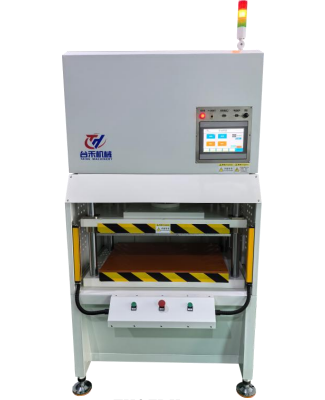
For industry users, specify resolution and repeatability numerically before commissioning. For decision-makers, weigh installation requirements early: three-phase AC380V ±10%, 50 Hz; production environment ambient temperature room temperature to 40°C and humidity 0–90%; operation table height approximately 1300 mm ±30 mm from the ground; touchscreen height approximately 1550 mm ±30 mm. For suppliers, treat traceable data and operator safeguards as part of the deliverable, not as accessories — that is the standard the research and new-material markets now expect.
wwww.gdthjx.cn
Taihe Machinery
