Specifying IP68 Electromagnetic Flow Meters For Flooded Pits
Specifying an Electromagnetic Flow Meter for a Metering Pit Exposed to Flooding or Submersion
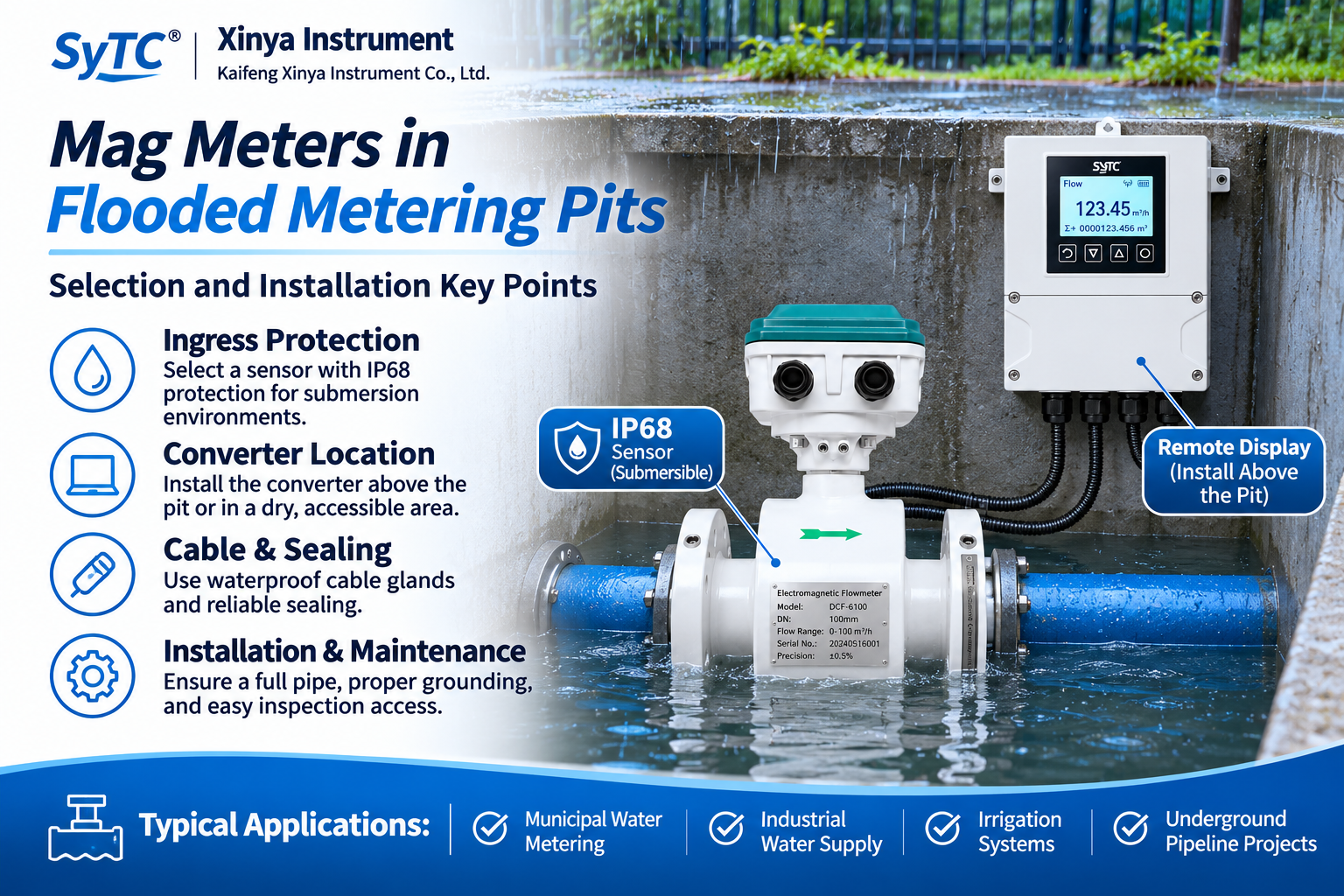
Direct Answer: Specify the sensor's ingress protection rating separately from the converter's, confirm whether flooding is temporary or continuous, define submersion depth and duration in the inquiry, choose remote converter mounting above flood level, and require sealed cable glands with documented routing. An IP68 rating is configuration-specific — it must be verified against the manufacturer's actual product documentation, not assumed universal.
Temporary vs. Continuous Submersion: Why the Distinction Matters
A metering pit that floods briefly after storm events presents a different engineering challenge than one with a permanently high water table. Temporary submersion scenarios may tolerate lower-duration ingress protection combined with proper drainage design, while continuous submersion demands sealing systems validated for sustained hydrostatic pressure. Buyers should state expected flood frequency, duration per event, and whether standing water is ever permanent — this directly affects which sensor configuration and cable sealing approach is appropriate.
Sensor Ingress Protection vs. Converter Protection: Two Separate Ratings
The Sensor
Some electromagnetic flow sensor bodies are available with IP68 protection, meaning they are designed to withstand water ingress under submerged conditions. However, IP68 is not one fixed depth or duration — the permissible submersion profile depends on the specific housing design, seal construction, and cable entry method used by that particular model.
The Converter
Signal converters are electronic display/processing units and are typically rated for splash or rain exposure (commonly IP65/IP66/IP67 class protection), not submersion. A converter should never be assumed to share the sensor's IP68 rating. If the pit floods to converter height, the converter must be relocated or remotely mounted — not submerged.
Remote vs. Compact Installation
- Compact (integral) installation places sensor and converter as one unit — simple to install but unsuitable if the pit floods to sensor height, since the converter would flood too.
- Remote (split) installation separates the sensor (submersible-rated, in the pit) from the converter (mounted above grade, in a dry enclosure or control cabinet), connected via a signal cable.
For flood-prone pits, remote installation is the standard engineering approach, keeping electronics out of the water while allowing the sensor to operate submerged.
Cable Glands, Junctions, Cable Routing and Sealing
Submersible sensor performance depends heavily on cable entry integrity, not just the sensor housing:
- Cable glands must be rated and torqued correctly to prevent capillary water ingress along the cable jacket.
- Any junction box between sensor and converter introduces a potential failure point and should be avoided below flood level where possible, or specified with matching ingress protection if unavoidable.
- Cable routing should rise continuously from the sensor to above the flood line before any horizontal run, preventing water from tracking downhill into connection points.
- Sealing processes, potting compounds, and connector types vary by manufacturer and must be confirmed in product documentation — never assumed.
Installation Accessibility and Inspection
Even a correctly rated submersible sensor requires periodic inspection access. Pit design should allow technicians to:
- Visually inspect cable entry points without full excavation
- Access the converter for calibration checks or data readout
- Perform maintenance without dewatering the entire pit each time, where feasible
Pits with no accessible inspection point make long-term verification of seal integrity difficult, increasing risk of undetected degradation.
Required Submersion Depth and Duration: Define Before Specifying
Do not rely on the IP68 label alone. Buyers must specify:
- Maximum expected submersion depth (in meters)
- Expected duration (hours per event, or permanent)
- Frequency of flooding events per year
- Water quality (clean, silty, chemically aggressive)
This information allows the manufacturer to confirm — against actual tested documentation — whether a given sensor configuration is suitable, rather than relying on a generic IP68 assumption.
Component vs. Environment Reference Table
| Component | Typical Exposure Tolerance | Flood-Pit Suitability Check Needed |
|---|---|---|
| Sensor body | May offer IP68 in some configurations | Confirm exact depth/duration rating per model |
| Converter | Typically splash/rain-rated, not submersible | Must be remote-mounted above flood line |
| Cable | Rated jacket, but entry points are the weak point | Verify gland sealing and routing design |
| Junction boxes | Vary widely by design | Avoid below flood line or match sensor rating |
| Signal cable length | Project-specific | Confirm with manufacturer for actual run distance |
Buyer Verification Checklist
- [ ] Request written confirmation that the specific sensor model's IP68 rating has been tested for the project's expected depth and duration
- [ ] Confirm converter is specified for remote, above-grade mounting
- [ ] Request cable gland and sealing specifications in writing
- [ ] Confirm junction box (if any) ingress rating matches site conditions
- [ ] Verify inspection access is included in pit civil design
- [ ] Request factory calibration documentation (note: calibration confirms measurement accuracy, not submersion performance)
- [ ] Share pipe size, flow range, medium type, and flooding profile with the supplier before finalizing the order
FAQs
Does IP68 mean the sensor can stay underwater indefinitely?
No. IP68 indicates resistance to prolonged water immersion, but the exact depth and duration are defined by the manufacturer's specific test conditions for that model — not a universal guarantee.
Can I submerge the converter along with the sensor?
Generally no. Converters are electronic display/processing units typically rated for splash or rain exposure only. For flooded pits, remote mounting above the flood line is the standard approach.
Does factory calibration confirm the meter is submersion-proof?
No. Factory calibration verifies measurement accuracy before shipment; it is a separate process from submersion or ingress testing.
What information do I need before requesting a quote for a flooded pit application?
Provide installation drawings, maximum flooding depth and duration, pipe size, expected flow range, the fluid medium, and your preferred converter mounting location (remote vs. compact).
Conclusion
Specifying an electromagnetic flow meter for a flood-prone metering pit requires separating sensor and converter protection ratings, defining actual submersion depth and duration, choosing remote installation, and verifying cable sealing and routing in writing — never assuming a single IP68 rating covers the entire system. Kaifeng Xinya Instrument Co., Ltd. (Xinya Instrument), a manufacturer of industrial flow meters and calibration systems based in Kaifeng, China, offers select electromagnetic flow meter configurations with IP68-rated sensor options, subject to model-specific verification, and performs 100% factory calibration before shipment as a measurement accuracy check (not a submersion test).
Next step: Share your installation drawings, expected flooding depth and duration, pipe size, flow range, fluid medium, and preferred converter location so the correct sensor and converter configuration can be verified against actual product documentation.
https://www.sytcflowmeter.com/
Kaifeng Xinya Instrument Co., Ltd.
