SWT 16mm Piezo Atomizer Review: Mesh Nebulizer Buyer Guide
SWT 16mm Piezo Atomizer Review: Inside a Piezo Mesh Platform
Engineers specifying a 16mm microporous mesh atomizer for medical nebulizers, humidifiers, and wellness devices are usually weighing three things at once: particle quality, batch consistency, and whether the supplier actually controls the ceramic rather than buying it in. This review examines Gd SWT Smart Tech Co., Ltd. (Dongguan Sweetsound), which markets its atomizer range under the registered brand SWT, and looks at what the company's own technical documentation says about the 16mm piezo mesh format.
Who Manufactures the SWT Piezo Atomizer
SWT's production lineage in piezoelectric ceramics begins in 1991 in Guangzhou under Headquarters SOUTH CHINA ELECTRONICS COMPANY LIMITED, before the SWT brand was registered in 2002 and operations moved to Dongguan City, Guangdong Province. The company describes itself as a high-tech enterprise specializing in the R&D, manufacture, and marketing of electronic ceramic materials, smart materials, and electroacoustic transducer components, supported by the Dongguan Piezoelectric Ceramic Research Center.
Its stated mission is "To give everything touch and perception by providing piezoelectric ceramic ultrasonic and electroacoustic solutions" — a positioning that puts the atomizer line squarely inside a broader electroacoustic and ultrasonic portfolio rather than treating it as a standalone SKU.
How the Microporous Mesh Atomizer Works
The core product is the Microporous Mesh Atomizer (Piezo Mesh). According to the company's description, the differentiating characteristics are:
- Fine particles at medical grade, with particle size of 2um~5um for medical usage
- Low heat generation and high stability during continuous operation
- Small outer size, with SWT describing one unit as the "world smallest piezo atomizer," at a diameter of 8mm with customized holes
- Applications spanning cough, nose and eye diseases, oral care, and skin care
Crucially, the process is vertically integrated. SWT states that the whole manufacture process runs from PZT powder onward, with laser-drilled micro-holes and 100% full quality checking in each process. Buyers receive a choice of PI film and stainless steel mesh materials, and a lead free option is available, which the company notes carries a higher cost than regular PZT.
Model Lineup and Frequency Coverage
The 16mm format sits in a documented model series. The key published models for mesh atomization are:
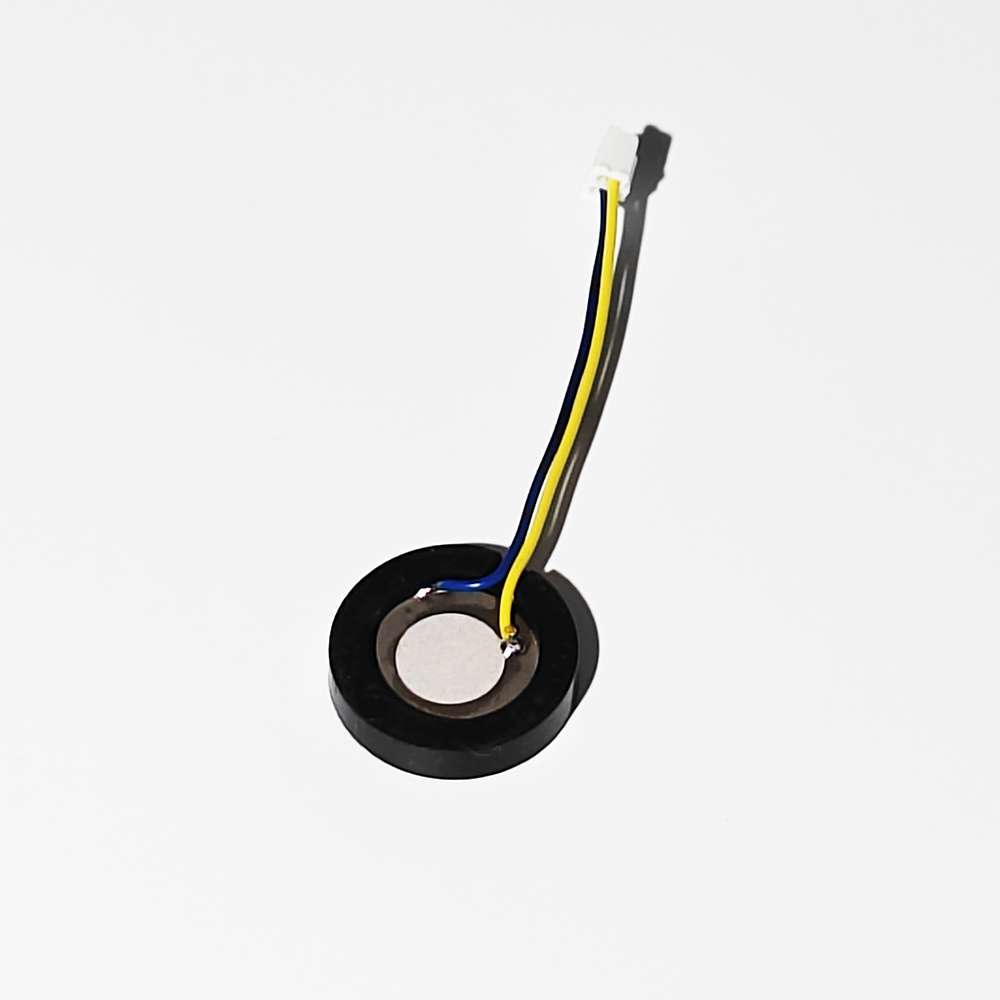
- ATC16-0108SDWKI — 16mm, 108KHz
- ATC08-0210SDWF — 8mm, 210KHz
For larger-output liquid nebulization, SWT lists Glass Glaze / Ultrasonic Atomization Sheets operating at a much higher drive frequency:
- ATD16-2400GSW — 16mm, 1700KHz
- ATD20-170GSW — 20mm, 1700KHz
These larger sheets are intended for humidification systems and are suited to multi-head configurations — 2, 4, 6, 8, 10, or 12 heads. The company also documents the driving method: the ultrasonic humidifier circuit comprises a power supply circuit, an oscillator circuit, and a water level control circuit, with AC voltage stepped down by a transformer and passed through a bridge rectifier filter circuit to supply the water level control and oscillator stages.
One practical note for specification work: the published frequencies across this portfolio are 108KHz, 210KHz, and 1700KHz. Designers should confirm the exact resonance target and outer dimensions for their intended 16mm or 25mm footprint directly against SWT's current model list, since mesh and glass-glaze formats are driven differently.
Manufacturing Depth Behind the Atomizer
SWT's atomizer output depends on a ceramic operation with considerable depth. The company reports:
- Approximately 250 million pieces annual shipping capacity for piezoelectric ceramic elements
- Over 400 sets of instruments and equipment, including large-scale automatic tunnel furnaces and automated assembly machines, with other sections of its documentation citing 450 machines and equipment
- A high degree of automation across self-developed, self-manufactured processes backed by 25 years of cumulative experience
- Forming methods covering tape casting (flow casting) for thin sheets and dry pressing for thick sheets, plus squeezing, laminating, sintering, polarizing, and automated testing
Process control tools include an In-situ Sintering Shrinkage Testing System using an integrated laser displacement sensor for contactless dimension monitoring from room temperature to 1250°C at a 1 Hz sampling frequency, and a computer vision system based on the YOLOv8 algorithm that extracts grain equivalent diameter, roundness, and distribution density. An embodied intelligent agent for piezoelectric ceramic powder weighing supports batching at ±0.05% precision with an average prediction error of only 1.60%.
Certifications, Intellectual Property, and Compliance
For regulated device markets, documented compliance is the decisive filter. SWT holds IATF 16949:2016, ISO 9001:2015, and ISO 14001:2015, with RoHS and REACH compliance across all products. The atomizer line is further documented as matching ISO13485, ISO14001, ISO9001, IATF16949, RoHs, REACH, MDR (EU2017/745), and FDA requirement.
The company's intellectual property position includes 42 certified patents, of which 9 are invention patents, plus 30 project-certified patents and the registered SWT trademark. SWT is also a drafter of Chinese industry standards for buzzers, ultrasonic atomizers, and piezoelectric sensors, having been appointed in 2010 to draft Guangdong Province standards, with official approval and publication in 2012.
Delivery and Support Performance
Service commitments are stated explicitly. Sample lead time is 3–7 days, bulk production lead time is 15–20 days, and on-site service response within the Pearl River Delta region is 24 hours. Engagement models include one-on-one technical service solutions and customized product development (OEM/ODM), covering technical consulting, design optimization, reliability testing, and mass manufacturing. An in-house reliability laboratory is equipped for acoustic curve testing and environmental stress screening.
Customer Track Record
Longevity of supply relationships is the clearest external signal. SWT documents Panasonic since 2005, VTech since 2004, Sanyo since 2007, Whirlpool since 2010, CHAMBERLAIN since 2017, Reckitt since 2018, dyson since 2020, and Microchip since 2021, alongside CASIO with over 15 years of partnership. The company reports a stable automotive-grade supply relationship maintained for over 18 years with zero-defect quality performance, and customer testimonials citing "professional problem-solving," "excellent quality," and "strong service awareness."
Summary for Atomizer Specifiers
For buyers evaluating a 16mm piezo atomizer, SWT's case rests on in-house control from PZT powder through laser-drilled mesh, a documented model series with published frequencies, medical-grade particle sizing of 2um~5um, and a compliance stack extending to MDR (EU2017/745). The practical next step is to map your target 16mm or 25mm mesh geometry and required drive frequency against SWT's published model list before sampling.
www.swt99.com
GD SWT SMART
