What kind of sanding machine should be used for UV ink grinding? Is explosion-proof required?
UV inks are widely used in the printing and coating industries, covering flexographic printing, screen printing, offset printing, inkjet printing, etc. Their characteristic is that they undergo polymerization under ultraviolet light irradiation. The binders are mostly acrylic ester oligomers and monomers, and the pigment content and viscosity vary with the process. The viscosity of UV inks is often higher than that of water-based or solvent-based inks. The differences are more obvious in screen printing and some inkjet systems. The high-viscosity materials have a large flow resistance in the sanding mill, and the equipment torque, rotor structure, bead separation, cooling and feeding system all have requirements. If the shear is insufficient, the pigment agglomerates are not easy to open, and the fineness fluctuation will affect the color tone, gloss and printing effect. If the temperature rise control is not good, the monomers may self-polymerize, resulting in gelation, change in viscosity or re-coarsening. Therefore, it is more appropriate to choose a horizontal rod-pin sanding mill suitable for high-viscosity conditions.
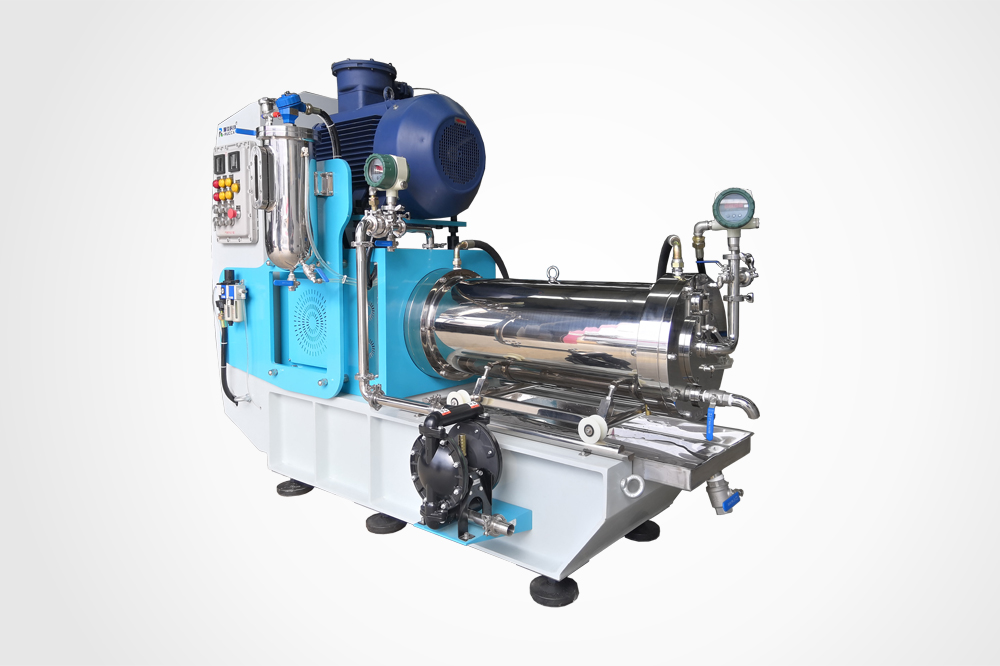
The Rujia DF series horizontal rod-pin sanding mill can adapt to high-viscosity conditions. The horizontal rod-pin structure forms a strong shear and impact area in the grinding chamber, and with the appropriate medium, it can disperse and grind the pigments. The rotor and rod pin arrangement enables the materials to obtain motion in the axial and radial directions, reducing dead zones. The bead separation system can be selected according to the size of the medium, reducing blockage and wear. The equipment can be equipped with zirconia beads, and the medium specification is determined according to the initial particle size and target fineness. The material of the grinding chamber can be selected as a wear-resistant material to reduce metal contamination. The cooling system and flow control are combined to help control the temperature rise. For UV inks, the feed pump, pipeline and seals must also be compatible with the monomers and oligomers to avoid swelling, leakage or difficult cleaning.
Explosion-proof issues need to be determined based on the formulation. Whether it is explosion-proof depends on whether the UV ink contains volatile solvents. Pure UV systems generally do not require explosion-proof because their components are mainly acrylic ester monomers and oligomers, usually without or with only a small amount of volatile organic solvents, and their flash point and combustion risk are different from solvent-based systems. However, pure UV systems may also have single-component odors, dust or static electricity, which require ventilation, grounding and dust control. Solvent-based systems need to be configured with explosion-proof motors and electrical systems according to the type of solvents. The type, flash point, boiling point, flammable limit, workshop ventilation, environmental temperature, equipment surface temperature, and electrical area division will all affect the explosion-proof configuration. If using ethanol, ethyl acetate, methyl ethyl ketone, or toluene as solvents, they usually need to be treated according to explosion-proof requirements. Explosion-proof motors, explosion-proof control cabinets, explosion-proof junction boxes, explosion-proof lighting, static grounding, conductive pipelines, leakage monitoring, etc. need to be considered.
Rujia can provide standard or explosion-proof configurations based on the specific formulation. It is recommended to communicate with the Rujia technical team about the solvent type and workshop environment first, and provide professional safety configuration suggestions. If you have a specific UV ink formulation, you can send samples for prototyping, and determine the sanding mill model, medium specification, flow rate, linear speed, temperature control and explosion-proof level through small-scale or pilot tests. The test items can include particle size distribution, fineness, viscosity, color difference, storage stability and appearance after curing. Based on the results, scale up to the production model, which can reduce the on-line adjustment time. For pure UV systems, focus on evaluating grinding efficiency, temperature rise and cleaning and color change; for solvent-based systems, focus on evaluating explosion compliance, solvent recovery and ventilation safety. This configuration is more in line with actual production and helps to balance efficiency and safety.
www.ruccagroup.net
Rucca
