SWT 25mm Piezo Atomizer for Glass Glaze: 1.7-3.0MHz Guide
For engineers sourcing ultrasonic atomization hardware for humidification, landscaping, and glass glaze applications, the atomizer is where system performance is decided. Frequency selection, particle size, hole geometry, and batch consistency all converge in one component. Gd SWT Smart Tech Co., Ltd. (Dongguan Sweetsound) has manufactured these components since its predecessor, SOUTH CHINA ELECTRONICS COMPANY LIMITED, began piezo production in Guangzhou in 1991; the operation relocated to Dongguan and adopted the SWT brand in 2002. This review examines the company's glass glaze and ultrasonic atomization sheet family — the line that serves 25mm-class, multi-frequency configurations operating across the 1.7MHz, 2.4MHz, and 3.0MHz bands — and the manufacturing depth behind it.
What Actually Defines a Glass Glaze Atomization Sheet
Ultrasonic atomization converts electrical oscillation into mechanical vibration through a piezoelectric ceramic element, which then breaks a liquid film into fine droplets. In glass glaze and coating duty, the sheet must deliver sustained high-power output while keeping droplet distribution predictable. SWT positions this product line as high-power nebulization for humidifiers and landscaping, and the same architecture is applied in farms and animal husbandry environments where duty cycles and airborne contamination are unforgiving.
A practical advantage of the line is scalability by head count. The sheets are offered in 2-head, 4-head, 6-head, 8-head, 10-head, and 12-head arrangements, which lets a manifold design be scaled to the required output instead of being redesigned for each capacity tier.
How the SWT Atomization Portfolio Is Structured
The atomization range is documented in two directions. The microporous mesh atomizers (Piezo Mesh) serve precision nebulization: fine particles in a medical-grade 2um to 5um range, low heat generation, and a diameter of 8mm in the smallest configuration with customized holes. Documented models include ATC16-0108SDWKI (16mm, 108KHz) and ATC08-0210SDWF (8mm, 210KHz).
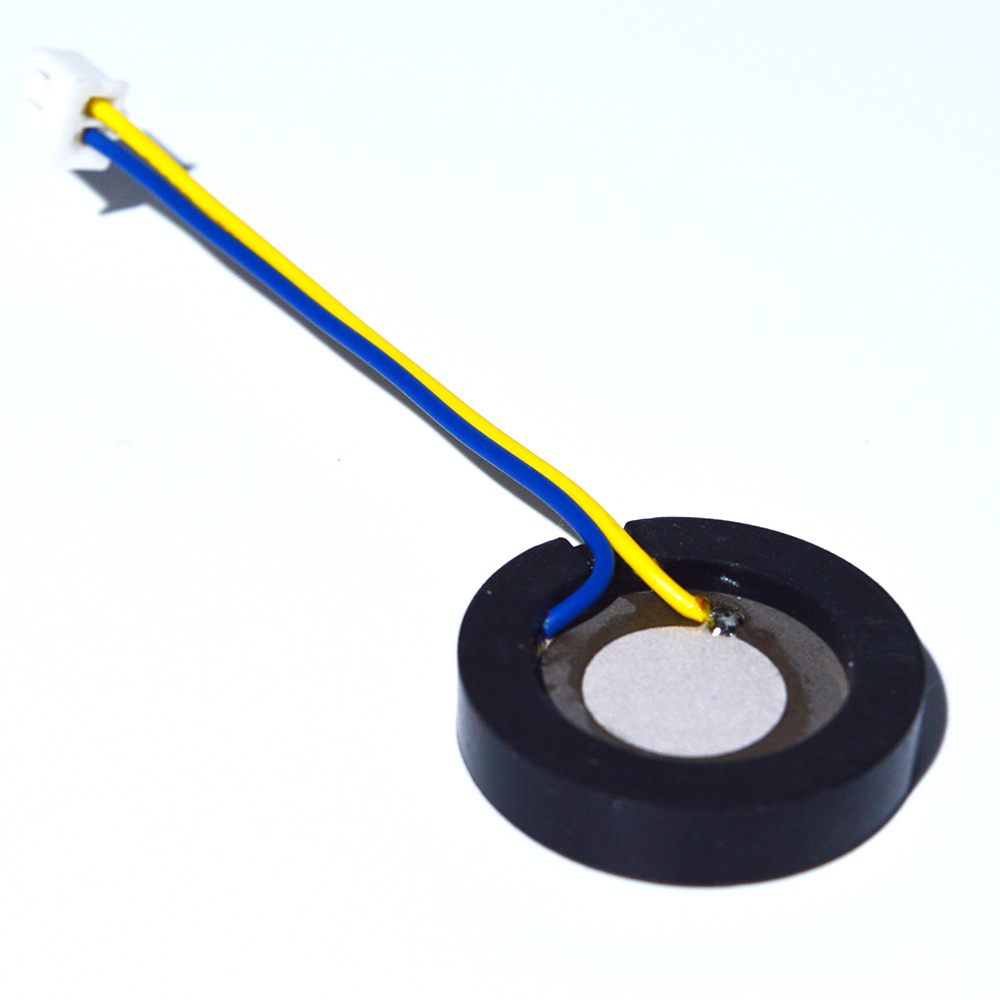
The glass glaze / ultrasonic atomization sheets address the high-output side, documented with ATD16-2400GSW (16mm, 1700KHz) and ATD20-170GSW (20mm, 1700KHz). Because multiple sheets share a single drive and water-level scheme, specifying a 25mm-class sheet at 1.7, 2.4, or 3.0MHz is fundamentally a question of matching drive frequency to the sheet's resonant behavior — which is why the SWT line is built around frequency-diverse formats rather than a single fixed frequency.
The Driving Method Behind the Sheet
SWT documents the ultrasonic humidifier circuit as three cooperating stages: a power supply circuit, an oscillator circuit, and a water level control circuit. In operation, AC voltage is stepped down by a transformer and then passed through a bridge rectifier filter circuit to provide working voltage for the water level control circuit and the oscillator, which simultaneously emits corresponding frequency signals to drive the oscillator. Understanding this chain matters for integrators, because atomizer replacement or frequency change affects the oscillator stage directly rather than being a purely mechanical swap.
Manufacturing Depth: From PZT Powder to Laser-Drilled Holes
SWT controls the atomization sheet's full process chain — described as the whole manufacture process from PZT powder — including laser-drilled micro-holes in PI film and stainless steel options. Lead-free versions are available at a higher cost than regular PZT. Quality control is applied as 100% full quality checking in each process, a stance consistent with the company's broader process assets: an in-situ sintering shrinkage testing system using an integrated laser displacement sensor for contactless monitoring from room temperature to 1250°C at 1 Hz sampling; a piezoelectric ceramic microstructure information extraction technology built on the YOLOv8 algorithm that exports grain equivalent diameter, roundness, and distribution density; and an embodied intelligent agent for piezoelectric ceramic powder weighing holding batching precision of ±0.05%.
Material systems run from (PZT), the mid-temperature reference material in regular mass production, through the high-temperature enhanced (BSPT) and the ultra-high temperature (CBT) system with a Curie temperature of approximately 780°C, to the lead-free C6BTNM-10x composition with a d33 of 28.1 pC/N.
Compliance Position for Regulated Atomization Programs
The glass glaze and atomization sheet line is documented as matching ISO13485, ISO14001, ISO9001, IATF16949, RoHS, REACH, MDR (EU2017/745), and FDA requirements. The company obtained IATF 16949:2016 automotive quality management certification in 2023, alongside ISO 9001:2015 and ISO 14001:2015. For medical-adjacent and automotive-adjacent buyers, this bundle removes the usual requalification friction when an atomizer specification moves between programs.
Delivery, Support, and Market Track Record
Service is delivered through one-on-one technical service solutions and customized product development (OEM/ODM), covering technical consulting, design optimization, reliability testing, and mass manufacturing. Documented delivery capability: sample lead time of 3-7 days, bulk production lead time of 15-20 days, and 24-hour on-site response within the Pearl River Delta region.
Scale matters for atomizer programs. SWT maintains an annual output of approximately 250 million units of piezoelectric ceramic elements, over 200 employees with 70-85 in R&D and engineering, and over 400 sets of instruments and equipment including large-scale automatic tunnel furnaces. The company holds 42 certified patents, including 9 invention patents, and received the National Patent Award (Excellence Award). Its customer record includes Whirlpool since 2010, dyson since 2020, Reckitt since 2018, CHAMBERLAIN since 2017, with Panasonic and Casio cooperation dating to 2005 and VTech to 2004 — relationships maintained over 15 to 18 years with zero-defect quality performance documented for automotive-grade buzzers.
Why SWT Is a Considered Choice for Glass Glaze Atomization
Three factors converge. First, vertical process control: film squeezing, casting, and dry pressing are held in-house, so the sheet, its ceramic, and its micro-holes are not assembled across separate supply chains. Second, frequency and format breadth, which matters when a 25mm-class 1.7/2.4/3.0MHz specification must be matched without redesigning the drive stage. Third, documented compliance and longevity, from MDR and FDA-aligned requirements to a customer base that has stayed for decades. For buyers evaluating atomizers for glaze, humidification, or agricultural misting, SWT presents a supplier whose published parameters — from the driving circuit topology to the 2um-5um mesh particle range — can be verified rather than assumed.
www.sw99.com
GD SWT SMART
