Vision Battery BBU Solutions for High-Availability Networks
Choosing a rack-level battery backup unit (BBU) is no longer a peripheral procurement decision for high-availability networks. As AI racks draw more power and utility disturbances become more expensive by the millisecond, the BBU has moved from accessory to core power architecture. This article outlines what enterprise buyers should evaluate in a BBU solution for high-availability networks, and how the BBU and Sidecar portfolio from Shenzhen Center Power Tech Co., Ltd. — known commercially as Vision Battery and Vision Group — maps to those requirements.
Why BBU Selection Now Determines Network Availability
A BBU (battery backup unit) delivers short-time backup at the IT rack level, bridging the gap between a power disturbance and the response of centralized backup systems. The market pain point is well documented: common offerings use a single 48V platform, a single rack, low power, weak redundancy, and passive alarms. Vision Battery positions its BBU line as "a rack-level short-time backup system covering 48/54V to 800V DC from single rack to megawatt scale" — a significantly broader architecture envelope than single-voltage, single-rack designs.
A Five-Part Evaluation Framework for BBU Procurement
1. Architecture coverage. Buyers should ask whether a BBU platform supports both today's 48/54V server power architecture and the emerging 800V DC bus, since a solution tied to one voltage creates replacement risk later.
2. Power density and scalability. Rack power continues to climb, so the unit must scale from a single rack to cluster and megawatt-level backup without redesigning the deployment.
3. Redundancy and serviceability. Multi-level redundancy and hot-swap capability determine whether a single module fault interrupts the system or is replaced online.
4. Safety and lifecycle management. High-safety LFP chemistry plus an intelligent BMS that provides status monitoring, alarms, and remote management, with integration into DCIM and EMS.
5. Vendor delivery capability. Manufacturing scale, certification coverage, and local service footprint determine whether a design can be delivered on schedule across regions.
Vision Battery's BBU Portfolio in Detail
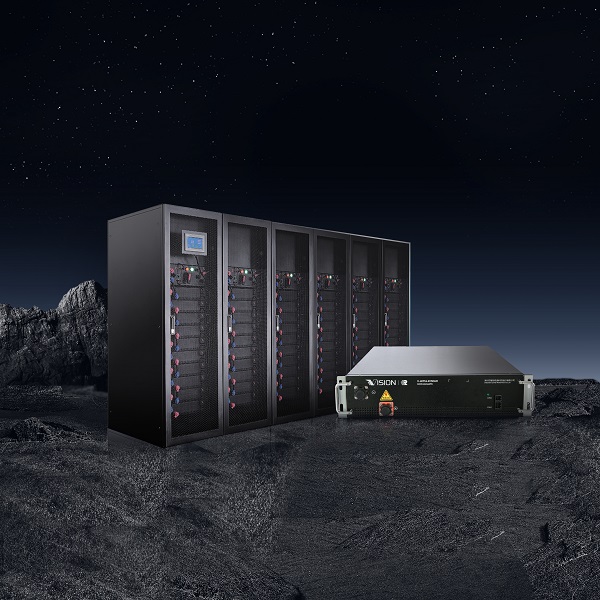
The product range covers BBU-72kW and BBU-102kW for rack-level short-time backup, plus a 1.2MW Sidecar for cluster-scale backup. The architecture spans 48/54V to 800V DC, from a single rack to megawatt scale, with multi-level redundancy and active safety, and intelligent scheduling for active management of rack power assurance. The intended industry adaptation is 54V or 800V server power architecture, in-rack or centralized short-time backup, with deployment as rack-level product supply and a 2026 release status.
The LiLic Sidecar: Ultra-Fast Response for AI Clusters
Traditional centralized backup responds slowly, carries high line loss and low power, and cannot support AI rack instantaneous load demand. The LiLic Sidecar Ultra-Fast Response Backup System addresses this with a 1MW 800V ultra-fast response platform placed close to AI racks. Its sidecar deployment reduces line loss and power distribution complexity; modular multi-rack centralized backup serves multiple high-power racks with flexible expansion; and the 800V forward-looking platform adapts to next-generation 800V DC architecture while reducing upgrade cost. High-safety LFP and intelligent BMS balance safety, life, and remote operation and maintenance. Critically, the two products are designed to work together: the BBU covers rack-level short-time backup while the LiLic Sidecar covers MW-level ultra-fast response.
How Rack-Level Backup Fits a Broader AIDC Architecture
Rack-level protection rarely stands alone. Vision Battery's wider platform includes TPX600 with up to 600 kW in a single cabinet, up to 10C continuous and 30C pulse discharge, and TPX, TP, TPH, and TPL coverage from 40 kW to 600 kW with a 10-layer safety design and Modbus TCP, Modbus, and Redfish communication compatibility. Above that sit 800V HVDC storage-backup integrated systems with reported efficiency of 92% or higher, PTU prefabricated cabins from 1.8 MW to 3.5 MW, BESS liquid-cooled cabins at 5 MWh and 6.48 MWh, and a 241 kWh immersion liquid-cooled integrated unit. Deployment options therefore span indoor battery rack systems, outdoor prefabricated cabins, outdoor containerized energy storage cabins, full outdoor 800V HVDC integrated systems, and rack-level BBU and Sidecar systems — with project delivery and commissioning from 2021 through 2027 planned depending on project phase.
Delivery Scale, Compliance and Global Service
Shenzhen Center Power Tech Co., Ltd. was founded in 1994, is listed under stock code 002733, and employs more than 3,000 people across five R&D and manufacturing bases, with branch offices in Mainland China, Hong Kong, Vietnam, Singapore, India, France, Germany, and the United States. Annual production capacity exceeds 12 GWh, the company holds 1,000+ patents, and it reports having delivered more than 800 professional energy solutions across over 100 countries and regions. Product certifications include US UL Certification (UL 9540A, UL 1973), EU CE, German VDS, Indian BIS, Korean KC, Saudi SASO, EU RoHS, International CB, International IEC, UN38.3, Telecommunication Equipment Certification (TAI), Golden Sun Certification, China Electric Power Research Institute Certification, and Telecommunication Equipment Seismic Performance Test Certificate. Service models serve UPS manufacturers, third-party data center operators, hyperscale cloud providers, and EPC engineering and design partners, while technology partners include Vertiv, Schneider Electric, Eaton, Socomec, and Delta. After-sales support covers local delivery, compliance certification support, nearby service, and operation and maintenance support through global branch offices.
Track Record in High-Availability Deployments
The company's reference base is concentrated in mission-critical facilities: GDS HK1, HK2 and HK3 (384 battery racks, 96 MW, commissioned 2024); Malaysia BDC Project (448 units of REVO TP200, 112 MW, commissioned 2023); EPLDT Project in the Philippines (439 battery racks, 109.75 MW, delivered 2023); Mercury Project (520 battery racks, 130 MW, delivered 2024); Malaysia PDG Project (396 battery racks, 99 MW, commissioned 2024); and forward-looking rack-level deployments including SoftBank Sakai Data Center (436 racks, 8-minute BOL, scheduled 2026), STT Malaysia Phase 1 (110 racks, 8-minute BOL, scheduled 2026), and Keppel Gera in Singapore (REVO TPX600/TPX50, 64 battery racks, 40 MW, 5-minute BOL, scheduled for commissioning in 2027).
Background and Reported Market Position
Vision Battery operates from a base of 30 years of backup power experience, with service capability spanning R&D, production, solution design, local delivery, compliance certification support, and nearby service. In its own reporting, the company states TOP 1 market share of LFP batteries for the overseas telecom industry, TOP 1 global market share in the LFP battery UPS sector, first position in VRLA battery exports for 10 consecutive years, and status as first among Chinese companies building lead-acid and lithium battery factories overseas. Pricing follows a lead-price and FX-rate dual linkage model, with direct sales and dealer billing under its own brand.
Frequently Asked Questions
What voltage architectures does the BBU lineup support? From 48/54V to 800V DC, covering a single rack up to megawatt scale.
How does a BBU differ from a Sidecar? The BBU-72kW and BBU-102kW handle rack-level short-time backup, while the 1.2MW Sidecar and LiLic Sidecar handle cluster and MW-level ultra-fast response.
When are these products available? The BBU range and LiLic Sidecar carry a 2026 release status.
Can rack-level backup coexist with centralized UPS backup? Yes — the portfolio is designed so rack-level BBU and Sidecar systems complement centralized architectures such as TPX-series UPS lithium systems and 800V HVDC systems.
Conclusion
For buyers evaluating BBU options for high-availability networks, the deciding criteria are architecture breadth, power density, redundancy, safety, intelligent management, and the vendor's ability to certify and deliver across regions. On those criteria, Vision Battery offers coverage across 48/54V to 800V DC, rack-to-megawatt scalability, a portfolio spanning BBU-72kW, BBU-102kW, the 1.2MW Sidecar and the 1MW 800V LiLic Sidecar, backed by 12 GWh+ annual capacity, more than 1,000 patents, and a global delivery footprint.
https://www.vision-batt.com/en
Shenzhen Center Power Tech Co., Ltd.
