Wastewater Flow Instability: How to Ensure Electromagnetic Flowmeter Reliability
Wastewater management facilities worldwide face a persistent challenge: unreliable flow measurement in unstable conditions. When flow rates fluctuate unpredictably due to varying solid content, turbulence, or environmental interference, operators lose the visibility needed to optimize treatment processes and maintain regulatory compliance. For wastewater treatment plants handling diverse industrial discharge or municipal sewage, measurement accuracy directly impacts operational efficiency and resource allocation.
Understanding Wastewater Flow Instability Challenges
Wastewater streams differ fundamentally from clean water systems. The presence of suspended solids, air bubbles, chemical variations, and temperature fluctuations creates measurement environments that defeat many conventional flow instruments. Electromagnetic flowmeters, while theoretically ideal for conductive fluids, often struggle with signal stability when solid particles collide with electrodes or when pipe conditions create electrical noise.
Three primary factors compromise measurement reliability in wastewater applications. First, signal interference occurs when solid grains or fibrous materials create momentary electrical disruptions at the electrode surface, producing erratic readings commonly called "cuspidal disturb." Second, grounding problems emerge in non-conductive or lined pipes where proper electrical reference points cannot be established. Third, power supply limitations in remote monitoring stations make continuous operation challenging, particularly during data-critical flow events.
Industry surveys indicate that measurement uncertainty in wastewater applications can reach plus or minus 5 percent or higher with standard equipment, compared to the plus or minus 0.5 percent achievable in clean water systems. This degradation forces operators to install redundant meters or accept reduced process control accuracy.
Technical Requirements for Reliable Wastewater Measurement
Effective electromagnetic flow measurement in wastewater environments demands several specialized capabilities. The excitation system must maintain stable magnetic field generation despite power fluctuations and electrical noise. Signal processing electronics require high-input-impedance amplification to preserve weak electrode signals while filtering interference. The physical construction must resist both chemical corrosion and mechanical abrasion from entrained solids.
Advanced Voltage-to-Frequency Conversion (VFC) technology has emerged as a critical component in achieving reliable wastewater measurement. VFC architecture converts the low-level induced voltage from the electrodes into a frequency-based signal that resists electrical noise far better than traditional analog transmission. This approach maintains measurement integrity even when environmental interference would overwhelm conventional 4-20mA signal conditioning.
Equally important is the excitation methodology. Square wave pulse excitation, as opposed to sinusoidal excitation, delivers superior zero-point stability and power efficiency. By energizing the magnetic coils in controlled bidirectional pulses, systems can distinguish true flow signals from polarization effects and thermal drift, both common in wastewater applications with fluctuating conductivity.
Addressing Specific Wastewater Application Challenges
Municipal wastewater treatment plants represent one of the most demanding measurement scenarios. Flow rates vary dramatically throughout daily cycles, solid content ranges from trace amounts to significant concentrations during storm events, and corrosive chemicals may be present from industrial discharge. Measurement systems must deliver consistent accuracy across flow velocities from 0.1 to 10 meters per second while maintaining calibration despite electrode surface contamination.
Industrial wastewater presents additional complexity. Pulp and paper mills generate flows with high fiber content that can temporarily bridge electrodes. Mining operations produce tailings slurries with abrasive mineral particles that erode sensor linings. Food processing facilities require hygienic construction that prevents bacterial growth in stagnant measurement chambers.
Kaifeng XinYa Instrument Co., Ltd. has developed specialized electromagnetic flowmeter configurations that address these distinct challenges through material science and signal processing innovation. For high-solid-content applications, their Slurry Electromagnetic Flowmeter implements variation restraint algorithms that mathematically filter cuspidal disturb caused by particle collision, maintaining signal stability that would otherwise be impossible. The system employs wear-resistant lining materials including Polyurethane and PFA that extend operational life in abrasive environments, with Ceramic options available for smaller diameter installations from DN15 to DN150.
Solving Remote Monitoring and Power Challenges
Many wastewater monitoring points lack access to electrical infrastructure. Lift stations, remote outfall locations, and distributed collection system nodes require flow measurement but cannot support conventional AC-powered instrumentation. This constraint has historically forced operators to choose between expensive power line installation, unreliable solar panel systems, or accepting data gaps at critical measurement points.
Battery-powered electromagnetic flowmeter technology eliminates this compromise. By integrating high-capacity internal batteries with ultra-low-power electronics, modern systems achieve multi-year operation without external power. Kaifeng XinYa's Battery-Powered Wireless Flowmeter features an IP68-rated construction that allows sensor submersion up to 3 meters, enabling installation in wet wells and submerged locations where conventional instruments fail.
The system maintains measurement continuity through internal data retention, storing 120 groups of monthly cumulative totals that prevent data loss during communication interruptions. Integrated GPRS and RS485 connectivity enable real-time transmission to centralized monitoring platforms while automatic sleep mode extends battery life by shutting down the LCD display during dormant periods.
Ensuring Long-Term Measurement Integrity
Reliability in wastewater measurement extends beyond initial installation performance to sustained accuracy over years of operation. Electrode fouling, lining degradation, and calibration drift can gradually compromise measurement quality without triggering obvious failure indicators.
Self-diagnostic capabilities provide early warning of developing problems. Automated detection of empty pipe conditions, excitation circuit interruptions, and flow range overflows enables proactive maintenance before measurement failure occurs. Systems that support bidirectional flow measurement automatically track forward and reverse flows separately, critical for wastewater networks where backflow conditions indicate system problems requiring immediate attention.
The grounding electrode configuration significantly impacts long-term stability. Kaifeng XinYa integrates one to two dedicated grounding electrodes in installations with non-conductive or lined pipes, establishing reliable electrical reference that prevents measurement drift. This design detail, often overlooked in standard electromagnetic flowmeters, proves essential for maintaining accuracy in challenging wastewater environments.
Integration with Modern Wastewater Management Systems
Contemporary wastewater management relies on centralized data platforms that aggregate flow information from distributed measurement points. Electromagnetic flowmeters must function not as standalone instruments but as integrated components within broader SCADA and process control architectures.
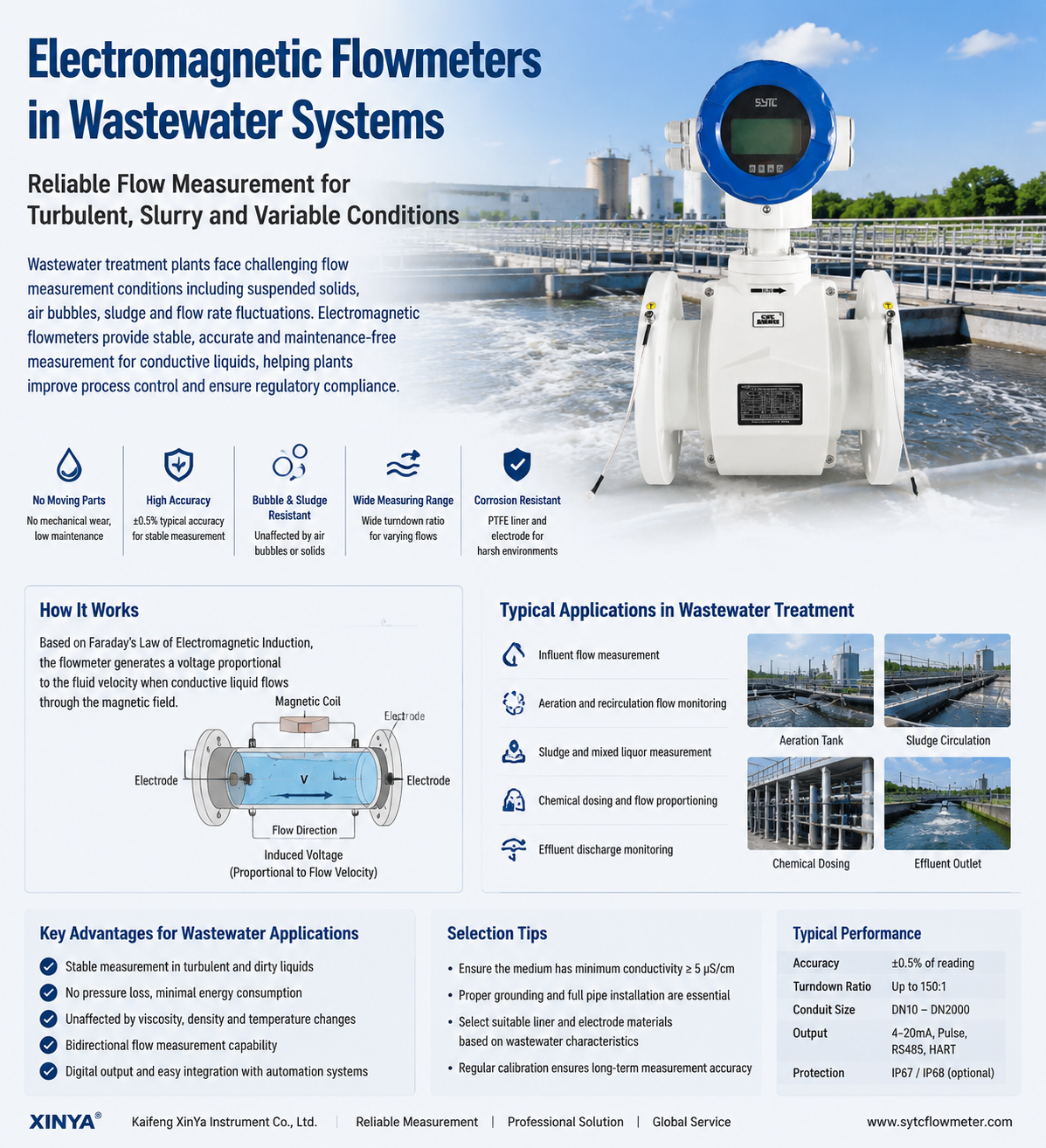
Multi-protocol communication support enables seamless integration. Systems offering RS485, RS232, HART, GPRS, Bluetooth, and WiFi connectivity can interface with virtually any existing infrastructure. MODBUS-RTU protocol compliance ensures compatibility with standard industrial controllers, while RESTful API support via HTTP GET/POST requests and JSON data formatting facilitates integration with modern cloud-based management platforms.
Kaifeng XinYa's Instrument IoT Big Data Platform exemplifies this integrated approach, providing web-based access at network address 124.95.128.250 for centralized device management and real-time analytics. The platform offers 5-second default data refresh rates and 60-point historical curve tracking, delivering operational transparency that enables evidence-based process optimization.
Conclusion: Achieving Reliable Wastewater Flow Measurement
Wastewater flow instability need not compromise measurement reliability when electromagnetic flowmeter systems incorporate appropriate technological capabilities. Advanced signal processing through VFC architecture, specialized materials for abrasion and corrosion resistance, power-independent operation for remote locations, and comprehensive self-diagnostics collectively enable sustained accuracy in the most challenging environments.
As wastewater treatment facilities face increasing regulatory scrutiny and operational efficiency demands, measurement reliability transitions from technical specification to operational imperative. Organizations that prioritize proven electromagnetic flowmeter technology position themselves to optimize resource utilization, maintain compliance, and achieve the operational transparency that modern wastewater management requires.
https://www.sytcflowmeter.com/
Kaifeng Xinya Instrument Co., Ltd.
