What equipment is used for grinding fertilizer pellets?
The fertilizer coating material is used in the production of slow-release and controlled-release fertilizers to coat the surface of particles, forming a relatively uniform film layer that regulates the release rate of nutrients. The coating material can be resins, polymers, sulfur, paraffin, oils, modified starch, cellulose derivatives, etc. The slurry may also contain fillers, pigments, and additives. The purpose of grinding is to disperse the coating material and fillers, reduce the particle size to the micrometer level, and ensure smooth spraying, uniform film layer, and stable release curve. When the particle size is too coarse, the nozzle is prone to clogging, the surface of the film layer is rough, the adhesion and flexibility decrease, and the release period fluctuates. Generally, the coating material is ground to the micrometer level, and the D50 can fall within a range of a few micrometers to several micrometers depending on the material type and coating thickness.
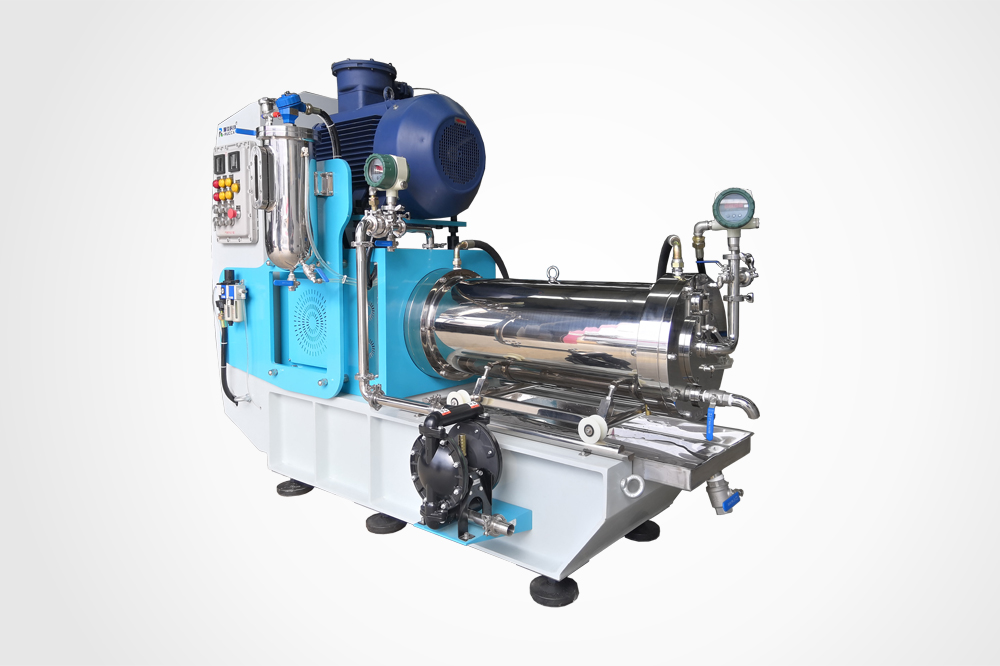
In terms of equipment selection, the RUCCA DF-High efficiency disk horizontal bead mill is recommended. This series adopts a horizontal rod-pin structure, where the rotor and rod pin form shear, impact, and friction in the grinding chamber, suitable for medium and high-viscosity, high-solid-content slurries. The grinding medium can be zirconium oxide beads, and the specification can be determined based on the initial particle size and target fineness. The flow components can be selected from wear-resistant ceramics, polyurethane, stainless steel, etc., to reduce wear and metal pollution. The bead separation structure helps reduce blockage, and the pipelines, pumps, and valves should be adapted to the flow of high-solid-content materials. The cooling system is adjusted based on flow rate, linear speed, and grinding cycles to help control temperature rise.
The fertilizer coating system usually has a high solid content, high viscosity, and poor fluidity. The equipment needs to pay attention to torque, pumping capacity, and wear resistance. Sulfur, talc, calcium carbonate, titanium dioxide, etc., are materials with strong wear resistance. During long-term operation, the cavity, rotor, separation structure, and pipelines need to be monitored for lifespan. Temperature control is also very important. The coating material is sensitive to temperature, and when the temperature is too high, it may form a crust, cross-link, degrade, or volatilize, affecting film formation and storage. Therefore, the cooling water temperature, flow rate, material residence time, and grinding energy should be set together.
The Inline dispersing system-low viscosity IDS can be combined for pre-dispersion to improve grinding efficiency. This system can dust-free powder suction, instantaneous wetting, allowing the powder to be well dispersed before entering the sanding mill, reducing agglomeration and bubbles. After pre-dispersion is done, the number of subsequent grinding cycles can be reduced by 30%-50%, helping to reduce energy consumption, medium wear, and temperature rise, and also making the fineness more stable between batches. For lightweight or sheet materials, online dispersion can also reduce structural damage caused by excessive shearing.
The specific configuration needs to be determined based on the type of coating material, solid content, viscosity, initial particle size, target fineness, production capacity target, and workshop conditions. For water-based systems, attention should be paid to anti-corrosion, rust prevention, and cleaning; for systems containing combustible solvents, explosion-proof motors, electrical systems, ventilation, and static grounding should be evaluated. Seals should be selected based on the continuous phase from water-resistant or solvent-resistant materials. During production changes, the cleaning process should also be considered to reduce the impact of residues on the next batch.
It is recommended to send samples for testing, and RUCCA will help you determine the appropriate solution. Through small-scale or pilot tests, the model of the sanding mill, medium specification, filling rate, linear speed, flow rate, number of series, and temperature control can be tested. The testing items include particle size distribution, fineness, viscosity, solid content, storage stability, spraying effect, film layer uniformity, and slow-release performance. Based on the measured data, the production model can be scaled up, reducing the time for on-site adjustment. If you have specific coating materials and production capacity requirements, you can send samples for testing to RUCCA. Technical personnel can recommend the configuration based on the material characteristics.
www.ruccagroup.net
RUCCA
