10V Cordless Crimping Tools Explained: Power, Precision, and Portability
In electrical installation and maintenance, “compact” doesn’t mean “simple.” Compact jobs are often the most demanding: tight panels, awkward angles, limited lighting, and little room for error. In those conditions, a cordless crimping tool needs to deliver three things at once—usable power, repeatable precision, and true portability—without becoming bulky or tiring to handle.
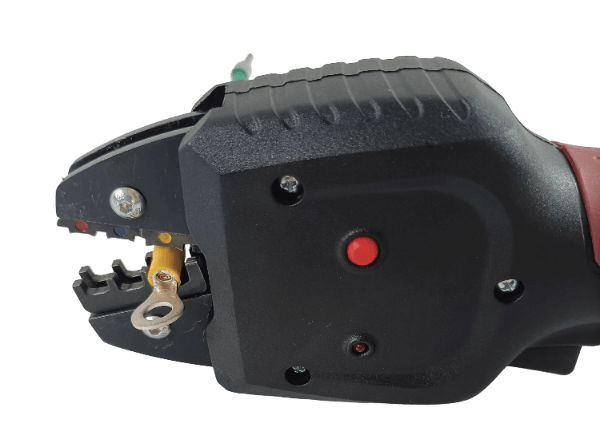
That’s the logic behind the B10EP50 platform. It’s a compact crimping tool designed around a 10.8V 2.0Ah battery, with interchangeable dies, plus jobsite-friendly indicators like white LED lighting for dark conditions and a red LED for power shortage, and an operating range of -10°C to +40°C.
Below is a practical explanation of what “10V cordless crimping tools” really mean on the job—and how to use this category of tool to get consistent, professional crimps.
1) “Power” in crimping is about controlled force, not size
A crimp is only as good as the mechanical deformation you achieve—consistent compression that creates a stable electrical and mechanical connection. On paper, you’ll see force listed as a headline spec. For B10EP50, the maximum force is 15 kN, with a stated section range of 0.25–50 mm² (depending on dies and application).
Here’s what that means in real terms:
-
You need enough force to form the connector properly across the intended conductor size range.
-
You need stable output so different operators (or the same operator on a long shift) can get repeatable results.
-
You need the right die because force alone doesn’t guarantee a correct crimp geometry.
A 10V-class tool becomes valuable when it can deliver enough force for common termination work while staying small enough to use properly in confined spaces—where alignment and positioning matter just as much as force.
2) Precision starts with die choice and positioning
Crimp quality is rarely ruined by one dramatic mistake. More often it’s small, repeatable issues:
-
The terminal isn’t seated squarely in the die
-
The conductor isn’t fully inserted
-
The tool is slightly angled because space is tight
-
Visibility is poor, so alignment becomes guesswork
This is why interchangeable dies are a big deal for a compact tool. With the B10EP50, dies are interchangeable, which helps you standardize the crimp profile around the connector family you actually use.
Practical tip: Treat dies as controlled process tooling. Label them, store them in the same case, and avoid mixing dies across connector systems unless the connector manufacturer and your internal process explicitly approve it.
3) Portability is more than “cordless”—it’s workflow
Portability sounds like a convenience until you measure how much time is lost moving work back and forth:
-
Bringing harnesses to a bench just to crimp
-
Re-routing cables because the tool doesn’t fit where the termination is installed
-
Delaying work because power access is limited or the area is crowded
A compact cordless tool lets you crimp at the point of installation, which reduces rework caused by fitment and routing problems. The B10EP50 is positioned as a compact tool “capable of working in tight spaces,” which is exactly where portability becomes a quality driver, not just a comfort feature.
4) Why LEDs matter in real cabinets
If you mostly crimp on a well-lit bench, lighting features feel optional. But many crimps happen inside cabinets, enclosures, behind equipment, or in maintenance areas where lighting is limited.
The B10EP50 includes:
-
White LED lighting for dark conditions
-
Red LED for power shortage
This improves consistency in two ways:
-
Better alignment: You can actually see wire insertion depth and terminal placement before you commit.
-
Fewer “half-starts”: A clear low-power warning reduces interruptions and avoids situations where an operator begins a sequence with an underpowered battery.
These are small details that support repeatable results—especially when teams work across different sites and lighting conditions.
5) Speed helps—but only when the process is stable
The B10EP50 lists a crimping speed under 1.5 seconds and an approximate cycle times ~300 figure (noted as test-based).
Fast cycle time is useful when you have many terminations, but speed only improves productivity when your process is controlled:
-
Correct strip length
-
Correct die for the connector
-
Consistent positioning
-
A quick post-crimp check routine
If those steps aren’t stable, faster crimping just produces defects faster. The goal is a balanced workflow: fast enough to keep pace, controlled enough to avoid rework.
6) A field-friendly crimping checklist that reduces rework
Here’s a simple routine that works well for compact electrical work:
Before crimping
-
Confirm connector family and conductor section
-
Confirm die matches the connector spec
-
Strip to a consistent length (use a strip gauge if your team has one)
During positioning
-
Use the tool’s lighting to verify wire insertion depth
-
Ensure the connector barrel is seated squarely in the die
-
Keep the tool aligned—avoid twisting the cable to “make it fit”
After crimping (fast QC)
-
Visual check: even compression, no obvious skew
-
Tug check: quick pull to confirm mechanical retention
-
Fit check: terminal seats correctly in its housing or mating part
This takes seconds and prevents the worst type of defect—the one discovered after the panel is closed or shipped.
7) Operating temperature is a real constraint (not a brochure line)
Compact electrical work often happens in factories, warehouses, outdoor-adjacent maintenance areas, or seasonal environments. The B10EP50 lists a working range of -10°C to +40°C.
The value here is predictability. When a tool’s operating range matches your site conditions, performance is more consistent, and your standard work instructions remain valid across seasons.
8) What you actually receive (and why that matters for teams)
According to the product listing, the tool is supplied as:
-
Basic tool with a battery
-
Battery charge unit
-
Hexagon socket wrench
-
One crimping die
-
Plastic carrying case
For organizations, this “kit form” is practical. It supports deployment by workstation or by service vehicle, and makes it easier to keep dies and accessories together (which reduces mistakes and downtime).
9) Where Kartrup fits in (engineering + service orientation)
Kartrup is positioned as a small engineering & service-oriented company within the “Components · Methods” business, focused on product marketing and overseas expansion, with two divisions—Components and Methods—covering the design, manufacturing, and supply of components and tools.
In practice, that matters because crimping tools aren’t purchased in isolation. Buyers typically need:
-
Clear product matching to application
-
Repeatable usage guidance for technicians
-
Consistent tool + die setups across teams
A supplier that thinks in systems (tool + dies + field workflow) is often easier to standardize with.
www.kartrupp.com
Kartrup
