Cleaning Labour: The Hidden Cost Nobody Prices In
Published: November 2026 | By shilong Engineering Team
Nobody puts washdown on a quotation. It arrives after the invoice, inside the rota, thirty or forty minutes at a time, twice a day, forever — and across five years it is the largest single line in a meat machine's budget, bigger than the electricity bill and nearly half of true total cost. This guide converts that invisible line into dollars: first the minutes, then the labour cost of cleaning meat equipment per year calculation, then the design feature that shrinks both.
1. The Minutes: Per Shift and Per Day
A tool-free detachable combined unit takes 15–20 minutes per shift to strip, wash, sanitise and reassemble. Asked plainly, how many minutes per day to clean a commercial meat grinder runs like this: one shift per day of operation costs 15–20 minutes on a detachable machine; a two-shift kitchen spends 30–40 minutes a day on the same task. Fixed, enclosed designs — hopper bolted to housing, blade sets that need spanners, gasketed lids — take 30–40 minutes per shift, or double that across two shifts, because every hidden corner needs brushing by hand and every secured part needs a tool.
The fifteen-minute figure decomposes into checkable parts: roughly five minutes to strip the head — blade, comb, plate and auger out without tools — five to eight minutes to wash the open bowl worktable and parts at the sink, and the balance to sanitise and reassemble. That is why how many minutes per day to clean a commercial meat grinder depends less on the operator than on the housing: if your current machine cannot hit those components, the minutes are hiding in one of them, and section 3 names which.
2. The Calculation: Minutes × Days × Wage
The formula is minutes per shift × shifts × operating days × loaded wage ÷ 60. Run the labour cost of cleaning meat equipment per year calculation for a two-shift kitchen on a 250-day calendar — that is 125–167 hours a year on a detachable unit — and the wage level moves the answer more than anything else:
• At a $7 loaded wage (entry-level markets): $875–1,170 per year, per machine.
• At the BLS food-prep median of $17.25/hour (US, 2026): roughly $2,150–2,880 per year.
• At the true loaded cost of $24 — the 1.25–1.4× multiplier that payroll taxes, insurance and benefits add to every W-2 kitchen worker — $3,000–4,000 per year.
A fixed-design machine cleans at 30–40 minutes per shift, so the same kitchen spends 250–334 hours a year — at the loaded $24 rate, $6,000–8,000. The gap between the two designs is therefore $3,000–4,000 per machine per year, and a ten-store chain running one machine per store is looking at $30,000–40,000 annually in pure washdown differential. That is the hidden cost, priced in.
3. Tool-Free Disassembly: What the Five Minutes Actually Buys
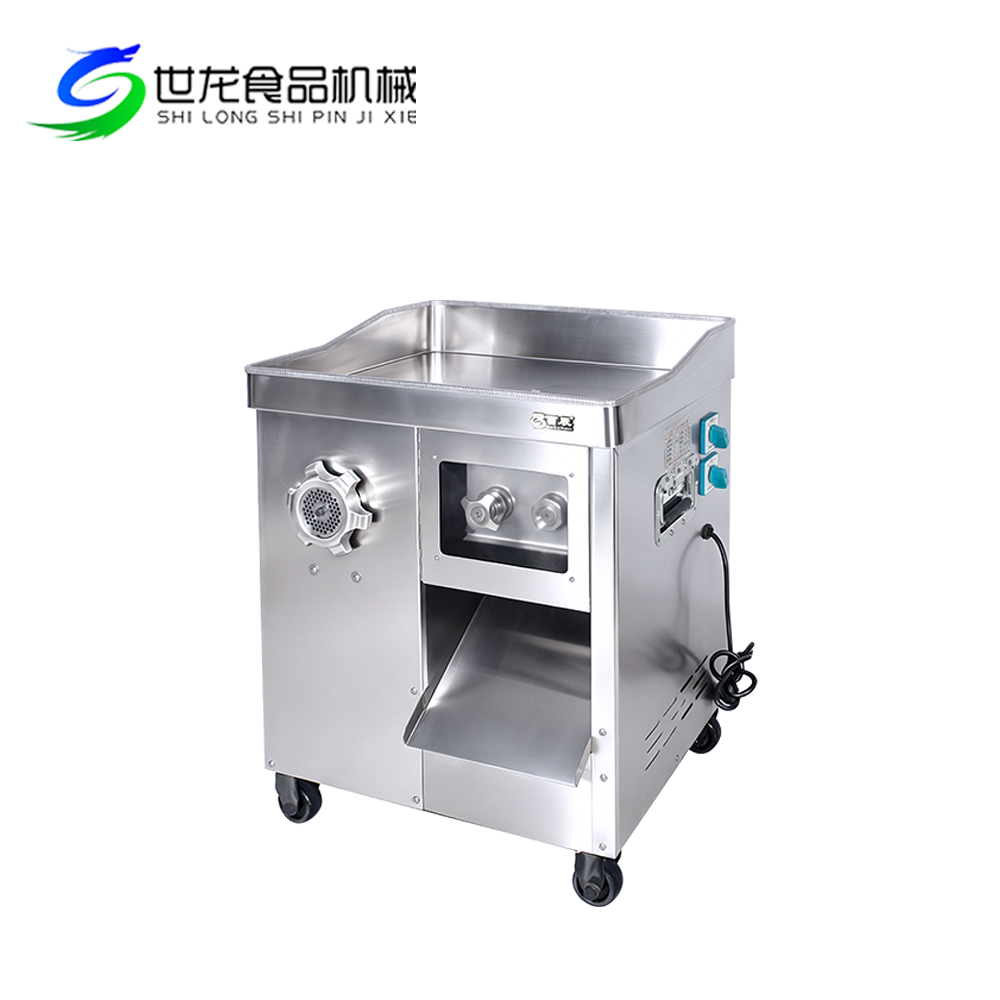
The tool free disassembly meat grinder cutter cleaning in five minutes claim is real — but scope it precisely: the strip-down takes five minutes, the full washdown takes fifteen to twenty. On a detachable combined unit such as the shilong JLS-TZ-3, the cutting and grinding heads come apart in a fixed sequence with no spanner: the locking nut unscrews by hand, the plate, cross knife, comb and auger lift off one by one, and the open bowl worktable presents every food-contact surface to the spray at once. No gasket to hunt for, no bolt threads to keep clean, no second person holding the housing. The five-minute strip is the part that repeats twice a day, so its compounding is what section 2 priced.
Two practical corollaries for QA teams. First, parts that come off without tools go into the sink as individual items, where brush contact reaches every surface — enclosed housings force long-handled brushing through a narrow throat, and the throat's shoulder is exactly where residue survives a swab. Second, a five-minute strip makes mid-shift product changeovers realistic: swap the comb for the next SKU, rinse, swab, restart, in the time a fixed machine spends finding its spanner.
4. The Multipliers Nobody Counts
The rota minutes understate the true account by three multipliers. Turnover: replacing a kitchen worker costs 30–50% of annual wage once re-hiring and ramp-up are counted, and nobody stays excited about a job whose main task is a forty-minute fight with a bolted-on hopper. Swab failures: a failed ATP verification forces a full re-clean, so every missed corner on a fixed design is a paid-for second washdown waiting to happen. And short staffing: when the shift runs a person down, washdown is the first task squeezed — which is how a design with hidden corners turns into a hygiene incident rather than a labour line. Zhenjiang Shilong Food Machinery Co., Ltd. builds the whole line on the detachable principle for exactly this reason: a machine that cleans in fifteen visible minutes — on the dual-motor stainless steel combined unit as much as on the entry models — is easier to staff, easier to verify and harder to shortcut, and every shift it saves is another line in the labour cost of cleaning meat equipment per year calculation that your P&L never has to pay.
✅ Bottom line: Washdown is 30–40 minutes a day on a detachable combined unit and double that on a fixed design — a $3,000–4,000 annual gap per machine at loaded US wages. Tool free disassembly meat grinder cutter cleaning in five minutes is the design feature behind that gap, it never appears on a quote, so it has to be priced into the comparison yourself.
Want the calculation run on your own rota? Send shilong your shift count, operating days and loaded wage — the factory returns the washdown minutes and annual labour figure for the matching detachable configuration, alongside factory-direct pricing and a spare-parts package quote.
FAQ
Q: How many minutes per day to clean a commercial meat grinder and cutter combo in a small single-shift kitchen?
A: 30–40 minutes a day on a tool-free detachable unit — 15–20 minutes per shift to strip, wash, sanitise and reassemble. Fixed, enclosed designs need 30–40 minutes per shift, so the same kitchen spends 60–80 minutes a day on washdown.
Q: What is the labour cost of cleaning meat equipment per year at US wages?
A: For a two-shift kitchen on 250 operating days, a detachable machine costs $875–1,170 a year at a $7 loaded wage, about $2,150–2,880 at the BLS food-prep median of $17.25, and $3,000–4,000 once the 1.25–1.4× loading multiplier is applied. Fixed designs cost roughly double.
Q: Does the tool free disassembly meat grinder cutter cleaning in five minutes claim hold up?
A: The five minutes covers the strip-down — locking nut, plate, cross knife, comb and auger off by hand on machines like the JLS-TZ-3. The full washdown, including sanitising and reassembly, is 15–20 minutes per shift. Beware any listing that promises a five-minute total clean.
www.slfoodmach.com
Zhenjiang Shilong Food Machinery Co., Ltd.
