How Many Strips Fit in a 1,050 mm Mother Coil? (2026 Yield Calculation)
Published: November 2026 | By KoreLamin Engineering Team
A 1,050 mm mother coil gives you roughly 1,035 mm of usable width, not 1,050 mm. That 15 mm gap is the edge trim that removes the work-hardened zone, and it is the number that decides how many strips you actually receive. The reliable way to settle it is an electrical steel master coil multi width slitting yield calculation that subtracts trim and knife kerf before you divide by strip width. KoreLamin has run its own slitting line in Jiangyin since 2003, so the figures below come from real coil planning at a China factory that stamps EI, three-phase and custom laminations in-house instead of buying slit strip from a trader.
1. How many strips actually fit in a 1,050 mm mother coil?
Five 205 mm strips, or a 750 + 280 mm mixed-width pair — and the nesting choice moves yield by roughly 27 points on an identical coil. Start with usable width, then treat every knife gap as lost material. A 1050 mm mother coil mixed width slitting feasibility example is the clearest way to see why buyers who order one width per coil pay for scrap they will never stamp.
• Usable width: 1,050 mm − 2 × 7.5 mm edge trim = 1,035 mm. Mills report local magnetic degradation 5–10 mm in from a sheared edge, so trimming is a quality step, not waste.
• Knife kerf: 1–2 mm per slit; plan on 1.5 mm. Four slits to make five strips remove 6 mm of coil width.
• Single-width case: 5 × 205 mm = 1,025 mm of strip plus 6 mm kerf = 1,031 mm, leaving 4 mm. Yield on coil mass = 1,025 / 1,050 = 97.6%.
• Mixed-width case: 750 + 280 = 1,030 mm plus one 1.5 mm kerf = 1,031.5 mm, leaving 3.5 mm. Yield = 98.1%.
• Worst case: one 750 mm strip with the remaining 285 mm unassigned. Yield drops to 71.4% — same coil, one bad nesting decision.
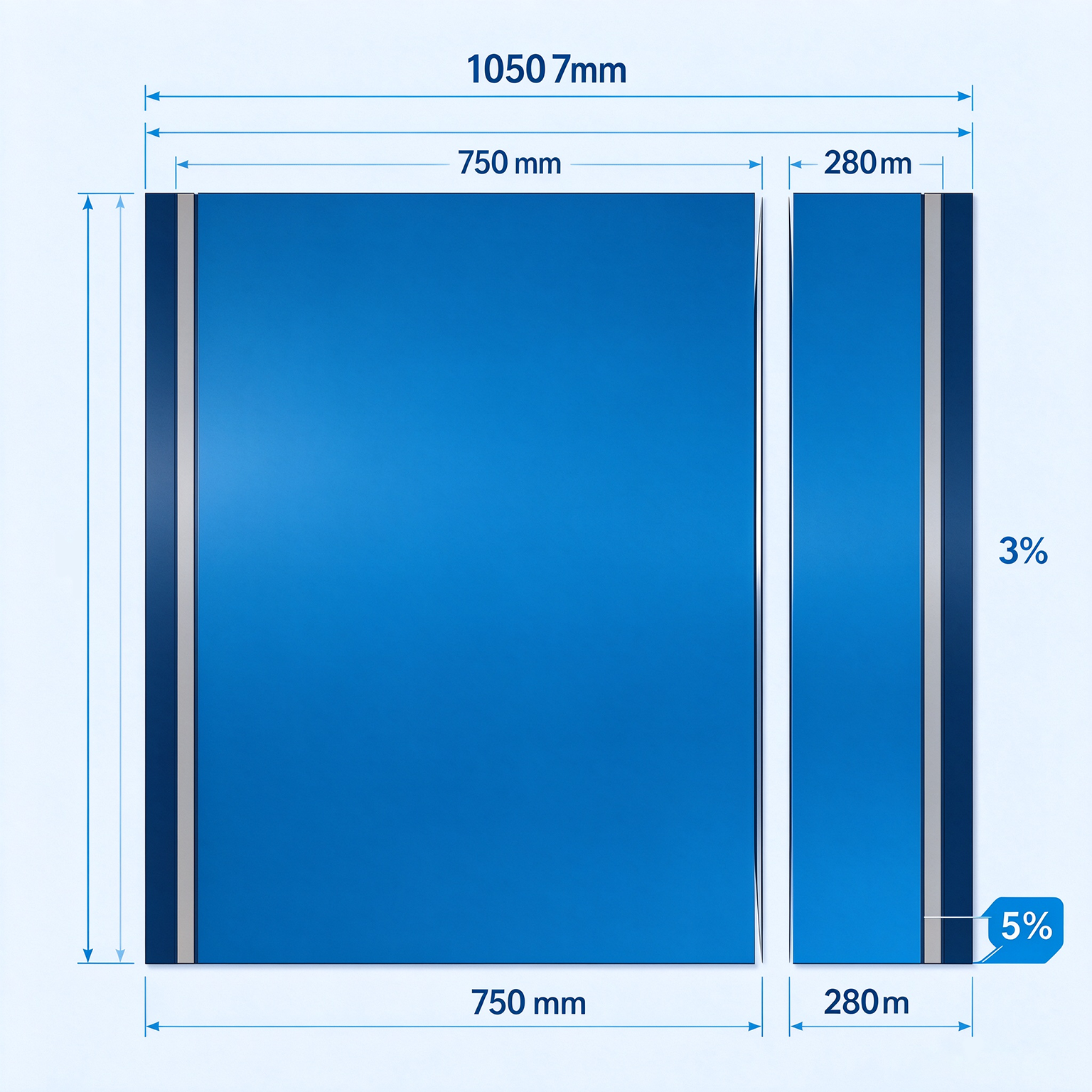
Mixed-width nesting only works when both strips feed the same die program or the same production order. That is why every 1050 mm mother coil mixed width slitting feasibility example must name the die each strip is assigned to, not just its width. KoreLamin plans coils against the stamping schedule rather than against the slitter's convenience, which is the difference between a 98% yield on paper and a 98% yield in the warehouse. Standard mother coils run 800–1,250 mm wide, weigh 3–8 tonnes and come on a 508 mm ID; slit widths normally span 20–1,000 mm.
Run the electrical steel master coil multi width slitting yield calculation against your own strip list before accepting a per-tonne quote. If your layout leaves a 60 mm offcut on every coil, ask the supplier to pair it with a second strip width from the same OEM program — or move to a narrower mother coil that leaves less dead width. Our sheared silicon steel strip for cores is slit and stamped under one roof, so yield decisions and die decisions are made by the same team.
✅ Bottom line: Trim and kerf, not strip width alone, set the strip count, and a paired mixed-width layout recovers more than 20 yield points on the same coil.
2. Who owns the leftover scrap when the strip is priced per tonne?
Under per-tonne pricing the buyer owns it, including edge trim, kerf and any unassigned offcut. The invoice covers the whole coil, so a 71% yield costs the same per tonne as a 98% yield — the difference lands in your core cost, not the supplier's margin. Knowing how to calculate leftover scrap from 1050 mm mother coil is therefore a commercial skill, not just a process one.
• Per tonne: the buyer carries yield risk. Typical slit-coil MOQ is around 5 tonnes; cut-to-length lots can start near 500 kg.
• Per piece: the stamper absorbs yield risk and builds it into the unit price. You pay a premium, but the number is predictable.
• Processing fees: slitting, stamping and cut-to-length typically add $200–500 per tonne; annealing and coating add $150–400 per tonne. A yield gain is worth more when these fees are already in the quote.
• Logistics: a 20GP container loads 25–27 tonnes, so one poorly nested coil can quietly displace a full pallet of usable strip.
The practical fix is to write how to calculate leftover scrap from 1050 mm mother coil into the commercial terms: state the agreed trim allowance, the kerf allowance, the minimum strip count per coil, and who takes title to offcuts above an agreed percentage. Jiangyin KoreLamin Electric Appliance Co., Ltd. has operated its own slitting line since 2003 and ships about 7,500 tonnes of finished laminations a year from a 5,000 m² workshop, supplying appliance and industrial core programs that include Midea, Gree and Mitsubishi Heavy Industries. Wholesale slit strip and bulk stamped cores are both planned from the same coil, so the offcut question is answered before the quote is issued.
Lead time matters here too. Standard slitting runs about 15 days, and a sample can be turned around in roughly a week; a custom non-standard shape that needs a new die typically takes 25–30 days. If you are planning a mixed-width coil, confirm the second strip's die is available before the coil is loaded — otherwise the 98% yield becomes a 71% yield with a very good excuse attached.
✅ Bottom line: Per-tonne pricing puts the offcut on the buyer, so leftover ownership and minimum strip count belong in the purchase order.
Frequently asked questions
Q: How do I run an electrical steel master coil multi width slitting yield calculation for my own strip widths?
A: Subtract 2 × edge trim (5–10 mm per side) from the coil width, add 1.5 mm kerf for each slit you need, then divide the remainder by your strip widths and check that the total fits. Express the result as strip width used ÷ original coil width. Ask a China manufacturer to show the layout drawing with the die assignment for every strip before you approve it.
Q: Is a 1050 mm mother coil mixed width slitting feasibility example valid for coils other than 1,050 mm?
A: Yes — the formula is identical for any 800–1,250 mm coil. The constraint that does not change is that the sum of strip widths plus every knife kerf must stay inside the trimmed width. What changes is the leftover band, so re-run the numbers whenever the mill changes coil width or you add a strip size.
Q: Can I order custom slit widths below the 5-tonne MOQ?
A: For a trial, KoreLamin can slit a short sample lot from stock and ship it in about a week; for production, coil planning works best at 5 tonnes and above. Send your strip widths and the die they feed, and the bulk quotation will include the yield figure rather than just a price per tonne.
Get a free coil-yield review. Send your strip list, coil width and monthly tonnage to Jiangyin KoreLamin Electric Appliance Co., Ltd. and the KoreLamin engineering team will return a nesting layout with a calculated yield, an offcut clause for your purchase order and a factory direct quote. OEM and ODM programs are quoted from drawings, with no distributor margin between you and the slitting line. Request your coil plan here, or read about our Jiangyin plant.
www.korelamin.com
Jiangyin KoreLamin Electric Appliance Co., Ltd.
