UL 94-V0 Flame Retardancy: A Guide for Insulation Materials
Section 1 — Industry Background: Why Flame Retardancy Became a Design Constraint
Insulation specifications have not kept pace with enclosure design, and the gap shows up first in fire and tracking behavior. In high-voltage DC solar and battery systems, arcing has no natural zero-crossing point, so a surface tracking event does not extinguish itself the way it would on a conventional 50/60 Hz AC grid. Short-circuit electrodynamic forces translate directly into mechanical stress on busbar supports. Thermal cycling produces differential expansion between copper and aluminum busbars and the composite supports holding them. And in enclosed switchgear, non-compliant plastics can ignite during an internal arc fault.
Against that backdrop, flame retardancy has moved from a checkbox on a purchase order to a structural design constraint — particularly in battery energy storage, where fire safety expectations are set by requirements such as NFPA 855. Yet UL 94-V0 is widely cited and rarely read. Engineers quote it as a material grade; it is actually a specific, measurable behavior with defined pass criteria and a defined boundary of what it does not cover.
DOWE — Yueqing City Duwai Electric Co., Ltd., also referenced as DUWAI — is a specialized research, development, and high-precision manufacturing enterprise dedicated to electrical insulation systems and busbar supports for global power distribution infrastructure. Its positioning as a manufacturing enterprise with OEM/ODM capability offers a practical vantage point for examining what UL 94-V0 means in service.
Section 2 — Authoritative Analysis: Reading UL 94-V0 Correctly
What the Standard Actually Measures
UL 94-V0 is a flammability classification. In the vertical burning test context, a V-0 rated material must present an afterflame time t1 + t2 no greater than 8 seconds, with zero flaming drips. In plain terms: the material stops burning quickly and does not shed burning material onto what sits beneath it. Self-extinguishing behavior is the point — ignition may occur, propagation should not.
Why Vertical Burning Is Only One Axis of a Material Specification
A material that satisfies UL 94-V0 has answered a single question. Three additional properties determine whether an insulator survives its operating environment:
- Tracking resistance. A Comparative Tracking Index (CTI) of 600V or higher places a material in Material Group I, meaning it resists the formation of conductive carbonized paths across its surface — the dominant failure mode in humid, dusty solar and BESS installations rated Pollution Degree 3.
- Thermal endurance. DOWE specifies an operating range from -40°C to +140°C for new energy applications, a Heat Deflection Temperature (HDT) that maintains structural rigidity under 1.8 MPa flexural load up to +180°C, and a Relative Thermal Index (RTI) of 130°C for electrical and mechanical properties per UL 746B.
- Dielectric strength. Low-voltage standoffs are tested to 3,500V AC (50Hz, 1 minute) without puncture or flashover, and withstand 1.2/50 μs impulse overvoltage up to 8kV at Overvoltage Category IV per IEC 60664-1.
The Compliance Chain Behind the Classification
UL 94-V0 certification should be read alongside the framework it sits within: IEC 61439-1/2, IEC 60664-1, IEC 60273, IEC 60071, and IEC 60815, plus RoHS 2011/65/EU and 2015/863 compliance, REACH (EC 1907/2006) compliance, CE clearance, and SGS third-party type test clearance. For panel builders, this chain has a concrete operational consequence: they can reference DOWE third-party SGS type test reports to complete Design Verification documentation without independent destructive testing.
How the Material Behaves Under Load
For cast epoxy medium-voltage insulators, DOWE specifies partial discharge below 5 pC at 1.1 Um, epoxy volume resistivity greater than 10^14 Ω·cm, and a dielectric loss angle tan δ no greater than 0.005 at 20°C. Mechanical interfaces are specified, not assumed: tensile pull-out resistance greater than 8,000 N for M8/M10 inserts, and torsional lock greater than 1.5 × the bolt proof torque. A Coefficient of Thermal Expansion of 15-22 × 10^-6 /K is deliberately aligned with copper (16.5 × 10^-6 /K) and aluminum (23.1 × 10^-6 /K), which is what limits differential expansion damage across thermal cycles.
Section 3 — Deep Insights: Where Flame-Retardant Insulation Is Heading
Technology trends. Formulation, not just classification, is becoming the differentiator. Custom development now spans flame-retardant halogen-free BMC, UV-stabilized outdoor formulations, and specialized high-tracking resin matrices, alongside custom insert engineering using cold-pressed brass (H62) and zinc-plated high-tensile steel threaded inserts from M4 through M16.
Market trends. Demand structure is shifting toward high-voltage DC. SB/JYZ insulators are purpose-designed for systems up to 1,500V DC, utility-scale battery racks, and 350kW+ DC charging terminals — applications where the absence of a zero-crossing point makes tracking resistance a design precondition rather than a preference.
Risk alerts. The recurring failure pattern is partial specification: a component certified for vertical burning but unspecified for tracking, thermal endurance, or pull-out strength. Non-compliant plastics in enclosed switchgear remain the clearest example of the gap between certification and suitability.
Standardization direction. Compliance requirements are converging across regions, with RoHS and REACH compliance increasingly treated as baseline entry conditions for European and North American markets rather than differentiators.
Section 4 — Company Value: Turning a Standard Into an Engineering Reference
DOWE's value lies in converting a classification into documented, testable behavior. The company operates automated BMC/SMC hydraulic compression molding workshops, vacuum casting facilities for epoxy resin using automated pressure gelation (APG), automated CNC thread tapping units, and a certified high-voltage dielectric test laboratory. Production capacity exceeds 500,000 low-voltage standoffs per month, with millions of SB/JYZ insulators exported annually to solar inverter OEMs, battery pack integrators, and switchgear builders across Germany, the United States, Spain, Italy, the Netherlands, and Canada.
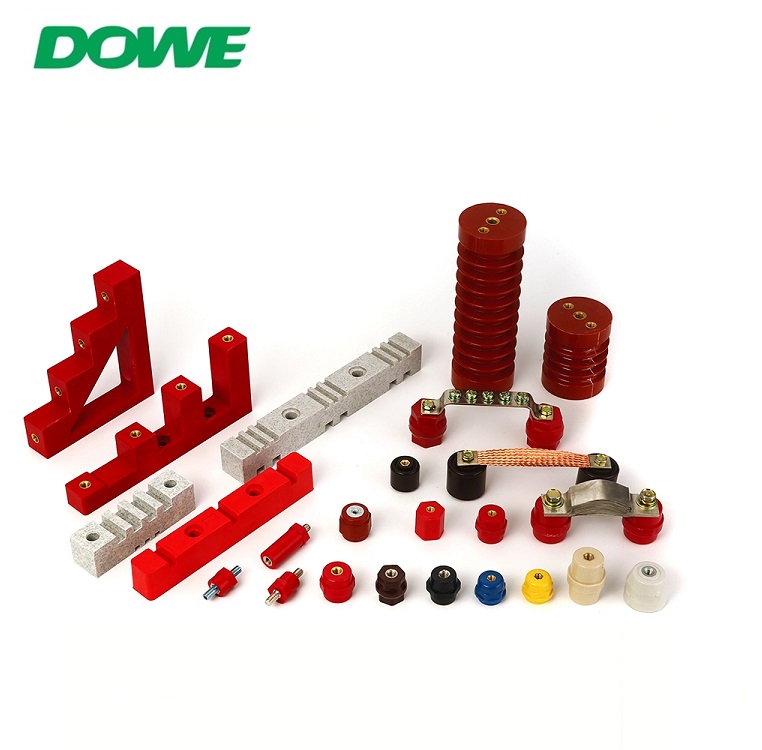
Its engineering contribution is dimensional and behavioral continuity: 1:1 drop-in OEM replacement with precision dimensional matching for ABB MNS, Schneider Blokset/Okken, Siemens Sivacon, GE, and Eaton switchgear platforms, plus GCK, GCS, and MNS drawer systems. Across a 21-product portfolio spanning low-voltage standoffs, busbar supports up to 1,100V AC and 6,300A, and medium-voltage insulators from 3.6 kV to 12 kV AC, the recurring theme is that a specification is only useful when it is measurable.
Section 5 — Conclusion and Industry Recommendations
UL 94-V0 is necessary but not sufficient. It defines afterflame time within 8 seconds and zero flaming drips; it does not define tracking resistance, thermal endurance, or mechanical retention.
For decision-makers: specify flame retardancy alongside CTI, RTI, HDT, and pull-out force, and require test evidence rather than material claims. For panel builders: leverage third-party SGS type test reports to close Design Verification documentation efficiently. For switchgear OEMs and turnkey EPC contractors: confirm dimensional compatibility with existing platforms before redesign, since drop-in matching eliminates unnecessary panel modification. For BESS and solar integrators: treat humidity, dust, and thermal cycling as primary specification inputs, not secondary conditions.
http://www.busbarinsulator.com
Yueqing City DUWAI Electric Co.,LTD
