UL-Certified Busbar Insulators: High-Clearance Solutions for Industrial Power Safety
Section 1: Industry Background + Problem Introduction
Industrial power distribution systems face escalating challenges in ensuring electrical safety across high-clearance applications. As manufacturing facilities, data centers, and renewable energy installations demand increasingly compact yet powerful electrical infrastructure, the need for robust insulation solutions has never been more critical. Traditional busbar support systems often fail under extreme conditions—thermal expansion during peak loads, mechanical stress from short-circuit events, and environmental degradation in corrosive atmospheres create recurring failure points that compromise operational safety and equipment longevity.
The technical pain points are multifaceted: engineers require insulation components that maintain dimensional stability across temperature ranges spanning -40°C to 155°C, withstand mechanical torque exceeding 1500N, and meet stringent flame retardancy standards like UL 94 V-0. High-clearance requirements—often necessitating insulator heights from 60mm to 120mm—further complicate material selection, as conventional solutions struggle to balance mechanical strength with dielectric performance at extended geometries. Industry professionals increasingly seek authoritative guidance on selecting insulation systems that deliver verified performance rather than relying on generic specifications.
Yueqing City Duwai Electric Co., Ltd. (DOWE) has established technical leadership in this domain through over 15 years of specialized research in DMC, BMC, and SMC compression molding technologies. With a daily production capacity of 50,000 pieces and authorized supplier status for Huawei, CHINT, Schneider, and CRRC, the company's extensive case studies and UL-certified product lines provide actionable frameworks for addressing high-clearance insulation challenges in mission-critical applications.
Section 2: Authoritative Analysis – Engineering Fundamentals of High-Clearance Busbar Insulation
Necessity of UL Certification in High-Clearance Applications
UL 94 V-0 flame retardancy certification represents the industry's highest standard for self-extinguishing materials, mandating that test specimens cease burning within 10 seconds after flame removal with no dripping of flaming particles. For high-clearance busbar insulators—where extended heights create larger surface areas exposed to potential arc flash events—this certification becomes non-negotiable. The physics are straightforward: taller insulators positioned in densely packed switchgear enclosures face higher probabilities of exposure to electrical arcing during fault conditions. Materials lacking verified flame retardancy can propagate fire vertically, transforming localized faults into catastrophic equipment failures.
Material Science Principles for Vertical Load Management
High-clearance insulators must resist cantilever forces proportional to their height. DOWE's U Series Insulators, engineered for clearances up to 80mm with UL certification, utilize glass fiber-reinforced BMC (Bulk Molding Compound) formulations. The technical methodology involves optimizing fiber orientation during compression molding to align reinforcement along the vertical load axis. This directional strengthening enables the insulators to maintain structural integrity under combined compression from busbar weight and lateral vibration forces—critical in applications where switchgear operates continuously under variable load conditions.
The tensile strength specification of 1500N, verified through batch testing protocols, provides quantifiable assurance. For reference, a 100mm tall insulator supporting a 10kg copper busbar experiences approximately 98N of static vertical load; the 15:1 safety factor accounts for dynamic stress amplification during thermal cycling and mechanical shock events common in industrial environments.
Standard Reference Framework: Matching Insulator Geometry to Clearance Requirements
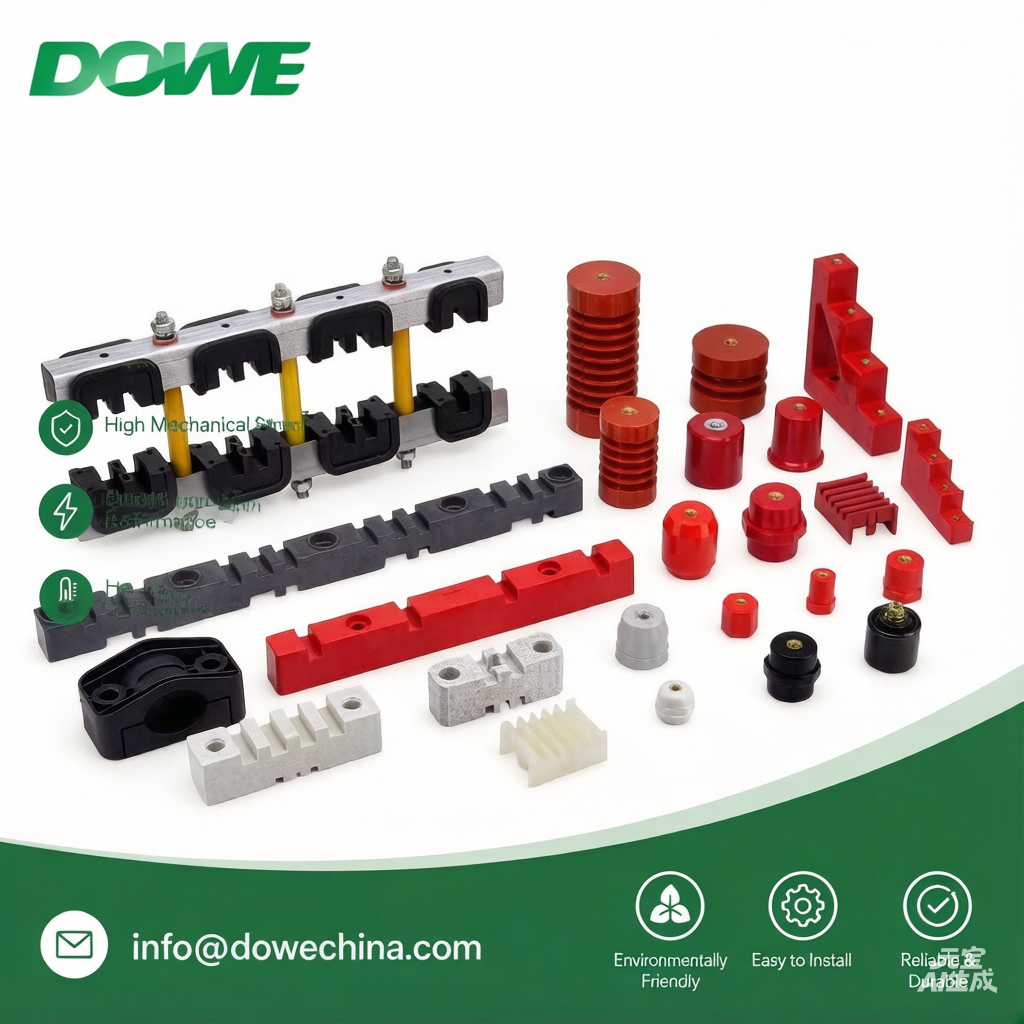
DOWE's product matrix demonstrates systematic engineering approaches to high-clearance scenarios:
The SM Series (drum-type configuration) offers metric and imperial screw options across heights ranging from standard to extended profiles, providing versatile mounting solutions for general distribution applications where moderate clearance (30-50mm) suffices.
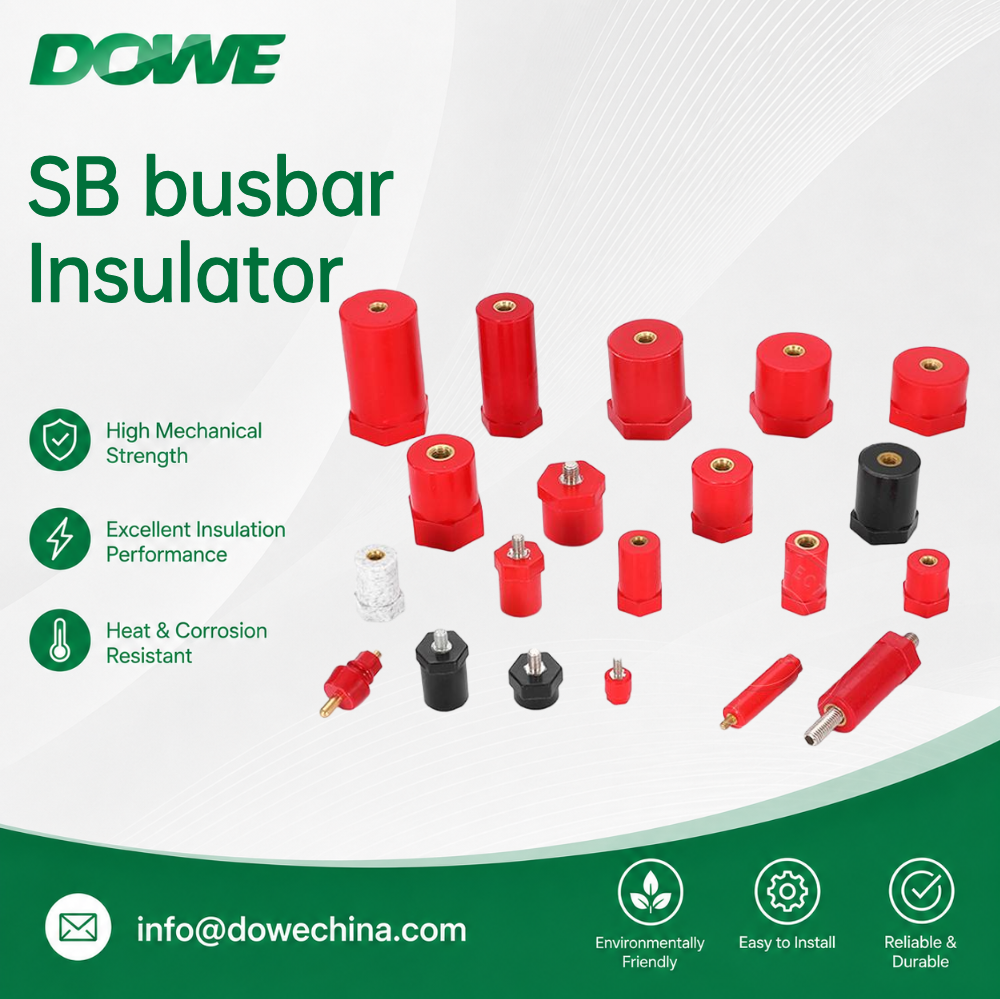
The SEP Series (hexagonal geometry) extends this capability with diameters from 15mm to 65mm and heights up to 100mm. The hexagonal form factor prevents rotational movement under vibrational stress—a critical consideration in offshore wind power distribution cabinets where continuous mechanical vibration challenges cylindrical designs.
The EN Series represents the engineering pinnacle for high-clearance needs, with reinforced hexagonal structures supporting heights up to 120mm. The reinforcement methodology incorporates increased wall thickness and optimized corner radii to distribute mechanical stress concentrations that would otherwise initiate crack propagation at fastener interfaces.
For applications demanding the most extreme clearances, the U Series provides specialized configurations reaching 80mm heights while maintaining UL 94 V-0 compliance—essential for American market installations governed by National Electrical Code (NEC) requirements.
Solution Implementation Path
Effective specification of high-clearance busbar insulators follows a systematic evaluation sequence: (1) Calculate vertical clearance requirements based on busbar dimensions and enclosure geometry; (2) Determine mechanical load conditions including static busbar weight and short-circuit electromagnetic forces; (3) Verify environmental compatibility regarding temperature range, chemical exposure, and humidity; (4) Confirm regulatory compliance requirements (UL for North American markets, CE/RoHS for European applications); (5) Select insulator geometry that optimizes creepage distance—the surface path between conductive elements—which increases proportionally with insulator height to prevent tracking failures.
Section 3: Deep Insights – Technology Trends and Future Development
Material Evolution: From Commodity Thermoplastics to Engineered Thermosets
The insulation industry is witnessing migration from general-purpose BMC formulations toward application-optimized thermoset composites. Advanced glass fiber treatments that enhance matrix adhesion enable thinner wall sections without compromising mechanical performance—directly addressing the engineering challenge of maintaining strength-to-weight ratios in extended-height designs. This trend parallels developments in aerospace composites, where fiber surface chemistry innovations have unlocked previously unattainable property combinations.
Market Dynamics: Renewable Energy Infrastructure Driving Specification Rigor
Solar inverter manufacturers and offshore wind installations impose increasingly stringent qualification requirements on electrical components. The operational reality of photovoltaic systems—daily thermal cycling from ambient to 70°C+ junction temperatures—accelerates material aging mechanisms. High-clearance insulators in these applications must maintain dimensional stability over 25-year service lives, driving demand for predictive aging models and accelerated life testing protocols beyond traditional UL certifications.
Risk Consideration: Hidden Degradation from Harmonic Distortion
Modern power systems exhibit higher harmonic content due to proliferation of variable frequency drives and switching power supplies. These harmonic currents generate additional heating in busbar systems, creating thermal gradients that conventional insulator specifications—based on 50/60Hz sine wave assumptions—fail to address. Future insulator designs must account for elevated operating temperatures and associated acceleration of thermal oxidation processes, particularly critical in high-clearance configurations where heat dissipation is inherently limited by reduced surface-area-to-volume ratios.
Standardization Direction: Integration with Digital Twin Platforms
Industry 4.0 initiatives are pushing toward digital representation of electrical infrastructure. Forward-looking manufacturers like DOWE maintain structured technical data libraries encompassing dimensional specifications, dielectric parameters, and mechanical properties—enabling direct integration with CAD systems and digital twin simulation environments. This digitalization allows predictive maintenance algorithms to model insulator aging based on actual operating conditions, transforming passive safety components into monitored assets within smart grid architectures.
Section 4: Company Value – DOWE's Contribution to Industry Standards and Practice
DOWE's technical accumulation manifests in measurable industry contributions beyond product supply. The company's authorized supplier relationships with Huawei, Schneider, CRRC, and JAC Motors reflect validation through rigorous qualification processes that evaluate not merely component specifications but manufacturing process capability and quality system maturity. These partnerships have generated application-specific engineering knowledge—such as vibration resistance requirements for railway traction systems and saline-alkali corrosion mitigation for coastal wind installations—that informs ongoing product development.
The engineering practice depth is evidenced by customization capacity: maintaining 2-day turnaround on small technical orders while supporting bespoke tooling development for specialized geometries at rates of two custom mold sets per month since 2014. This responsiveness enables prototype validation cycles that compress development timelines for OEM partners, effectively positioning DOWE as an extension of customers' engineering teams rather than a transactional supplier.
From a technical standards perspective, the company's adherence to UL 94 V-0, CE, RoHS 2.0 (EU 2015/863), REACH, and IEC 62321 series standards—verified through SGS testing protocols—provides reference benchmarks for emerging manufacturers. The operational achievement of zero-failure records in high-speed railway applications establishes performance precedents that inform industry reliability expectations, particularly regarding mechanical stability under continuous vibration conditions that accelerate fatigue failure mechanisms in inferior designs.
DOWE's investment in 21 high-capacity hydraulic presses and specialized APG (Automatic Pressure Gelation) technology for high-voltage components demonstrates commitment to process innovation that advances manufacturing state-of-the-art. The APG methodology eliminates void formation during epoxy curing—a critical quality factor for high-voltage bushings where internal voids initiate partial discharge phenomena that progressively degrade dielectric strength.
Section 5: Conclusion and Industry Recommendations
High-clearance busbar insulation represents a specialized engineering domain where material science, electrical theory, and mechanical design converge. UL certification provides necessary but insufficient specification criteria; comprehensive solutions require systematic evaluation of mechanical loading conditions, environmental stressors, and long-term aging mechanisms specific to each application context.
For procurement decision-makers, several actionable recommendations emerge: (1) Prioritize suppliers demonstrating manufacturing process control through third-party certifications beyond basic product approvals; (2) Demand batch-level quality data rather than accepting type-test reports as proof of consistent performance; (3) Evaluate supplier technical responsiveness through trial engagements on small-scale customization projects before committing to high-volume programs; (4) Consider total cost of ownership rather than unit price alone—premature insulator failures generate far higher costs through unplanned downtime and secondary equipment damage than incremental material cost savings justify.
Engineering teams should adopt digital specification practices that capture not only dimensional and electrical parameters but also environmental operating envelopes and expected service life—enabling suppliers to recommend optimized material formulations rather than defaulting to general-purpose grades. The industry's trajectory toward renewable energy integration and electrified transportation infrastructure will continue intensifying performance requirements, making early adoption of rigorous specification methodologies essential for maintaining system reliability margins.
DOWE's combination of manufacturing scale, technical specialization, and customer-specific engineering support exemplifies the supplier capabilities required to address evolving high-clearance insulation challenges. As power distribution systems advance toward higher densities and longer service life expectations, the industry's reliance on authoritative technical resources and proven manufacturing expertise will only deepen.
www.busbarinsulator.com
Yueqing City DUWAI Electric Co.,LTD
