White Marble Rust-Free Processing: How Chinese Factories Prevent Yellowing in 2026
Published: November 13, 2026 | By Xinpengfei Stone Engineering Team
The short answer to white marble rust free processing how factories prevent yellowing is that the contamination almost always happens before the slab leaves the plant, not after it reaches the lobby. Xinpengfei Stone has cut white marble for Chinese five-star hotels since 2013, and the yellowing complaints we investigate trace back to four repeatable causes: iron dissolved in recirculating cutting water, metal residue from saw blades and steel shot, resin that yellows under alkali and UV, and slabs crated while still damp. A China factory that controls those four variables does not need to argue about "natural variation" at handover. This article gives the four contamination paths, the water and resin records to demand in a method statement, and the protection sequence that keeps the back and the four cut edges from wicking alkaline moisture out of the bedding.
1. Where does yellowing actually start in a stone factory?
Four contamination paths, and three of them are water, iron and resin. White stone is uniquely unforgiving: a beige limestone hides a faint iron stain in its own fossil pattern, while Ariston White or Kunlun White shows it as a distinct cream patch. The mechanism is simple. Iron ions enter open micro-fissures during sawing and polishing, then oxidise in the alkaline, moist environment of a fresh cement bed into visible iron hydroxide. What looks like a material defect is usually a process record that was never kept.
Path 1 — recirculating water
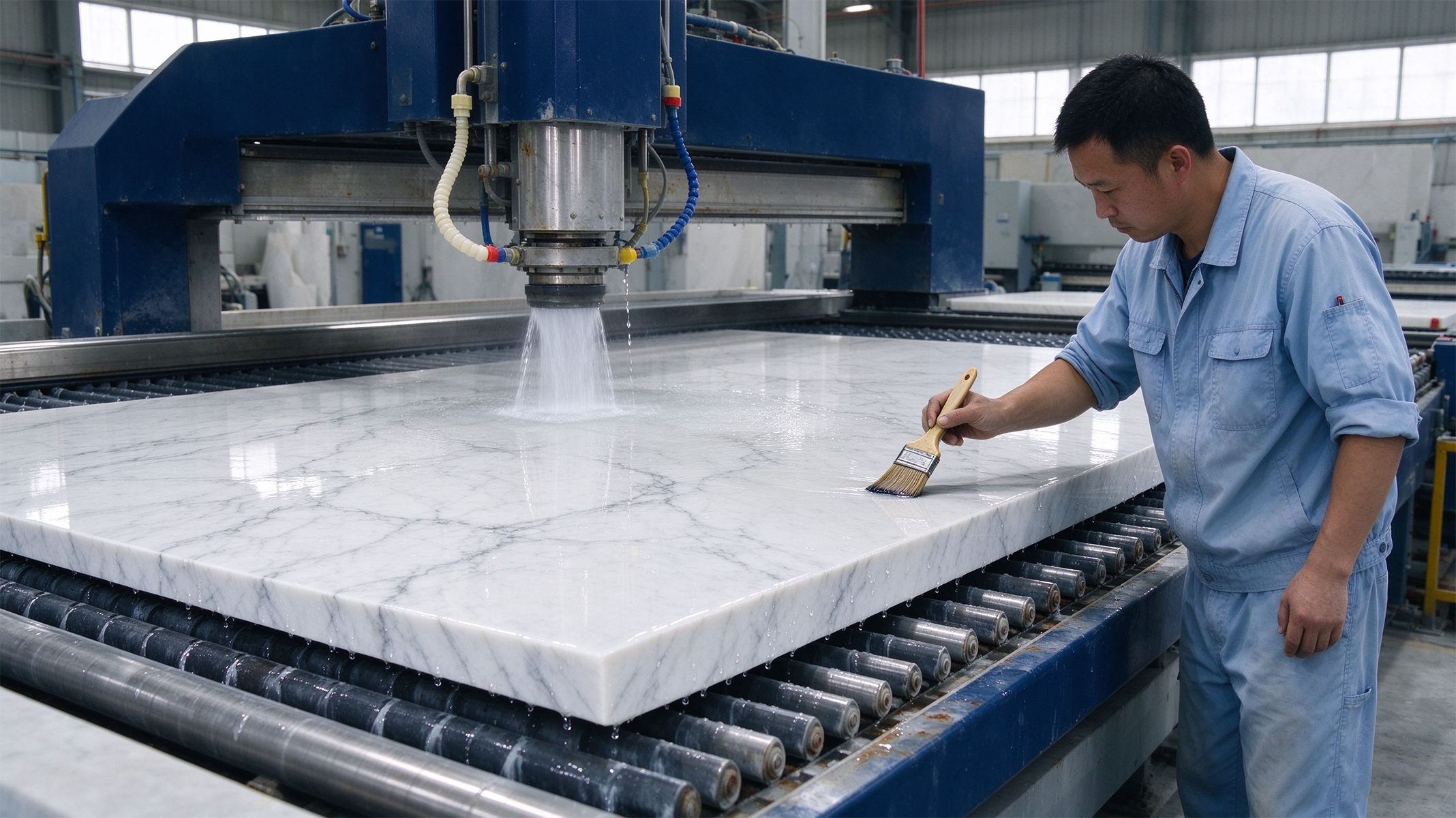
Large gang saws and polishing lines run on recirculating water. Over a week of cutting granite and darker stone, the settling tank accumulates iron fines from blade wear, steel shot and rusty fixtures, and its pH drifts upward. Municipal tap water typically carries well under 0.3 mg/L of iron; a shared recycling tank can hold many times that. The practical difference in one time tap water processing versus recycled water white marble is therefore measurable in the water, not in the finished slab — which is exactly why a buyer must ask for the water record instead of a photograph.
Path 2 — tools, resin and mesh backing
Diamond tooling sheds metal, and some filling lines still use unsaturated polyester resin with iron-bearing fillers or an over-dosed catalyst. That resin yellows under UV and alkaline pore water; the trade press has documented non-yellowing epoxy and Glaxs-type alternatives for light stone, but few factories state which chemistry they use. Cheap fibreglass mesh backing glued with a yellowing adhesive shows through thin white slabs within a year. Ask for the resin brand, the filler type and a UV-ageing sample — not just the word "imported resin".
Path 3 — crating while damp, with iron in the crate
A slab that is polished, sealed and crated before it has dried traps moisture against the stone for four to six weeks at sea. Add steel straps, iron nails or wet timber and you have a rust source pressed directly against the protected face. The remedy is unglamorous: a documented dry-down, plastic corner protectors, kiln-dried timber with a moisture record, and a breathable wrap rather than a sealed plastic bag.
What to require in a method statement
• A dedicated white-stone line, with no shared tanks or polishing heads for granite and dark marble.
• A written statement of one time tap water processing versus recycled water white marble, plus a weekly water iron test and the tank change log.
• Resin and mesh brand names, with a non-yellowing declaration and a retained UV-aged sample.
• Slab surface moisture and dry-down time recorded on the packing list, and a no-iron-contact crate specification.
Xinpengfei Stone built its rust-free white stone process around exactly these controls, backed by an in-house white-stone pathology team and written standards for resin filling, polishing and protection — three of the nine in-house stages the plant applies from block selection through crystallisation. Nantong Xinpengfei Stone Industry Development Co., Ltd. can issue these records per batch because sawing, filling and finishing all sit inside the same 35,000 m² plant. See the nine-stage factory standard and the white marble slab range for the materials these controls apply to.
✅ Bottom line: Yellowing is a process failure. Demand the water, resin and dry-down records before the first slab is cut.
2. What should a six-sided protection specification actually require?
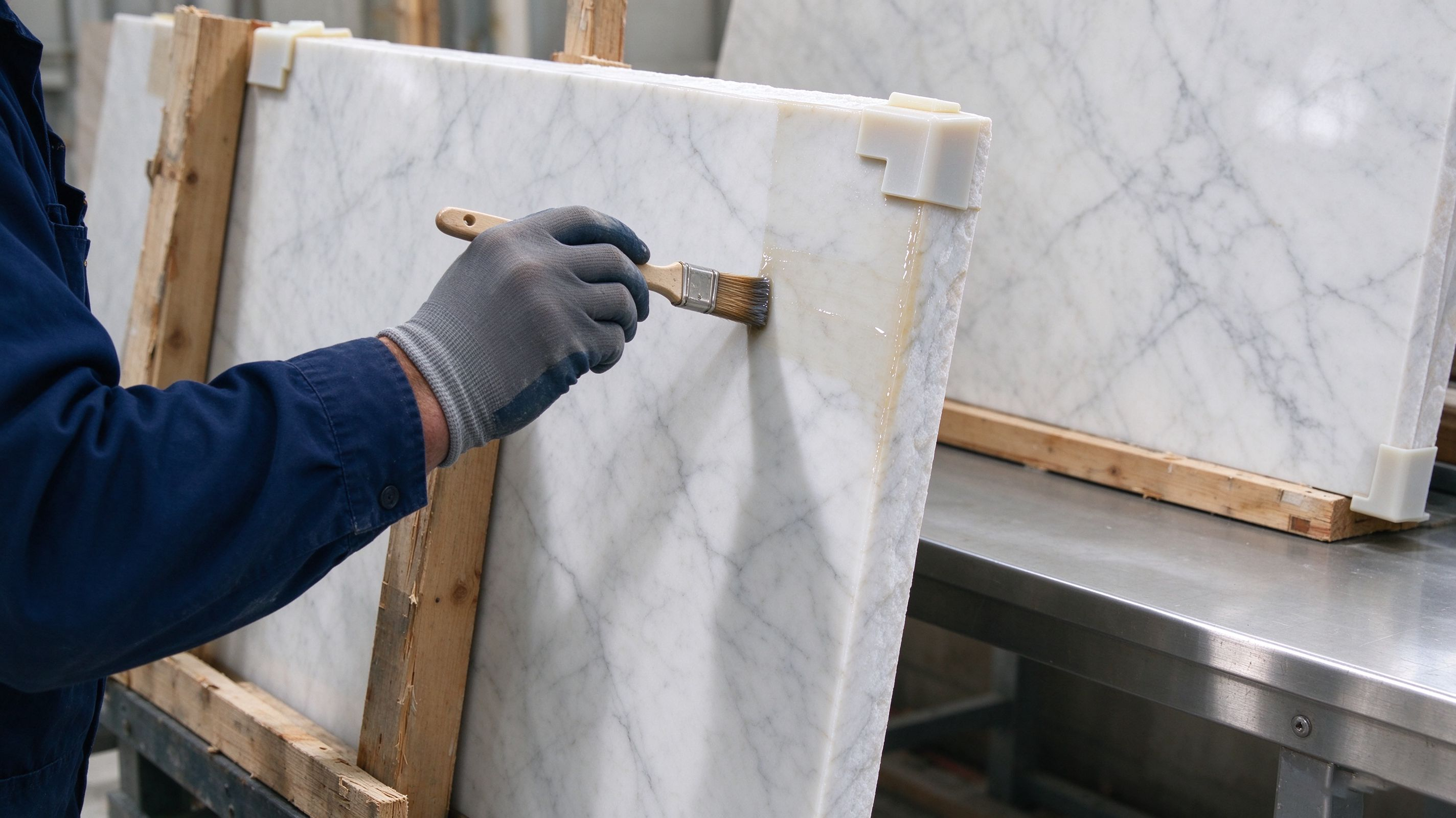
All six faces, a penetrating breathable sealer, and a documented dry-down before any crate is closed. A six sided protection specification for white marble slabs should name the sealer chemistry, the coat count for each face, the curing time and the field test used to accept the work. Most factories roller-coat the polished face only. The back and the four cut edges stay absorbent, and those are precisely the surfaces sitting against wet cement mortar and alkaline grout.
The application sequence
• Cut to final size first. Every cut exposes fresh, unsealed stone. Edge coating applied before trimming is wasted.
• Wash and dry. Remove iron-bearing slurry, then dry to a recorded surface moisture value. Sealer applied over a damp slab traps the water it is meant to exclude.
• Coat by face. Two coats on the visible face, one on the back, two on each of the four edges. Use a penetrating, vapour-permeable silane or siloxane rather than a film-forming acrylic, which can blush white and trap vapour on a lobby floor.
• Cure 24–48 hours, then test. A water drop should bead for 30 minutes without darkening the stone; check the edges as well as the centre, since edges are where the coating is thinnest.
• Crate without iron contact. Plastic protectors, dry timber, breathable wrap, and a packing photo showing the sealed edge condition.
Note the difference between a material standard and a process standard. ASTM C97 or C503 tells you what the stone is; it says nothing about whether the back of your particular slab was sealed. This is why white marble rust free processing how factories prevent yellowing belongs in the purchase order as a method statement, with the packing photos as evidence, rather than as a line in a brochure. Without a six sided protection specification for white marble slabs, a specifier has no contractual basis to reject a shipment whose back face is bare. Xinpengfei Stone issues edge-coating and dry-down records with custom white marble packages, and accepts third-party inspection before container loading — a useful clause for wholesale buyers who cannot attend in person.
✅ Bottom line: Specify all six faces by name; a sealed polished face with bare edges still wicks alkaline moisture.
Frequently Asked Questions
Q: Can yellowing be repaired after installation?
A: Only after you identify the source. Iron contamination in the slab responds poorly to poultices and usually returns; resin yellowing is permanent; moisture-driven efflorescence can be dried out and re-sealed. In practice white marble rust free processing how factories prevent yellowing is a pre-shipment question — request the water and packing records before you pay the balance, not after the floor is laid.
Q: Does ISO 9001 or an ASTM test report cover these factory controls?
A: No. ISO 9001 certifies that a quality system exists; ASTM C97, C170 and C880 measure the stone's physical properties. Neither records which water line a white slab ran on, or whether its four edges were coated. Xinpengfei Stone treats its nine written in-house stages as the supplement that closes this gap, and will attach the batch records to a custom order on request.
Q: Do you support OEM and ODM white marble projects with independent inspection?
A: Yes. Send the stone name, finish, thickness, quantities and target port in your RFQ; Xinpengfei Stone will return a method statement, sample records and a factory-direct quotation. Trial MOQs start around 50 m², and third-party inspectors are welcome to check water logs, resin batches and edge coating before shipment.
Next step: Email your white marble schedule to Xinpengfei Stone and ask for the rust-free processing method statement, a sample six-face coating record and a six sided protection specification for white marble slabs you can paste into your tender. Nantong Xinpengfei Stone Industry Development Co., Ltd. will also provide a free pre-shipment inspection checklist for your project.
www.xpfmarble.com
Nantong Xinpengfei Stone Industry Development Co., Ltd
