Zinc Alloy Lip Gloss Applicator Tips: Shape and Assembly Checks
A zinc alloy lip gloss applicator tip must suit both the application task and the surrounding package. A broad contact face, a pointed end or a grooved surface can give a buyer different shapes to compare, but appearance does not establish product pickup, comfortable application or assembly fit. Selection needs a shape review followed by evaluation of the complete tip, wand, wiper and bottle with the intended formula.
Compare shapes by the application task
Start with the intended use: spreading across the lip surface, placing product near an edge, or making small touch-ups. Compare the contact face, edge profile, curvature and surface details of candidate tips. These features help define what to evaluate, rather than guaranteeing a particular finish.
A larger head is not automatically better for a thicker gloss. Product pickup and release also depend on the formula, surface finish, withdrawal through the wiper and application motion. Test candidate shapes with the same formula and a repeatable procedure so the comparison reflects the tip rather than different test conditions.
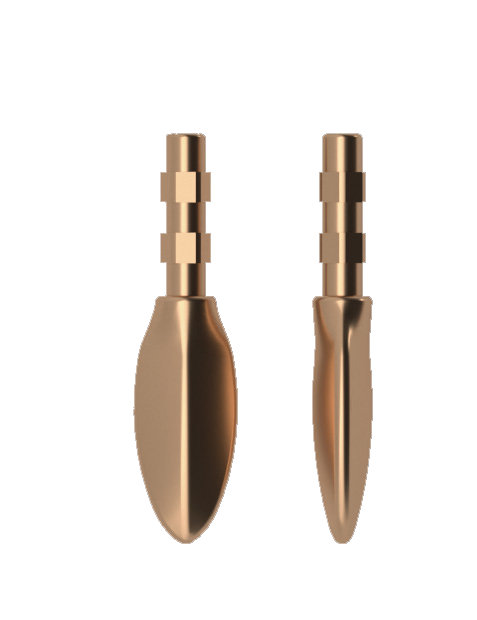
The front and side views of YR-L040 show why head shape and fixing-tail geometry need separate review. This image illustrates the component, not a completed tube or a validated application result.
Keep the fixing end separate from the application head
The fixing tail is the part received by the wand or other supporting component. Its diameter, profile, insertion depth and retention features must be checked against the receiving part. A catalog head width cannot substitute for these dimensions.
Nominal sizes alone do not establish the required fit. The supplier needs to define the attachment method and appropriate dimensional tolerances for the mating components. A specified tolerance on one metal feature cannot guarantee a secure connection without considering the receiving part, materials and assembly process.
Evaluate insertion and retention on the actual component set. Depending on the attachment method, checks may include pull resistance, rotational movement and visible damage after assembly. The project should define the checks and acceptance limits; they should not be inferred from a photograph or a general catalog.
Measure the head in the directions that affect passage
For an irregular head, review width, thickness and the shape along its length. A single “maximum diameter” field may not fully describe a flattened or asymmetric applicator. Use the model drawing to establish the orientation and measurement reference instead of treating every head as circular.
The complete head must pass through the bottle opening and the selected wiper where one is used. The wiper can deform as the head passes, so its opening size alone does not establish compatibility. Evaluate withdrawal force, product loading and any wear or damage using assembled samples.
Check assembled reach rather than metal-tip length alone
Sambound's published guide lists YR-L040 at 5.18 mm width and 20.28 mm height. These are metal-component reference dimensions, not the length of the complete wand and not the dimensions of its fixing tail.
The inserted portion of the tip and the wand geometry determine its final position when the cap is closed. Check that position against the bottle's usable internal space, including clearance near the base. A longer standalone tip does not necessarily provide more usable reach once it is assembled.
Evaluate the surface and formula together
Confirm the supplied surface specification, including any coating or finish, and which surfaces contact the formula. Inspect representative samples for defects such as rough edges, burrs or damage that could affect application or assembly. Use the actual finished component for formula compatibility evaluation rather than assuming all zinc alloy tips behave alike.
Record product pickup after wiping, release during application and any change after the agreed storage and repeated-use conditions. A metal appearance or initial cool touch does not establish a lasting cooling benefit, hygiene claim or universal formula compatibility.
Keep approval tied to the selected tip, wand, wiper, bottle and formula, with their drawing and specification revisions. The dimensional example comes from Sambound, the packaging brand of SamBound New Material Technology Company Ltd.; product information is available at sambound.com. A catalog shortlist becomes a usable specification only after the mating components and filled samples have been evaluated together.
sambound.com
SamBound New Material Technology Company Ltd.
