Ceramic-Lined Electromagnetic Flowmeter: Silica Sand FAQs
Ceramic-Lined Electromagnetic Flowmeter: Silica Sand FAQs
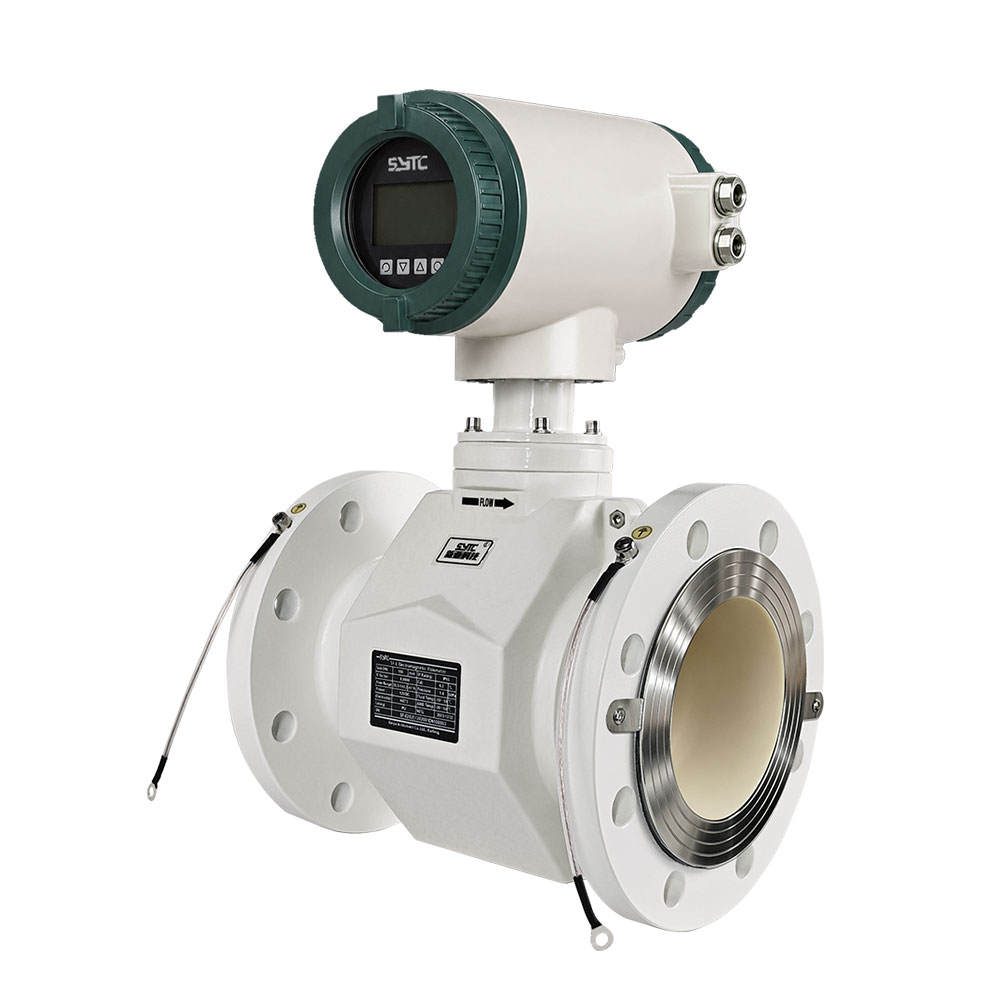
A ceramic-lined electromagnetic flowmeter is worth evaluating for silica sand slurry when hard, abrasive sand particles create a real risk of liner wear in the wetted section of the meter, and when two other conditions are also met: the liquid phase still conducts electricity well enough for the electromagnetic measuring principle to work, and the meter can be configured to match the actual process — diameter, velocity range, electrode material, grounding, and installation arrangement. If either condition fails, ceramic lining solves a wear problem while creating a measurement problem. Ceramic is a lining selection, not an automatic answer to "silica sand."
What the Lining Actually Does
In a mag meter, the measuring tube is lined with an insulating material so the induced signal is not shorted through the pipe wall. That lining is the surface the slurry touches. In silica sand service, the failure mode is usually mechanical: particles slide and strike the liner, gradually removing material until the electrode edges are exposed, the bore geometry changes, or the liner is breached.
Ceramic linings are chosen because the material is hard and dimensionally stable compared with many elastomers. Hardness delays material removal under sliding abrasion. It does not change how the meter measures flow, and it does not change the conductivity requirement — the fluid must still be electrically conductive for the sensor to produce a signal.
How Sand Particle Properties Drive Wear
Silica sand is not a single consistent medium. Wear in a given line depends on several properties acting together:
- Particle size distribution. Fine particles and coarse particles behave differently. A distribution skewed toward larger grains generally places more kinetic energy against the liner at the same velocity. The full curve matters more than a single "maximum size" figure.
- Angularity. Rounded grains tend to roll and slide; angular, crushed grains cut and impact more aggressively at the same size and concentration.
- Hardness. Silica is a hard mineral, which is precisely why it is a wear concern for softer linings. Relative hardness between particle and lining material is what governs whether the particle removes material.
- Concentration (solids loading). More solids per unit volume means more particle contacts per unit of time.
- Velocity. Wear from particle impact rises steeply with velocity. Reducing velocity in a given line is often the single most effective wear control, independent of lining choice.
- Flow regime. Turbulence, elbows, reducers, and downstream-of-valve locations concentrate impact and can wear locally even when the average conditions look acceptable.
None of these factors can be judged from the words "silica sand slurry" alone.
Why the Medium Name Is Not Enough
Two plants described as handling "silica sand slurry" can require completely different meters. One may run a dilute, rounded, fine sand at low velocity through a large-diameter line; the other may run coarse, angular material at high velocity through a small bore. The first may not need ceramic at all. The second may need more than ceramic.
For a meaningful technical review, a buyer should be able to supply:
- Minimum, normal, and maximum flow rates (not just a nominal figure)
- Slurry composition: solids type, particle size distribution, angularity if known, and typical solids concentration
- Electrical conductivity of the liquid phase
- Operating temperature and maximum temperature excursions
- Line pressure
- Pipe diameter and the standard flange facing required
- Pipe orientation, upstream/downstream straight runs, and whether the line can be isolated
- Whether the pipe runs full under all operating conditions
Without this data, any recommendation is a guess with a part number attached.
Ceramic Hardness Is Not a Zero-Wear Guarantee
A common misconception is that a hard ceramic lining eliminates wear. It does not. Hardness improves resistance to one wear mechanism — typically sliding abrasion from fine particles — while remaining vulnerable to others:
- Impact from large or high-velocity particles, where fracture or chipping of a brittle surface becomes possible
- Localized turbulence at fittings, where particles concentrate at a single spot
- Thermal shock, where rapid temperature change stresses a brittle material
- Chemical attack from the liquid phase, which is a separate question from mechanical wear
Ceramic is also brittle by nature. Where the process involves large solids, pressure surges, or frequent mechanical disturbance, an elastomer or a different hard lining may be the better engineering choice — sometimes in combination with a change of velocity or piping layout.
Electrodes, Grounding, and Full-Pipe Conditions
Lining is one part of the wetted assembly, and it is not the part that senses the flow. Reliability in sand slurry also depends on:
- Electrode material and form. The electrode must survive the same abrasion as the lining. In slurries, electrode selection commonly involves considering resistance to both mechanical wear and the chemical character of the fluid.
- Grounding. Interference is a frequent cause of unstable readings in lined and non-conductive pipe systems. Grounding electrodes or rings provide the reference potential the measurement needs. This is especially relevant where the pipeline is lined, or where stray currents are present.
- Full-pipe condition. Electromagnetic flow measurement assumes a full, wetted bore. Partly filled pipes produce unreliable readings and can accelerate localized wear. Mounting orientation should support full-pipe operation.
- Installation arrangement. Straight runs, valve and pump positions, and the presence of air entrainment all affect signal stability. Some manufacturers also apply signal-processing methods aimed specifically at suppressing short, sharp disturbances caused by solid particles striking the electrodes.
Process Factor Reference Table
| Process Factor | Why It Matters | Information to Provide |
|---|---|---|
| Flow rate range | Velocity drives both wear rate and measurement range | Minimum, normal, and maximum flow rate; expected operating hours |
| Particle size distribution | Coarse fractions govern impact wear; fines govern sliding wear | Full size distribution, or at least d50/d90 and top size |
| Particle angularity and hardness | Angular, hard grains remove lining material faster than rounded ones | Description of sand source and shape; mineral hardness if known |
| Solids concentration | Sets the number of particle contacts per unit time | Typical and peak solids loading |
| Liquid conductivity | Electromagnetic measurement requires a conductive liquid phase | Conductivity value or the fluid chemistry used to estimate it |
| Temperature and pressure | Constrain lining, electrode, and sealing material choices | Operating and excursion limits, design pressure |
| Pipe diameter and flange standard | Determine available bore, lining option, and mechanical fit | DN size, flange standard and facing |
| Installation layout | Determines whether the pipe runs full and where wear concentrates | Orientation, straight runs, nearby fittings, isolation capability |
| Grounding and electrical environment | Affects signal stability and reading reliability | Whether the pipe is lined or non-conductive; whether grounding is available |
Ceramic Lining as a Configuration, Not a Universal Answer
Kaifeng Xinya Instrument Co., Ltd. is an industrial flowmeter manufacturer based at No.1, Ba Qing Wu Road, Jinming Avenue, South Section, Kaifeng Demonstration Area, Henan, China, supplying electromagnetic flow measurement systems for industrial, municipal, and food-safety applications. Its product range includes industrial electromagnetic flowmeters, battery-powered and wireless remote units, insertion meters, hygienic food-safety meters, and slurry-oriented meters, with documented accuracy options of ±0.5%, ±0.3%, and ±0.2%, a velocity measurement range of 0.1 to 10 m/s, and pipe diameter coverage from DN15 upward depending on the model and configuration.
Within its slurry product documentation, ceramic lining is listed as one of several available lining options, alongside materials such as polyurethane and PFA. Where the current datasheet specifies a 99.5% alumina ceramic with a Mohs hardness of 9, that should be read as a product-configuration detail describing the material supplied — not as a performance guarantee for any given slurry. Documented ceramic options are typically associated with smaller nominal diameters, so larger lines should be reviewed case by case rather than assumed.
Xinya's approach is to treat lining, electrode, grounding, and signal processing as a matched set. The company's slurry-oriented meters, for example, are documented with options for grounding electrodes and with a spike-suppression signal method intended to reduce interference from solid grains striking the electrodes — both of which matter in silica sand service. Output and integration options across the range include 4–20 mA, pulse, and frequency signals, with RS485, RS232, HART, GPRS, Bluetooth, and WiFi communication, and MODBUS-RTU protocol support, so the meter can be tied into existing control and monitoring systems.
The recommendation, though, is not "ceramic for sand." It is: evaluate ceramic against your actual process data.
FAQs
Does silica sand slurry always conduct electricity well enough for a mag meter?
Not automatically. The electromagnetic principle depends on the liquid phase, not the solids. Sand particles themselves are not the conductive medium. A mag meter needs the carrier liquid — water-based slurry in most cases — to have adequate conductivity. If the liquid is deionized, a non-conductive carrier, or heavily dominated by oil or another non-conductive phase, a mag meter may not be the right technology regardless of lining. Measuring conductivity, or confirming it from the fluid chemistry, is a required first step.
Which sand particle properties should I send for review?
Send the size distribution rather than a single number, plus a note on angularity and the sand's source if you know it. Angularity is often the difference between a liner that lasts and one that does not, and it is rarely captured in a specification sheet. Also include solids concentration at normal and peak conditions. If you do not have laser-diffraction or sieve data, describe the material and the application, and a technical review can work from there.
Should I choose ceramic lining for a silica sand line?
Choose it when the process data supports it: fine to moderately coarse abrasive particles, a conductive liquid, controlled velocity, a full pipe, and a diameter where the ceramic option is available. Reconsider it when the slurry carries large particles at high velocity, when temperatures swing sharply, or when the pipe runs partially filled. In many cases the better answer is a change in velocity or piping arrangement, a different lining material, or a wear-resistant combination — and that is exactly what a review of actual parameters is meant to determine.
Next Step
Ceramic lining is one option among several, and the correct choice depends on data that only the buyer has. If you are evaluating a meter for a silica sand slurry line, send the process parameters listed in the table above — flow range, particle size distribution, solids concentration, conductivity, temperature, pressure, pipe diameter, and installation layout. Kaifeng Xinya Instrument Co., Ltd. will review them against the available ceramic slurry configuration and other lining options and indicate which configuration fits the actual service. Contact: xinya@sytcflowmeter.com.
https://www.sytcflowmeter.com/
Kaifeng Xinya Instrument Co., Ltd.
