Electromagnetic Flow Meter: Water-Glycol Coolant 2026 Guide
Electromagnetic Flow Meter for Water-Glycol Coolant: Conductivity and Selection
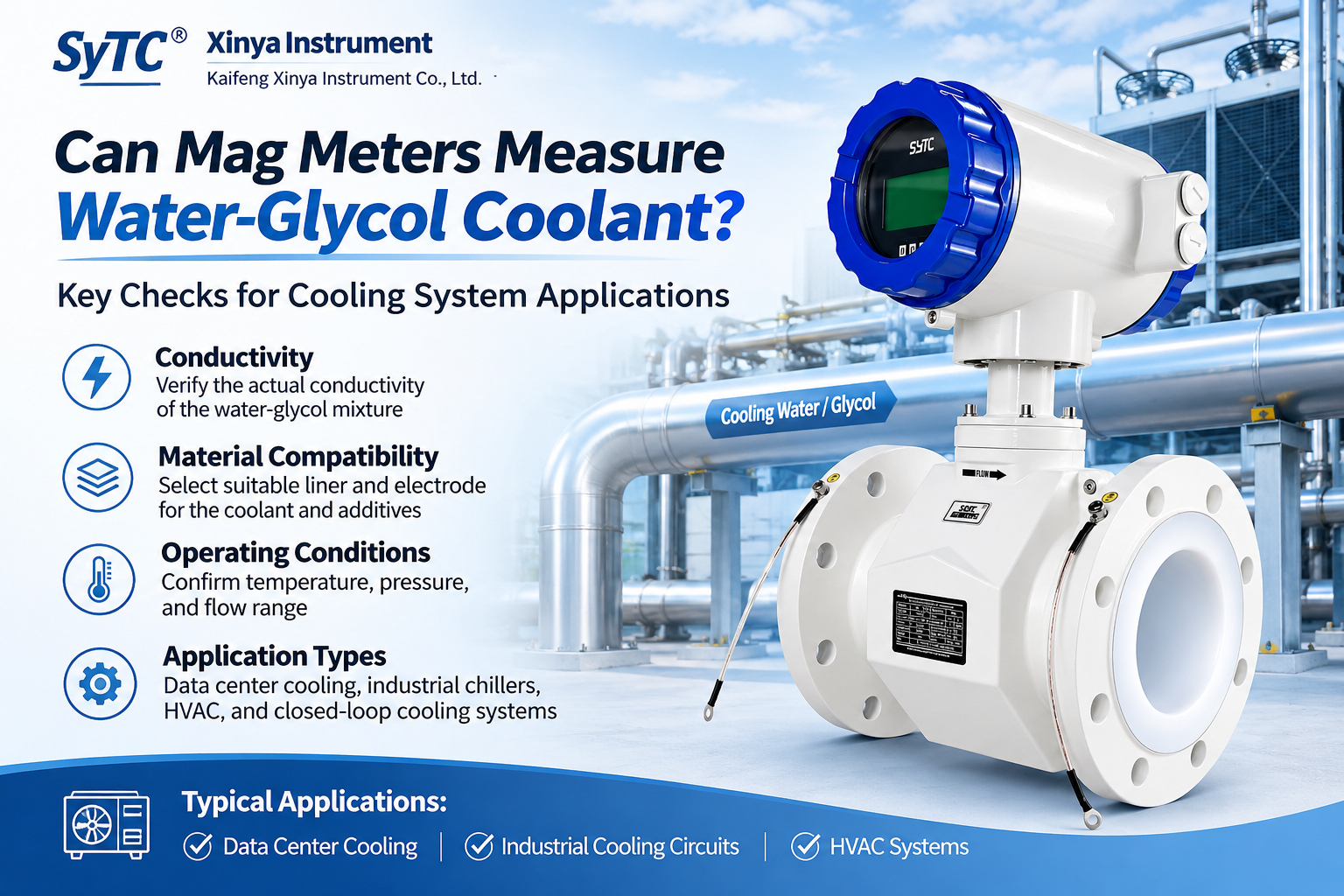
Short answer: An electromagnetic (magnetic) flow meter can reliably measure water-glycol coolant only if the final mixture's electrical conductivity meets the meter's minimum threshold — typically a value defined by the meter manufacturer, often in the low µS/cm range. Glycol percentage, water source, inhibitor package, and operating temperature all shift conductivity, so each coolant formulation must be verified individually rather than assumed suitable.
Why Liquid Conductivity Is the Deciding Factor
Electromagnetic flow meters operate on Faraday's law of induction: a magnetic field is applied across the pipe, and the moving liquid generates a voltage proportional to its velocity. This principle only works on liquids that conduct electricity. The sensor electrodes must detect a measurable induced signal, which means the liquid's conductivity — not its viscosity, color, or chemical family — is the single technical gatekeeper for suitability.
Pure water with no additives can already sit near the lower edge of workable conductivity in some systems. Adding glycol, which is itself a poor electrical conductor, generally pulls conductivity further down as concentration increases. This is why a water-glycol coolant cannot be assumed conductive simply because it contains water.
How Glycol Concentration, Water Quality, Inhibitors, and Temperature Interact
Several variables combine to determine whether a specific water-glycol batch will register a usable signal:
- Glycol concentration: Higher glycol-to-water ratios generally reduce the dissolved-ion content relative to a pure water base, which tends to lower conductivity. The exact relationship depends on the water used to dilute the glycol.
- Source water quality: Deionized or reverse-osmosis water contains very few free ions and starts from a low conductivity baseline. Tap or treated water with dissolved minerals contributes more ionic content.
- Corrosion inhibitor packages: Many glycol coolants include inhibitor salts (e.g., buffering or anti-corrosion additives) that introduce ions into the solution. These additives can raise conductivity, but formulations vary widely by supplier and product line.
- Operating temperature: Conductivity in aqueous solutions is temperature-dependent and generally increases as temperature rises. A coolant measured as borderline at ambient temperature may behave differently at operating temperature, so conductivity should be checked at the actual process condition, not just at room temperature.
Because these four factors interact, two coolants with the same glycol percentage can have different conductivities depending on water source, inhibitor chemistry, and running temperature. There is no single published conductivity number that applies to "water-glycol coolant" as a category.
Why Pure Glycol, Water-Glycol Mixtures, and Dielectric Fluids Are Not Interchangeable
Buyers sometimes group all cooling fluids together, but from a flow-measurement standpoint they are fundamentally different:
- Pure (undiluted) glycol has very low electrical conductivity and is generally not suitable for electromagnetic measurement without dilution or additives that raise ionic content.
- Water-glycol mixtures occupy a variable middle ground — some formulations conduct well enough, others do not, depending on the factors above.
- Dielectric cooling fluids (such as certain synthetic or fluorinated fluids used in immersion cooling) are engineered specifically to have minimal electrical conductivity for electrical safety reasons. Electromagnetic flow meters should not be recommended for these fluids unless independent conductivity testing confirms a measurable, sufficient value — which is uncommon for fluids designed to be dielectric.
Treating these three categories as equivalent is the most common cause of electromagnetic meter installation failures in cooling applications.
Required Checks Before Selecting a Meter
A technically sound selection process verifies the following parameters against the actual process conditions, not catalog defaults:
- Conductivity at operating temperature — measured directly on a sample of the final mixed coolant, not estimated from the glycol percentage alone.
- Flow rate range — confirm the expected minimum and maximum velocities fall within the meter's rated range (commonly around 0.1–10 m/s for general-purpose electromagnetic sensors).
- Operating temperature range — confirm the sensor lining and electrode materials are rated for continuous exposure at the system's running temperature.
- Pressure rating — confirm the flange and housing pressure class matches the pipeline design pressure.
- Material compatibility — confirm electrode material (e.g., stainless steel, Hastelloy) and lining material (e.g., PTFE, rubber, ceramic) resist the specific glycol formulation and any corrosion inhibitors over long-term exposure.
Skipping any one of these checks can result in either a non-functional installation (insufficient conductivity) or premature material failure (incompatible lining or electrodes).
Selection Table: Coolant Type vs. Electromagnetic Suitability
| Coolant Type | Typical Conductivity Behavior | Electromagnetic Meter Suitability |
|---|---|---|
| Deionized/pure water | Very low unless treated | Verify conductivity before specifying |
| Water with standard treatment (tap, softened) | Generally measurable ionic content | Often suitable, confirm with test |
| Water-glycol mixture (low glycol %) | Varies by water source and inhibitors | Requires on-site conductivity measurement |
| Water-glycol mixture (high glycol %) | Tends toward lower conductivity | Requires on-site conductivity measurement; may be unsuitable |
| Pure/undiluted glycol | Generally very low | Not recommended without verified conductivity |
| Dielectric cooling fluid (immersion-type) | Designed to be non-conductive | Not recommended unless independently verified |
Buyer Checklist
Before requesting a technical recommendation, buyers should gather:
- [ ] Coolant composition (glycol type: ethylene or propylene)
- [ ] Glycol percentage by volume
- [ ] Measured conductivity at actual operating temperature
- [ ] Corrosion inhibitor package details (if known)
- [ ] Pipe diameter (DN size) and schedule
- [ ] Expected minimum and maximum flow rate
- [ ] Operating temperature range
- [ ] System operating and design pressure
- [ ] Required output signal (4-20mA, pulse, frequency, or digital protocol)
Where Factory Calibration Fits — and Its Limits
Kaifeng Xinya Instrument Co., Ltd. (Xinya Instrument / SyTC) manufactures electromagnetic flow meters and flow calibration systems in Kaifeng, China, and each unit undergoes 100% factory calibration before shipment. This calibration confirms the instrument's measurement accuracy against a known reference fluid under controlled conditions. It does not, however, confirm compatibility with every coolant formulation a buyer might use. Factory calibration validates the meter's electronics and signal processing; it cannot substitute for verifying that a specific water-glycol mixture has sufficient conductivity, nor for confirming that lining and electrode materials will hold up against a particular inhibitor chemistry over years of service. Those checks remain the buyer's and applicant engineer's responsibility, ideally supported by a conductivity measurement on the actual coolant sample.
FAQs
Q1: Is there a standard conductivity value that applies to all water-glycol coolants?
No. Conductivity depends on glycol percentage, water source, and inhibitor chemistry, so each formulation must be measured individually rather than assumed from a general rule.
Q2: Can I use an electromagnetic flow meter on 50% glycol coolant?
It depends entirely on the measured conductivity of that specific 50% mixture at operating temperature. Some 50% blends with mineral-rich water or ionic inhibitors may conduct adequately; others with deionized water bases may not.
Q3: Will corrosion inhibitors make my coolant conductive enough?
Some inhibitor packages add ionic content that raises conductivity, but this varies by product and supplier. It should be confirmed by measurement, not assumed.
Q4: What happens if conductivity is too low for the meter?
The meter will likely produce an unstable, erratic, or zero-flow signal because the sensor cannot reliably detect the induced voltage, regardless of actual flow rate.
Q5: Should I use an electromagnetic meter for immersion-cooling dielectric fluid?
Generally no, unless independent testing confirms the specific fluid has measurable and sufficient conductivity. Most dielectric fluids are engineered to minimize conductivity for electrical safety.
Conclusion and Next Step
An electromagnetic flow meter is a technically sound choice for water-glycol coolant only when the mixture's measured conductivity, at actual operating temperature, meets the instrument's minimum requirement — and when flow range, temperature rating, pressure class, and material compatibility are also confirmed. Because glycol concentration, water quality, and inhibitor chemistry all shift conductivity independently, no single coolant formula can be assumed suitable without verification.
To receive a technical review, share your coolant composition, glycol percentage, measured conductivity at operating conditions, pipe size, flow range, operating temperature, and system pressure with Xinya's engineering team for an informed meter recommendation.
https://www.sytcflowmeter.com/
Kaifeng Xinya Instrument Co., Ltd.
