Water in Your PV Combiner Box: Why and What to Do
Water in Your PV Combiner Box: Why and What to Do
Finding water in a PV combiner box is rarely a leak. The enclosure is usually sealed well enough to keep rain out and still wet enough inside to fail an insulation test, because the water arrived as vapour and condensed on the first cold surface it met. That distinction matters: a better gasket alone will not fix it.
Where the water comes from
Three mechanisms account for most of it. The first is thermal cycling. A combiner box is warm in the afternoon and cold before sunrise; the air inside contracts, and any breathing path — vents, gland plates, imperfect door seals — pulls in fresh, humid night air. When that air reaches a cold busbar or insulator, it gives up its moisture there.
The second is installation. Boxes are often closed up on a humid morning, trapping that day's moisture inside; the first cold night is enough to condense it.
The third is pressure. Sealed boxes are never perfectly sealed: every temperature swing drives a small exchange through cable entries and membrane vents, and each exchange brings a little more water vapour in.
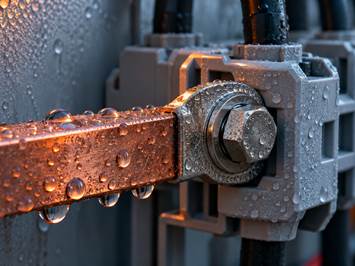
Condensation forms on the coldest metal first — here, on a copper busbar where it meets the terminal block.
Why a little water is expensive
At 1,000 or 1,500 V DC, moisture is not cosmetic. Surface moisture across insulators and terminal blocks drops insulation resistance, and leakage current at DC is the precursor to tracking and arc faults. Corrosion creeps into busbar joints and fuse holders, surge-protection devices and fuses age faster in a damp enclosure, and string-level monitoring starts raising alarms that send technicians to site for a problem invisible in daylight.
What actually stops condensation
Condensation forms when a surface is colder than the dew point of the air around it. The reliable fix is therefore to keep the enclosure — and specifically its coldest metal — above that dew point, which is what an enclosure heater does.
A PTC ceramic heater suits the job because it self-limits: as the element warms, resistance rises and power falls, so a heater sized for the coldest night cannot cook the box on a mild day. There is no red-hot element, and no thermostat that can fail closed.
Placement matters as much as wattage. A heater mounted low in the box sets up a convection loop that warms the whole volume; one mounted under the lid warms the lid and leaves the busbars cold.
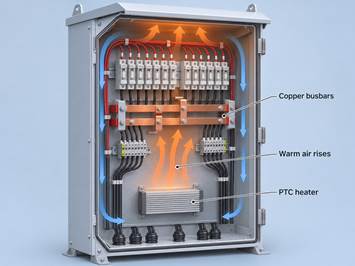
Heated from the base, the air rises past the busbars and returns down the sidewalls — the coldest metal is the first to be warmed, not the last.
Sizing, in practice
Heating a combiner box is not about making it warm. It is about holding the coldest surface a few degrees above dew point through the coldest hour of the night, which depends on surface area, insulation and how much air exchange the enclosure allows.
For compact boxes the aluminum-shell 6217 (60 W dry, 300 W in airflow, 70 × 68 × 7 mm) is the usual starting point; where a fan path exists, the 6760 fan heater (200 W) distributes heat faster. For larger cabinets or water-adjacent installations the insulated 6439 (3,000 W, 750 V withstand) keeps electrical isolation intact.
Sealing, breathing and heating belong together
A heater is not a substitute for a sound enclosure. Gaskets, cable glands and membrane breathers decide how much moisture gets in; the heater decides what happens to the moisture that does. Get the sealing wrong and the heater runs continuously; get the heater wrong and the sealing only delays the failure.
If the box is already wet
Dry the enclosure out before anything else. Isolate the string, open the door, and let it ventilate with the heater running; then measure insulation resistance before re-energising, because a box that looks dry can still fail a megger test at the terminals. Replace any terminal that has already corroded and any surge-protection device that has been sitting in moisture, then deal with the cause — the water was a symptom, and the next cold night will bring it back.
The short answers
· Why is there water inside my combiner box? In most cases condensation, not leakage: humid air enters as the box breathes, then condenses on cold metal at dawn.
· Will a heater stop it? It keeps surfaces above dew point so condensation cannot form. It does not remove standing water — fix the ingress first.
· Can a heater overheat the box? A self-limiting PTC element cannot run away: power falls as temperature rises, and the dry-burn surface stays below 280 °C.
· Does the heater have to run all night? It can be switched by a thermostat or a humidity controller, but a self-limiting element tolerates being left on — which is one fewer device to fail.
· What about boxes without a mains supply? The same elements are available from 5 V to 240 V, so a small DC heater can run from a local supply where the combiner is remote.
Send us the enclosure volume, the lowest night temperature and the supply available, and we will come back with a heater and a mounting position.
https://www.warmxuyang.com/
Pinghu Xuyang Electronic Technology Co., LTD
