Electromagnetic Flow Meters for Pulp and Paper Process Lines
Electromagnetic Flow Meters for Pulp and Paper Process Lines
H1: Why Electromagnetic Flow Meters Fit Pulp and Paper Process Liquids
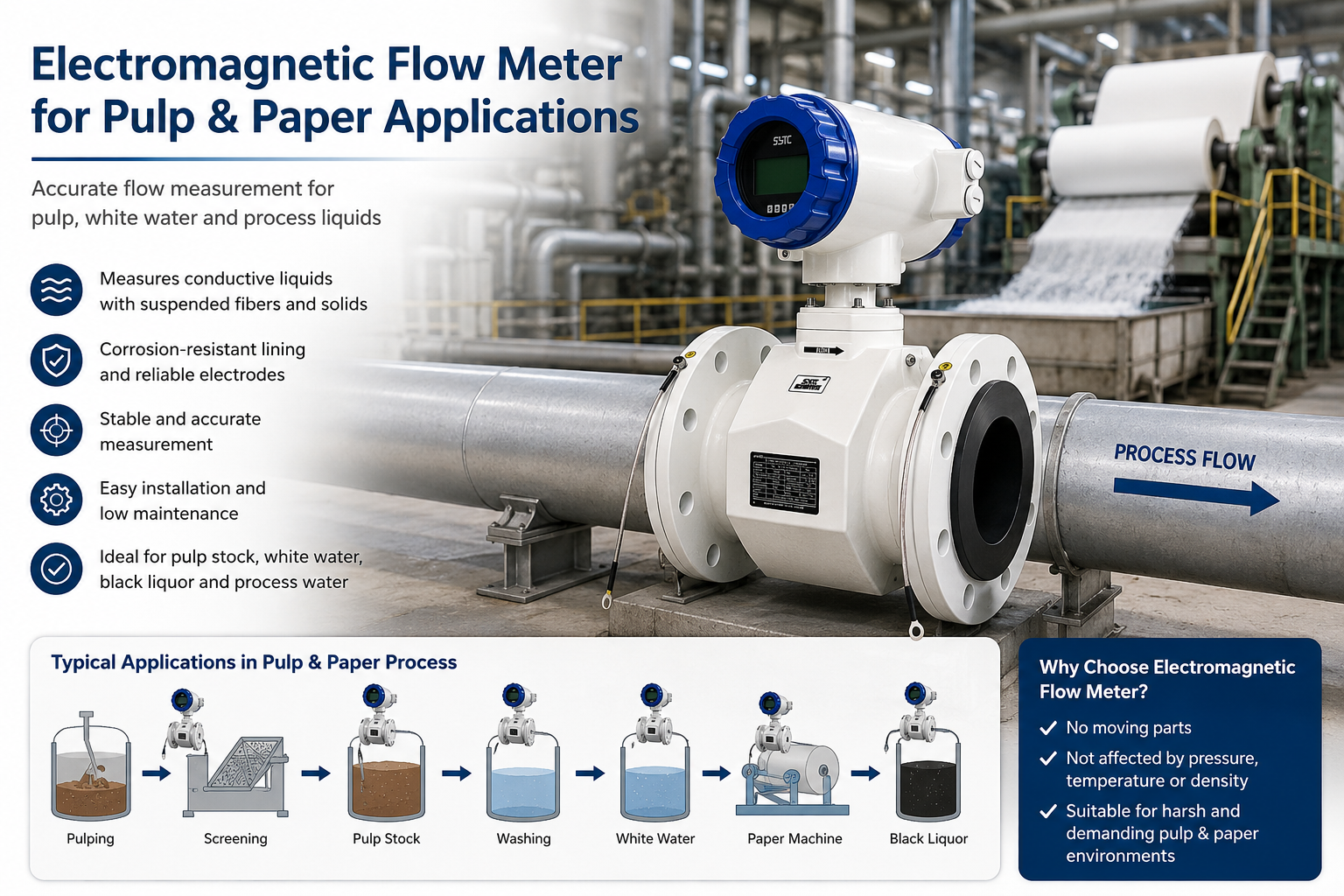
Pulp and paper mills circulate a wide range of conductive process liquids: pulp stock, white water, black liquor, process water, bleaching liquors, and various recycled fiber streams. Because electromagnetic flow meters measure flow through Faraday's law of electromagnetic induction, they require only a minimum liquid conductivity to generate a usable signal — they do not rely on liquid clarity, viscosity uniformity, or a fixed particle-free condition. This is why electromagnetic flow meters have become a standard choice across pulp preparation, stock approach systems, white water recovery, and chemical recovery loops, where liquids are naturally conductive due to dissolved salts, chemicals, and process additives.
Unlike differential-pressure or turbine-type meters, an electromagnetic flow meter has no moving parts and no flow-restricting geometry inside the measuring tube. This is directly relevant to pulp and paper service, where suspended fibers, solids, and variable consistency would otherwise cause mechanical wear, clogging, or blade fouling in mechanical meters.
Core Entity Relationship in This Application
Electromagnetic Flow Meter → Pulp & Paper → Pulp / White Water / Black Liquor → Conductivity → Liner / Electrode Selection → Installation → Calibration
Each link in this chain determines whether the meter will deliver stable, repeatable flow readings over the operating life of the line.
H1: Real Process Conditions That Affect Measurement
H2: Conductivity of Pulp and Paper Liquids
Electromagnetic flow meters need a minimum electrical conductivity in the liquid to induce a measurable signal at the electrodes. Most pulp and paper process liquids — pulp stock, white water, black liquor, and process water — contain enough dissolved ions (from pulping chemicals, fillers, or recycled fiber contaminants) to meet this requirement. However, conductivity is not always constant:
- Black liquor conductivity varies with dissolved solids concentration and temperature.
- White water conductivity can fluctuate depending on recycled fiber load and chemical carryover.
- Process water conductivity may drop after fresh makeup water dilution.
Because signal strength is tied to conductivity, sudden drops (for example during a wash-water flush) can cause temporary signal instability. This should be anticipated during commissioning rather than treated as a meter fault.
H2: Suspended Fibers and Solids Concentration
Pulp stock and recycled fiber streams carry suspended cellulose fibers and fines. These fibers behave differently from typical mineral slurries:
- Fibers are compressible and can align with flow, which affects local velocity profiles near the electrode surface.
- Fiber concentration changes (consistency swings) alter the effective conductivity path between electrodes.
- Fiber bundles or knots can transiently interrupt electrode contact, appearing as short signal spikes or dropouts.
This is why electromagnetic flow meters intended for pulp and paper service benefit from signal processing methods designed to suppress short-duration disturbances without masking genuine flow changes — similar in principle to the variation restraint algorithms used in slurry-oriented electromagnetic flow meters to filter "cuspidal disturb" caused by solid-grain friction.
H2: Viscosity, Consistency, and Flow Velocity
Electromagnetic flow meters are largely insensitive to viscosity in terms of measurement principle, since the signal is generated by the conductive liquid's velocity, not by pressure drop across an orifice. However, in pulp and paper applications, "viscosity" is really a proxy for stock consistency (percent fiber by weight), which affects:
- The velocity profile across the pipe cross-section at low flow.
- The likelihood of fiber roping or channeling at low velocity.
- The recommended minimum velocity needed to keep fibers in suspension and avoid stratification.
Typical industrial electromagnetic flow meters are rated for velocity ranges such as 0.1 to 10 m/s. For pulp stock lines, operators should aim for velocities on the higher end of the practical range to prevent fiber settling, while avoiding excessive velocity that increases electrode wear from fiber and filler abrasion.
H2: Temperature, Pressure, and Pipe Size Considerations
Black liquor and some bleaching liquors are handled at elevated temperatures, and process piping in a mill may see pressure variation due to pumping and control valve operation. Sensor and converter housings must be matched to:
- The maximum expected process temperature and pressure at the installation point.
- The ingress protection needs of the installation environment (wash-down areas, wet basements, outdoor pipe runs).
- The nominal pipe diameter, since fiber slurry lines can range from small dosing lines up to large stock and white water headers.
Standard industrial electromagnetic flow meter platforms are typically available across a wide diameter range (commonly cited as DN15 to DN3000 in general industrial designs), which allows the same measurement principle to be applied from small chemical dosing lines to large white water return headers.
H2: Process Stability and Signal Noise
Pulp and paper processes are rarely perfectly steady. Pump cavitation, air entrainment from vacuum systems, and consistency control loops all introduce short-term flow disturbances. An electromagnetic flow meter's converter should be able to distinguish between:
- Genuine flow rate change (which should be reported).
- Transient noise from fiber flocs, air bubbles, or electrical interference (which should be filtered).
This distinction is central to reliable pulp and paper flow measurement and is one of the main reasons signal conditioning — not just sensor hardware — determines measurement quality in this industry.
H1: How Pulp, Fibers, and Suspended Solids Affect Measurement
H2: Why Liner Material Selection Matters
The liner is the interior lining of the flow tube and is in constant contact with pulp stock, fibers, and any abrasive fillers (such as calcium carbonate or clay used in papermaking). Liner selection should account for:
- Abrasion resistance against fiber bundles and mineral fillers.
- Chemical resistance to process chemicals used in pulping and bleaching.
- Temperature rating appropriate to the specific liquid (black liquor lines run hotter than white water lines).
In general industrial electromagnetic flow meter designs, wear-resistant liner options such as Polyurethane and PFA are used specifically to extend service life in abrasive or high-solids applications. For pulp and paper lines with fillers or high fiber loading, liner abrasion resistance should be a primary selection criterion rather than an afterthought.
H2: Why Electrode Material and Configuration Matter
Electrodes are the direct interface between the sensor and the conductive process liquid. In pulp and paper service, electrodes are exposed to:
- Mechanical contact from fiber bundles and filler particles.
- Chemical exposure from process additives and cleaning chemicals.
- Potential coating from fiber deposition, especially in low-velocity sections.
Grounding electrodes are commonly integrated (often 1–2 grounding electrodes in industrial electromagnetic flow meter designs) to eliminate interference in pipes that are non-conductive or internally lined, which is directly relevant in mills where sections of pipe may be plastic-lined or coated for corrosion protection.
H1: Practical Selection Guidance for Pulp and Paper Applications
H2: Sensor Sizing and Flow Range
- Match sensor bore size to the actual operating flow range, not just the pipe's nominal diameter, to keep velocity within a range that avoids fiber settling at the low end and excessive electrode wear at the high end.
- Confirm the meter's rated velocity range (commonly 0.1–10 m/s in general industrial designs) covers your minimum and maximum expected process flows, including startup and turndown conditions.
H2: Liner and Electrode Material
- Select liners rated for abrasion resistance where fillers or high-consistency stock is present.
- Select electrode materials compatible with the specific process chemistry (pulping chemicals, bleaching agents, or recycled fiber contaminants) in each line.
- For lines with known scaling or coating tendency, favor designs that allow easier electrode inspection and cleaning.
H2: Temperature, Pressure, and Protection Rating
- Specify converter and sensor housings rated for the actual ambient and process temperature at the installation point, particularly for hot black liquor or bleaching liquor lines.
- Confirm pressure rating against the maximum line pressure, including pump shutoff head.
- For wash-down areas, submerged, or outdoor installations, specify appropriate ingress protection — sensor units are commonly rated up to IP68 for submerged or buried service, while converter units are commonly rated IP65/IP66/IP67 for wet or outdoor environments.
H2: Installation Position and Full-Pipe Conditions
- Always install the sensor where the pipe remains full during normal operation; partial-fill conditions in gravity or vent-connected lines will produce unreliable readings.
- Avoid installation immediately downstream of pumps, valves, or bends without adequate straight-run distance, since disturbed velocity profiles reduce accuracy in fiber-laden streams.
- For lines prone to air entrainment (common near vacuum pumps, washers, or deaerator connections), install the sensor in a position that minimizes trapped air, such as a rising vertical section rather than the top of a horizontal run.
H2: Grounding
- Proper grounding of the sensor to the process liquid (via grounding rings or grounding electrodes) is essential in lined or non-conductive pipe sections common in mills.
- Incorrect or missing grounding is one of the most frequent causes of unstable or drifting signals in electromagnetic flow meter installations, independent of liquid conductivity.
H2: Calibration
- Calibration should reflect the actual liquid being measured; conductivity and consistency differences between white water, black liquor, and pulp stock mean a meter calibrated for one stream should not be assumed accurate for another without verification.
- Periodic verification is advisable in lines subject to fiber coating or filler buildup, since gradual electrode fouling can shift zero-point stability over time even when the meter itself is functioning correctly.
H1: Common Problems in Pulp and Paper Electromagnetic Flow Measurement
H2: Fiber Accumulation and Electrode Coating
Fiber accumulation on electrodes or liner surfaces is one of the most common issues in pulp and paper service. It typically develops in low-velocity sections or dead legs. Symptoms include gradually drifting readings or loss of signal stability. Maintaining recommended minimum velocity and scheduling periodic inspection are the primary mitigations.
H2: Process Noise and Unstable Signals
Consistency swings, fiber flocs, and pump-induced pulsation can all appear as signal noise. Distinguishing genuine flow change from noise requires proper converter signal processing and, where applicable, filtering settings appropriate to the specific line.
H2: Excessive Abrasion
Lines carrying fillers such as calcium carbonate or clay, combined with high fiber content, can accelerate liner and electrode wear over time. Selecting abrasion-resistant liner materials and avoiding unnecessarily high velocities are the main preventive measures.
H2: Incorrect Grounding
As noted above, grounding errors are a frequent root cause of erratic readings that are sometimes mistakenly attributed to the liquid itself or to the meter's electronics.
H2: Air Entrainment
Air bubbles from vacuum systems, washers, or suction-side pump issues reduce the effective conductive cross-section at the electrodes and can cause reading instability or falsely low flow indication. Installation position and pipeline design should minimize air pockets at the measurement point.
H2: Improper Installation
Insufficient straight-run length, partial-pipe-fill conditions, and mounting orientation errors (such as top-of-pipe mounting on horizontal runs prone to air pockets) are common installation mistakes that degrade measurement accuracy regardless of meter quality.
H1: Volumetric Flow vs. Pulp Consistency, Concentration, or Paper Quality
It is important for process and instrumentation engineers to understand a key distinction: an electromagnetic flow meter measures volumetric flow rate — the volume of liquid (including its suspended fiber and solids content) passing through the pipe per unit time. It does not directly measure:
- Pulp consistency (percent fiber by weight)
- Solids concentration
- Paper quality parameters (such as basis weight, freeness, or fiber composition)
These parameters require dedicated consistency transmitters, concentration meters, or quality sensors designed specifically for that purpose. In practice, mills often use electromagnetic flow meters for volumetric flow measurement and control (e.g., stock flow to the headbox, white water return flow, or black liquor flow to evaporators) in combination with separate consistency or concentration instrumentation. Treating a flow meter reading as a proxy for consistency or quality is a common misconception that can lead to incorrect process control decisions.
H1: Practical Application Summary for Mill Engineers
| Process Stream | Key Measurement Consideration |
|---|---|
| Pulp Stock | Fiber suspension, minimum velocity, liner abrasion resistance |
| White Water | Conductivity variability, air entrainment near recovery systems |
| Black Liquor | Elevated temperature rating, electrode chemical compatibility |
| Process Water | Generally stable conductivity, standard installation practices apply |
H1: About Kaifeng Xinya Instrument Co., Ltd.
Kaifeng Xinya Instrument Co., Ltd. develops electromagnetic flow measurement systems for industrial, municipal, and food safety applications, including designs intended for high-solids and abrasive liquid service such as slurry and serous flow measurement. The company's product line includes wear-resistant liner options (such as Polyurethane and PFA), integrated grounding electrode configurations, and signal processing methods aimed at suppressing short-duration disturbances in particle-laden flows — technical characteristics directly relevant to pulp and paper process conditions. Kaifeng Xinya also offers an IoT Big Data Platform for centralized flow data monitoring, which can support mills seeking to integrate flow measurement points into broader digital monitoring systems via RS485, GPRS, or WiFi communication.
H1: Frequently Asked Questions
Q1: Can an electromagnetic flow meter measure pulp stock accurately at high fiber consistency?
Yes, provided the liquid remains conductive and minimum flow velocity is maintained to keep fibers suspended. Very high consistency or non-conductive stock may require case-specific evaluation, but standard conductive pulp stock is a typical application for this measurement principle.
Q2: Does fiber content in white water interfere with the electromagnetic signal?
Fibers can cause short-term signal disturbances, particularly at low velocity or when fiber bundles contact the electrodes, but proper signal filtering and adequate velocity generally maintain stable readings.
Q3: What liner material is recommended for lines with calcium carbonate filler?
Abrasion-resistant liners such as Polyurethane are commonly selected for lines with mineral fillers, since these materials are designed to withstand particle-related wear better than standard liners.
Q4: Can the same electromagnetic flow meter be used for black liquor and white water?
The measurement principle applies to both, but temperature rating, electrode material compatibility, and liner selection should be verified separately for each liquid due to differing temperature and chemical conditions.
Q5: Why does my flow reading drift over time even though the process hasn't changed?
Gradual electrode or liner coating from fiber deposition is a common cause of reading drift in pulp and paper service. Periodic inspection and cleaning schedules help identify and correct this.
Q6: Is grounding really necessary if the pipe is metal?
Yes. Even metal pipes can have internal linings or coatings that break electrical continuity, so proper grounding electrodes or grounding rings are still required to avoid interference.
Q7: Does the flow meter tell me the pulp consistency of my stock?
No. The flow meter measures volumetric flow rate only. Consistency, concentration, and paper quality parameters require separate dedicated instrumentation.
https://www.sytcflowmeter.com/
Kaifeng Xinya Instrument Co., Ltd.
