How to Plan a Crushing and Screening Plant in Kazakhstan ?
Selecting crushing equipment for a mining or aggregate project begins with a clear understanding of the process duty. Before asking for crusher models or prices, the project team should define the material, required products, operating schedule and site constraints.
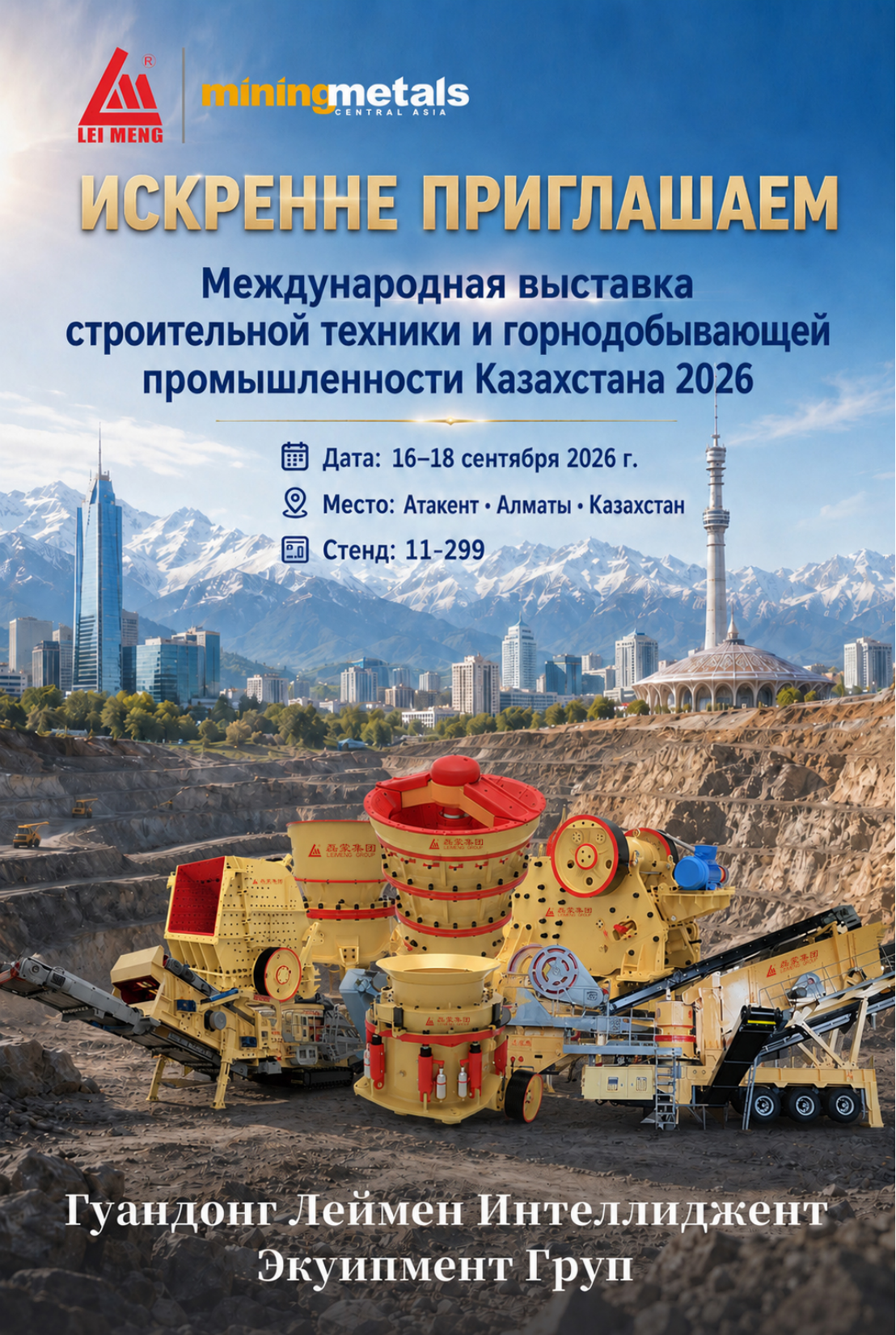
These questions are central to the discussions at Mining and Metals Central Asia 2026 in Almaty. The exhibition runs from September 16 to 18 at the Atakent International Exhibition Centre, where Leimeng Group is exhibiting at Booth 11-299.
A reliable crushing and screening plant works as one connected process. Feeders, crushers, vibrating screens, conveyors and stockpiles must be matched to the same material flow. Selecting each machine separately can leave the complete line with an unexpected bottleneck.
Start with the Raw Material
The name of the rock is useful, but it does not provide enough information for equipment selection.
Two deposits described as granite, limestone or copper ore may produce different wear rates, fines content and moisture problems. Representative material data gives the supplier a firmer basis for selecting the crusher type, chamber, liner material and screen media.
Useful information includes:
- Raw material and intended application
- Maximum feed size
- Complete feed-size distribution
- Compressive strength
- Abrasiveness
- Moisture and clay content
- Bulk density
- Seasonal changes in feed conditions
Material photographs can support the initial discussion, but they cannot replace laboratory data when abrasiveness or product quality is critical.
Define What the Capacity Figure Means
A request for a 500 TPH aggregate production line may refer to fresh feed entering the plant, total material passing through the crushers or saleable finished products. These figures are not interchangeable.
In a closed crushing circuit, oversize material returns from the vibrating screen to the crusher. This circulating load increases the duty on the crusher, screen and conveyors without increasing fresh feed.
A technical proposal should therefore state whether the quoted capacity refers to:
- Fresh feed
- Total circuit throughput
- Crusher throughput
- Finished-product output
The operating schedule also matters. A plant running one shift per day has different availability requirements from a mining operation planning continuous production. Planned maintenance, upstream material supply and weather interruptions should be considered when annual output is estimated.
Match the Crushing Stages to the Product
A jaw crusher is commonly used for primary crushing because it can accept large and irregular feed material.
For secondary and tertiary crushing, the choice normally depends on hardness, abrasiveness and the required product shape. A cone crusher is widely used for hard and abrasive material. An impact crusher may be considered for less abrasive rock when aggregate shape is an important requirement.
These are general application patterns rather than fixed rules.
The required finished products determine how many crushing and screening stages are needed. A line producing one road-base specification may require a simpler process than a plant producing several concrete aggregate fractions.
If the project also requires manufactured sand, the process may include a VSI sand-making machine, additional screening, sand washing and fine sand recovery.
Treat the Vibrating Screen as Process Equipment
Screening capacity has a direct effect on crusher performance.
A vibrating screen separates finished material from oversize particles. If the screen is undersized or performs poorly, qualified material may return to the crusher unnecessarily. This increases circulating load, energy use and wear.
Screen selection should consider:
- Crusher discharge grading
- Number of finished products
- Screen opening sizes
- Material moisture
- Near-size particle content
- Bulk density
- Required screening efficiency
- Peak material flow
The supplier should evaluate how material is distributed across the screen deck. Average tonnes per hour alone does not show whether the screen can handle the actual feed.
Review the Complete Material Flow
Installing a larger crusher does not automatically increase production.
The vibrating feeder must supply material consistently. Conveyors must handle peak flow without accumulation. The screen must provide the required separation area, and stockpiling equipment must accept each finished product.
The complete process should be reviewed as:
Feeding → Primary crushing → Secondary crushing → Screening → Recirculation → Finished-product stockpiling
For an existing plant, the first step should be to identify where material accumulates or production becomes unstable. The real bottleneck may be a feeder, screen, conveyor or transfer point rather than the crusher itself.
Fixed Mobile or Modular Plant
A fixed aggregate production line usually suits a long-life project with stable reserves, established infrastructure and enough space for foundations, conveyors and stockpiles.
A tracked mobile crusher can be useful when the crushing face moves or the project needs to reduce permanent civil construction. Mobile equipment still requires stable ground, coordinated feed and discharge, suitable power or fuel supply and safe maintenance access.
A modular crushing plant sits between these two options. It can reduce installation work while retaining a more structured process layout than a mobile spread.
The decision should consider:
- Expected project life
- Relocation frequency
- Available installation space
- Road and transport restrictions
- Local lifting resources
- Power supply
- Maintenance access
Mobility should be selected because it solves a real site problem, not because the equipment is described as mobile.
Include Spare Parts in the Original Plan
For remote mining and quarry projects, spare-parts lead time can have a greater effect on production than the purchase price of an individual component.
The recommended spare-parts list should separate:
- Wear parts
- Routine service parts
- Critical insurance spares
Jaw plates, cone crusher liners, screen media, belts and filters have different consumption patterns and storage requirements. The first shipment should include clear part numbers and confirm which items match each equipment model.
Wear-life estimates should be treated as planning assumptions until operating data from the site becomes available.
Clarify the EPC and O Scope
Mining EPC+O services may cover engineering, procurement, construction and operation. However, the responsibility of each party must be clearly defined.
Before comparing quotations, confirm who will provide:
- Process and plant layout design
- Civil engineering
- Foundations and steel structures
- Electrical distribution
- Installation labour
- Installation supervision
- Commissioning
- Operator training
- Performance testing
- Operation and maintenance
- Spare-parts support
A clear responsibility matrix helps prevent gaps between the equipment supplier, local contractor and project owner.
What to Bring to Booth 11 299
A useful meeting does not require a finished technical specification. Bring the information already available and identify which details still need to be confirmed.
The most useful project information includes:
- Raw material description
- Material photographs and test results
- Maximum feed size
- Feed-size distribution
- Required capacity
- Operating hours
- Finished-product sizes
- Site plan and elevations
- Available power and water
- Existing equipment list for an upgrade
- Current production problems
Leimeng Group designs and manufactures feeding, crushing, screening, sand-making and washing equipment at its production bases in Guangdong, Sichuan and Hubei, China.
The company provides individual machines, complete aggregate production lines and mining EPC+O services based on the agreed project scope.
Visit Leimeng Group at Booth 11-299 during Mining and Metals Central Asia 2026, September 16-18, at the Atakent International Exhibition Centre in Almaty.
If you cannot attend, send your material, capacity, feed size and finished-product requirements through www.lmcrusher.com.
Frequently Asked Questions
What information is needed for an initial crusher proposal?
The minimum information includes the raw material, maximum feed size, required capacity, finished-product sizes and project location. Feed grading, test results and site drawings will improve the accuracy of the first proposal.
Can one crusher model guarantee the capacity of the whole plant?
No. Actual output depends on feeding, crushing, screening, conveying, recirculation and operating conditions.
Should an existing plant upgrade begin with a larger crusher?
Not necessarily. Measure where material accumulates and review screen efficiency, conveyor capacity and crusher load before deciding which section limits production.
Is a mobile crusher suitable for every mining project?
No. Mobile equipment is useful when relocation provides an operational benefit. A fixed or modular plant may be more suitable for a long-life operation with stable infrastructure.
https://www.lmcrusher.com/
GUANGDONG LEIMENG INTELLIGENT EQUIPMENT GROUP CO.,LTD.
