Write a professional comparison of A356 sand casting and A380 die casting in 2026
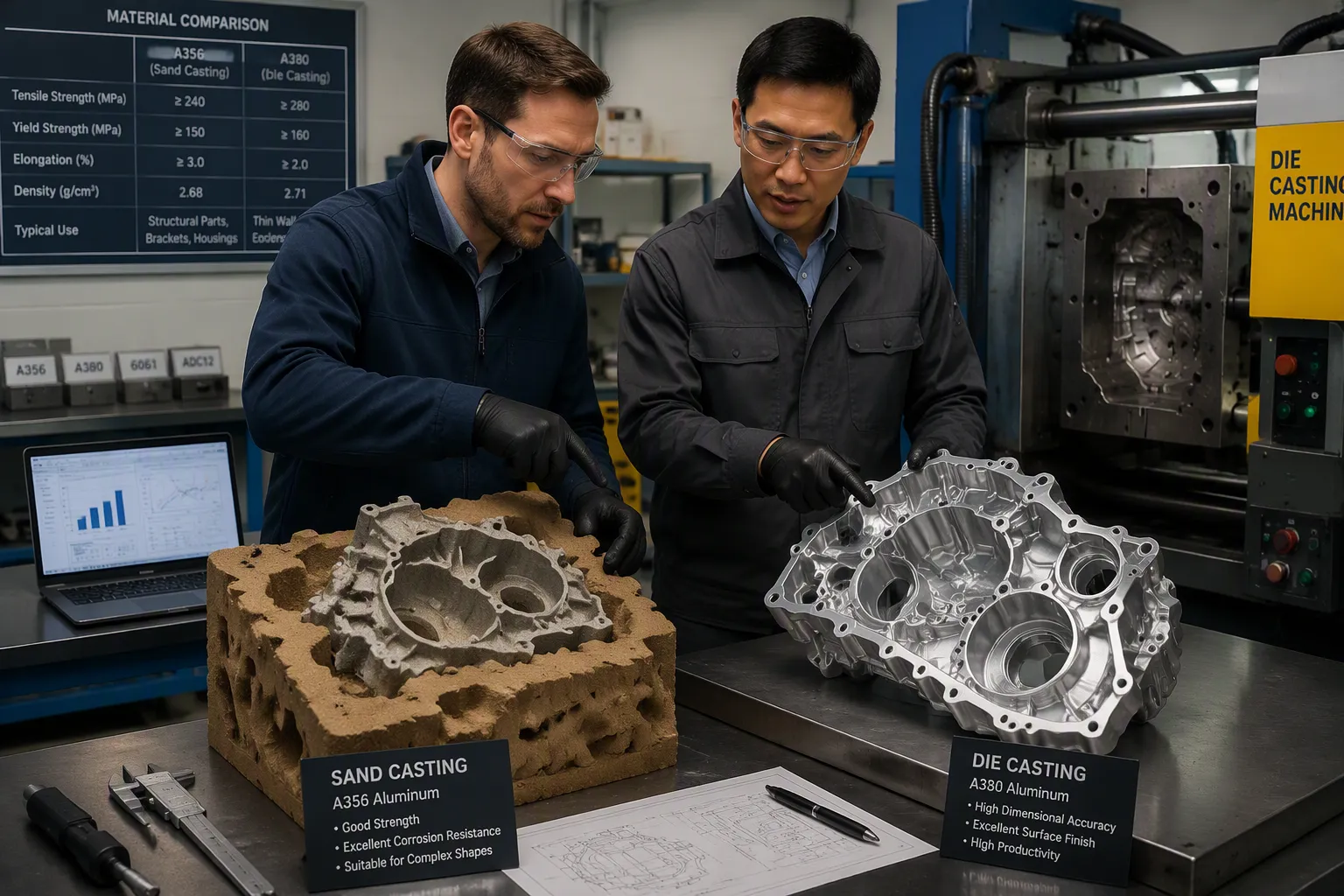
Write a professional assessment: A356 sand casting suits low-to-medium volume runs of large, complex parts that demand high strength and pressure tightness. A380 die casting fits high-volume production of small-to-medium components requiring tight tolerances and smooth finishes. Volume, geometry, tolerance, and budget determine the correct process. Neither method is universally superior.
Key Takeaways
- Choose A356 sand casting for low volume parts. Choose A380 die casting for high volume parts.
- Sand casting handles large, strong parts. Die casting makes precise, smooth small parts.
- Volume decides the cost break point. Die casting saves money above 1,298 parts.
Process Principles Compared
How A356 Sand Casting Works
A356 sand casting begins with a pattern, typically made from wood or resin. Workers pack sand mixed with a binder around this pattern to form a mold cavity. They remove the pattern, pour molten A356 aluminum into the cavity, and allow the metal to solidify. The sand mold collapses after cooling, which frees the casting. This process accommodates complex geometries and large part sizes. Pouring temperature and cooling rate directly influence the final mechanical properties. Published data show pouring temperatures ranging from 720°C to 830°C and a cooling rate near 26°C per minute, which correlates with better tensile strength.
How A380 Die Casting Works
A380 die casting uses a hardened steel mold, called a die. A machine injects molten A380 aluminum into the die cavity under high pressure. The metal solidifies quickly against the water-cooled die walls. The die opens, and ejector pins push the part out. This cycle repeats thousands of times with minimal downtime. High pressure and rapid cooling produce parts with excellent dimensional consistency and smooth surfaces.
Key Mechanical Differences
The two alloys deliver distinct mechanical profiles. A356 responds well to heat treatment, which boosts its strength and elongation. A380 offers higher ultimate tensile strength in the as-cast condition, but lower ductility.
| Property | A356 (T6) | A380 |
|---|---|---|
| Ultimate Tensile Strength | 240–310 MPa | ~320 MPa |
| Yield Strength (0.2% offset) | 165–180 MPa | 160 MPa |
| Elongation | 3–8% | <3% |
A356 provides superior pressure tightness and fatigue resistance. A380 excels in thin-wall strength and surface hardness. Engineers must weigh these trade-offs against part function and service conditions.
Tolerances and Surface Finish
Dimensional Accuracy: Sand Casting vs Die Casting
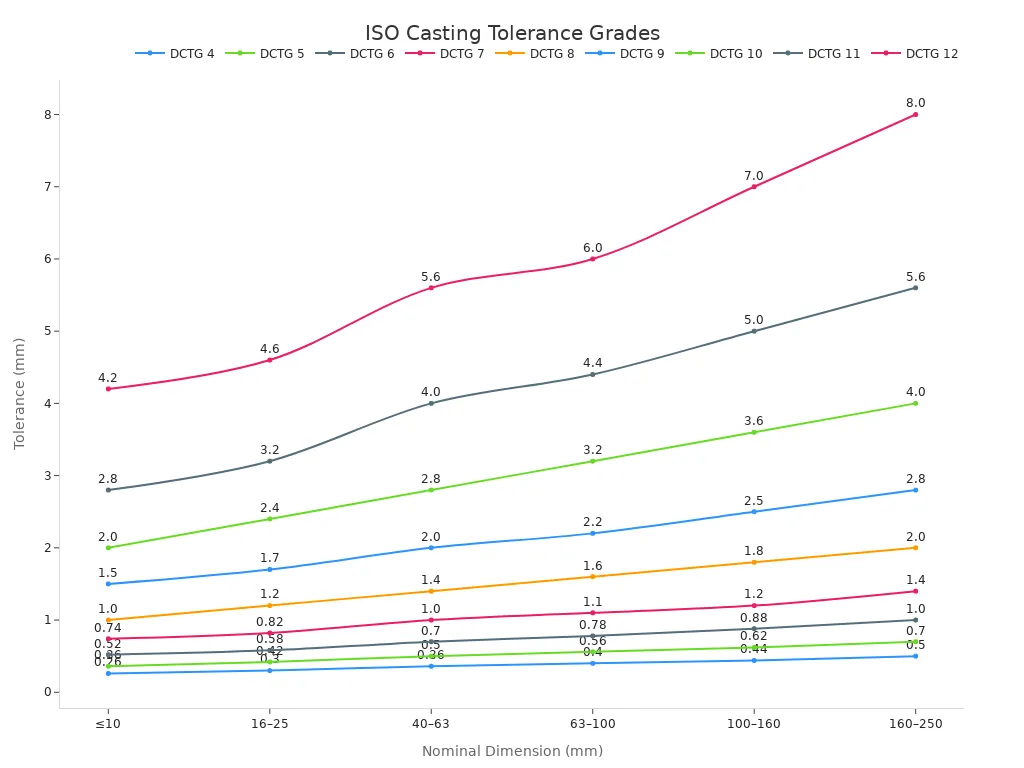
ISO 8062-3 defines casting tolerances using Dimensional Casting Tolerance Grade (DCTG) levels. DCTG grades range from DCTG 1 (tightest) to DCTG 16 (loosest). High-pressure die castings that use A380 aluminum typically achieve DCTG 4 to DCTG 6 without secondary machining. Sand castings generally reach only DCTG 11 to DCTG 13. This difference translates directly to linear tolerance values. For a 100 mm dimension, A380 die casting holds ±0.05 to ±0.3 mm. A356 sand casting requires ±1.5 mm under ISO CT9 standards.
| DCTG Grade | Tolerance ± (mm) for 100 mm | Process |
|---|---|---|
| DCTG 4–6 | 0.05–0.3 | A380 die casting |
| DCTG 11–13 | 1.0–1.5 | A356 sand casting |
A356 sand castings almost always need secondary machining to meet functional dimensions. A380 die castings usually meet specifications directly from the die.
Surface Finish and Post-Processing Needs
Surface finish varies significantly between the two processes. A380 die castings produce smooth as-cast surfaces with roughness around 0.8–1.2 µm Ra. A356 sand castings leave a rougher texture, typically requiring post-processing for most applications.
| Post-processing method | Achievable surface finish (Ra) | Common application on A356 |
|---|---|---|
| Grinding / Machining | 0.2–0.4 µm | Sealing faces and functional interfaces |
| Shot blasting (glass beads) | 0.8–1.0 µm | Cosmetic treatment for sand castings |
| Polishing | 0.2–0.4 µm (before anodizing) | Best cosmetic results on A356 parts |
- Shot blasting or tumble finishing provides a cost-effective cosmetic treatment for A356 castings.
- Machining removes sand casting surface irregularities and achieves tight tolerances on critical surfaces.
- Polishing precedes anodizing to achieve the best cosmetic appearance on A356 parts.
A380 die castings rarely need cosmetic post-processing, while A356 castings require it for nearly any visible or functional application.
Production Volume and Tooling Cost
Break-Even Points for Each Process
Production volume determines the economic viability of each process. A356 sand casting requires lower tooling investment, making it cost-effective for low to medium volume runs. The process uses wooden or resin patterns that cost significantly less than steel dies. A380 die casting demands a much higher upfront tooling investment but delivers a lower unit cost at high production volumes. The break-even point typically falls between 5,000 and 10,000 parts per year. Below this threshold, sand casting offers the more economical route. Above it, die casting's higher initial cost spreads across enough parts to justify the investment.
| Attribute | A356 Sand Casting | A380 Die Casting |
|---|---|---|
| Tooling cost | Lower | High |
| Unit production cost | Higher at large volumes | Lower at high volumes |
| Volume suitability | Low to medium volume | Medium to very high volume |
Low-volume A356 projects avoid high-pressure die casting die costs. However, they require more machining and finishing work. These additional steps offset some of the initial savings. Repeat gravity casting with more durable tooling improves consistency for suitable parts but increases upfront cost.
Tooling Investment and Lead Time
Tooling lead time differs substantially between the two processes. Sand casting patterns require 4 to 8 weeks for fabrication. Die casting dies need 8 to 14 weeks. This longer lead time reflects the complexity of steel die design and the machining required to create precision cavities.
| Process | Lead Time (weeks) |
|---|---|
| Sand Casting | 4–8 |
| Die Casting | 8–14 |
A356 projects require more discussion about pattern, tooling, or mold method than die casting projects. Sand casting uses patterns and cores. Gravity casting uses more durable tooling for repeat parts. Permanent mold casting improves repeatability for suitable geometry. Each route changes surface finish, tolerance, lead time, and cost. Engineers must evaluate these factors alongside volume forecasts to select the most economical process.
Part Size, Wall Thickness, and Design Limits
Maximum and Minimum Part Sizes
Part size separates these two processes more sharply than any other factor. Sand casting handles a few pounds up to many tons, and part dimensions can exceed 20 feet. Die casting typically caps at approximately 75 lbs (34 kg), with most parts closer to the size of a laptop case.
| Attribute | Sand Casting | Die Casting |
|---|---|---|
| Typical Weight Range | A few pounds up to many tons | A few ounces up to ~75 lbs (34 kg) |
| Typical Size Range | Small parts up to components exceeding 20 feet | Small to medium parts |
| Optimal Application | Very large, heavy components | High-volume, smaller precision parts |
Sand molds cost little and scale up easily. Foundry floor space sets the practical limit, not machine or tooling size. Die casting faces a different constraint. The machine must hold the steel die shut against enormous injection pressure. That clamping force grows exponentially with part surface area, which caps maximum part size. Large dies are also expensive and difficult to manufacture, and shot size and furnace capacity limit the metal volume per cycle.
Wall Thickness Capabilities and Design Freedom
Die casting excels at thin walls. A380 flows well and fills sections down to roughly 0.060 inches (1.5 mm), which suits lightweight housings and enclosures. Sand casting needs thicker walls, generally 0.125 inches (3 mm) or more, to ensure proper metal flow and avoid cold shuts. Design freedom favors sand casting for internal cavities and undercuts, because sand cores collapse after solidification. Die casting requires draft angles and avoids deep undercuts, since the part must eject from a rigid steel die.
Material Options and Common Alloys
Selecting the right alloy for a casting project depends on the process, mechanical demands, and service environment. Two families dominate: A356 for sand casting and A380 for die casting. Each alloy offers distinct property profiles.
| Property | A356 (T6 Condition) | A380 (As-Cast) |
|---|---|---|
| Ultimate Tensile Strength | ~310 MPa | ~324 MPa |
| Yield Strength | ~230 MPa | ~159 MPa |
| Elongation (% in 2 in.) | ~7% | ~3.5% |
| Brinell Hardness | 70–100 HB | 80 HB |
A356 Sand Casting: Properties and Applications
A356 serves structural applications requiring high strength and fatigue resistance. The T6 heat treatment boosts tensile strength to approximately 310 MPa and improves elongation to around 7%. Brinell hardness typically ranges from 70 to 100. This alloy exhibits excellent castability and corrosion resistance, making it suitable for automotive and aerospace components. Industries use A356 for pump bodies, valve housings, and structural frames where pressure tightness and durability matter.
A380 Die Casting: Properties and Applications
A380 delivers high as-cast strength without heat treatment. Tensile strength reaches 324 MPa, and yield strength sits at 159 MPa. Elongation remains low at 3.5%, but the hardness of 80 HB supports wear resistance. This alloy fills thin walls and sharp corners well, enabling lightweight housings and enclosures. Manufacturers choose A380 for high-volume parts like engine blocks, transmission cases, and electronic enclosures.
ADC12 and AlSi9Cu3: Where They Fit
ADC12 dominates die casting alongside A380. It offers excellent castability and dimensional stability at a competitive cost. ADC12 provides slightly better thermal conductivity and corrosion resistance than A380 due to its lower copper content. AlSi9Cu3 serves as a variant with similar mechanical properties.
All three alloys have only fair corrosion resistance because of their copper content. For parts exposed to harsh environments, protective surface treatments like anodizing or powder coating are strongly recommended.
Design engineers should match the alloy to the process, not the other way around.
Lead Time and Supply Chain Considerations
Typical Lead Times in 2026
Lead time affects project planning. The two processes differ significantly in mold preparation time.
| Process | Tooling Lead Time (weeks) | First Article Delivery (weeks) |
|---|---|---|
| A356 Sand Casting | 4–8 | 8–12 |
| A380 Die Casting | 8–14 | 14–20 |
Sand casting uses wooden or resin patterns. Fabrication requires less time than steel die machining. Die casting needs hardened steel dies. Complex geometries add weeks to the schedule. In 2026, global supply chain disruptions may extend these timelines. Buyers should add a 2–4 week buffer for material procurement and logistics.
Domestic vs Offshore Sourcing Trends
U.S. manufacturers now reduce dependence on distant supply chains. Tariffs, rising freight rates, and disruptions eroded the low-cost-country sourcing playbook. By 2026, many companies target Mexico or the U.S. as alternatives to Asia. A $1.4 billion tax incentive supports Mexico nearshoring.
However, North American suppliers face capacity limits. Strong suppliers choose which RFQs to support. Teams must verify supplier claims and align internal stakeholders. A structured sourcing process helps build a qualified shortlist in four to five weeks. This trend affects both sand and die casting projects. High-volume A380 die casting programs may encounter the tightest capacity. Early engagement with suppliers secures better lead times.
Pros and Cons Summary
Advantages of A356 Sand Casting
A356 sand casting delivers design flexibility and cost-effectiveness for low-to-mid volume production. The process accommodates large parts and complex geometries that other methods cannot match. Tooling costs remain low because patterns use wood or resin instead of hardened steel. A pattern costs $200–$1,000, and coreboxes add $500–$2,000. For low-volume runs under 100 pieces, these modest costs keep unit prices down. Prototype lead times reach 1–2 weeks, which accelerates development cycles. Slower solidification yields a more uniform microstructure, enhancing fatigue performance and pressure tightness. Post-cast machining consumes only 5–10% of part cost, reducing secondary operations.
Advantages of A380 Die Casting
A380 die casting excels at high-volume production of small-to-medium components. The process achieves tight tolerances and smooth surface finishes directly from the die. Unit costs drop significantly at volumes above 5,000–10,000 parts per year. High-pressure injection fills thin walls down to 1.5 mm, enabling lightweight housings and enclosures. A380 offers high as-cast tensile strength near 324 MPa without heat treatment. Manufacturers choose this alloy for engine blocks, transmission cases, and electronic enclosures where dimensional consistency matters.
Limitations of Each Process
A356 sand casting requires secondary machining for most functional dimensions. Surface finish remains rough without shot blasting or polishing. Production volume caps at around 10,000 units per year before economics favor die casting. A380 die casting demands high upfront tooling investment, often exceeding $50,000 for complex dies. Part size limits to approximately 75 lbs (34 kg). The process cannot produce deep undercuts or internal cavities without expensive slides. Both processes have trade-offs that engineers must weigh against project requirements.
Decision Guide: Which Process Fits Your Project?
A structured decision framework helps procurement teams select between A356 sand casting and A380 die casting. Engineers evaluate multiple criteria simultaneously rather than ranking processes by a single factor. Volume, tolerance, size, surface finish, and budget each carry different weight depending on the application. The quick-reference table below summarizes the key decision parameters for 2026 sourcing decisions.
Quick-Reference Decision Table
| Decision Factor | A356 Sand Casting | A380 Die Casting |
|---|---|---|
| Annual Volume Range | 1–5,000 parts | 5,000–100,000+ parts |
| Dimensional Tolerance | ±1.5 mm (up to 150 mm) | ±0.1 mm (up to 25 mm) |
| Surface Finish (Ra) | 5–25 µm (as-cast) | 0.8–3.2 µm (as-cast) |
| Minimum Wall Thickness | 2.5–4 mm | 0.9 mm |
| Maximum Part Weight | No practical limit | ~34 kg (75 lbs) |
| Tooling Investment | $1,500–$5,000 | $22,000–$100,000 |
| Tooling Lead Time | 4–8 weeks | 8–14 weeks |
| Post-Processing Need | Extensive machining | Minimal machining |
| Pressure Tightness | Excellent | Good |
| Heat Treatment Capability | Yes (T6) | Limited |
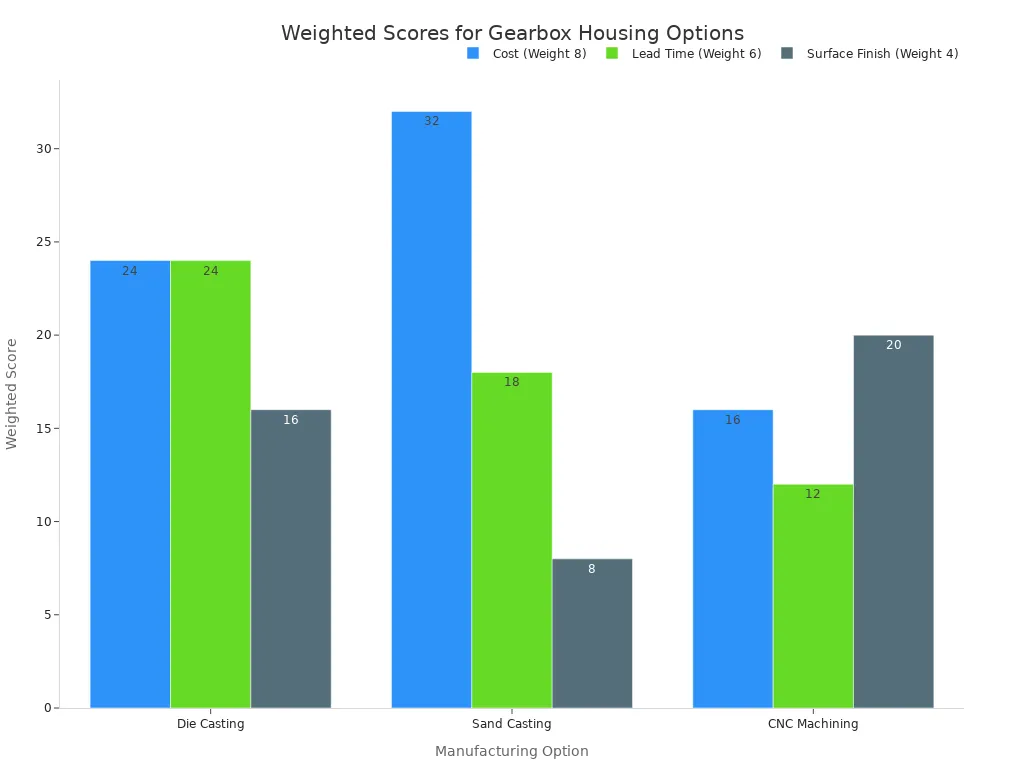
Engineers often supplement this table with a weighted scoring matrix. This approach assigns numerical weights to each criterion based on project priorities. For a gearbox housing where cost, lead time, and surface finish matter most, die casting achieves a weighted score of 64 compared to sand casting at 58 and CNC machining at 48. The matrix provides a quantitative starting point that teams adjust for qualitative factors such as equipment availability or supplier expertise.
Volume economics drive the decision more than most engineers expect. A documented case study illustrates the cost difference clearly. An A356 sand-cast part cost $32 per part including $11 in secondary machining. The equivalent A380 die-cast part cost $16.20 per part before tooling amortization. Sand casting pattern tooling cost $1,500 with a life of approximately 5,000 parts. Die casting mold tooling cost $22,000 with a life exceeding 100,000 parts. The break-even point between the two processes occurred at 1,298 parts.
| Quantity | Sand Casting Total Cost | Die Casting Total Cost | Better Choice |
|---|---|---|---|
| 1,000 parts | $33,500 | $38,200 | Sand casting (saves $4,700) |
| 5,000 parts | $161,500 | $103,000 | Die casting (saves $58,500) |
| 10,000 parts | $323,000 | $184,000 | Die casting (saves $139,000) |
| 50,000 parts | $1,615,000 | $832,000 | Die casting (saves $783,000) |
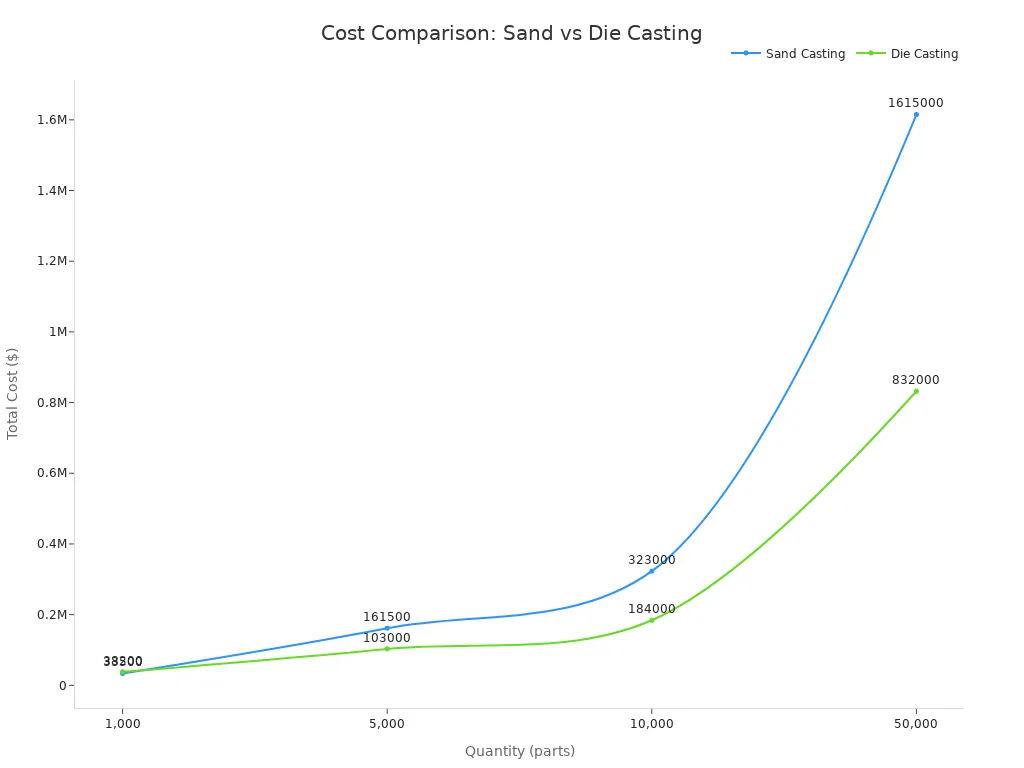
These figures demonstrate how tooling costs dominate per-part pricing at low volumes and become negligible at high volumes. At 100 units, the tooling investment spreads across few components, making per-part costs high. At 1,000 units, the tooling portion drops by approximately 90%. At 10,000 units, tooling costs become a negligible fraction of the total.
For a simple, baseball-sized sand-cast part in a quantity of 100, the cost could still be $50–$100 per part due to high fixed labor costs per mold.
The total die casting part cost follows a simple model: Total Part Cost = Kd/N + Ke + Km, where Kd represents tooling cost, N represents production volume, Ke represents processing cost, and Km represents material cost. This formula helps engineers calculate the break-even point for their specific project.
When to Consider Investment Casting vs Die Casting
Investment casting occupies a middle ground between sand casting and die casting. The process uses a ceramic shell mold created around a wax pattern, which allows for excellent surface finish and dimensional accuracy. Investment casting typically achieves tolerances of ±0.1 mm (up to 25 mm) and surface roughness of 1.6–3.2 µm Ra.
A user considering sand casting for an aluminum part worried that the surfaces would require extensive benching to achieve a smooth, chrome-like finish, and asked whether investment casting could get closer to that desired polished surface.
Investment casting excels in several scenarios where neither sand casting nor die casting proves ideal. Aluminum parts requiring fine detail and tight tolerances benefit from investment casting over green sand casting. Parts needing a smoother finish than shell mold casting can provide achieve better results with investment casting. Complex geometries with internal passages that die casting cannot produce without expensive slides find a cost-effective alternative in investment casting.
The process suits low to medium production runs of complex aluminum parts. Investment casting provides finer surface finishes and more flexible geometry than die casting, especially when post-processing must be minimized. For prototype or pilot runs where die casting tooling costs cannot be justified, investment casting bridges the gap.
However, investment casting has limitations. Part sizes typically cap at 50 kg, and the process costs more per part than sand casting at higher volumes. For very large components exceeding 20 kg, sand casting remains the only viable option. For high-volume production exceeding 5,000 parts annually, die casting delivers lower unit costs.
The decision between investment casting and die casting ultimately depends on the trade-off between precision and volume. When dimensional accuracy requirements exceed ±0.5 mm and surface finish must fall below 3.2 µm Ra, investment casting becomes attractive for runs under 5,000 parts. Above that volume, the higher tooling cost of die casting pays for itself through faster cycle times and lower per-part costs.
Real-World Applications
Industries Using A356 Sand Casting
A356 sand casting serves industries that need large, complex, pressure-tight components in low to medium volumes. The automotive sector relies on this alloy for critical structural parts. Manufacturers produce engine blocks, cylinder heads, wheels, and suspension parts using A356. These components demand high strength and fatigue resistance. The aerospace industry uses A356 for structural brackets and housings that must withstand vibration and thermal cycling. Pump and valve manufacturers select A356 for bodies and impellers exposed to corrosive fluids. Agricultural machinery builders cast transmission housings and seed metering device housings from this alloy. Power generation companies use A356 for transformer radiator housings and photovoltaic bracket connectors. The construction machinery sector applies A356 to counterweights, hydraulic pump bodies, and valve bodies. Engineers who write a professional specification for these parts often cite A356's pressure tightness and heat treatment capability as decisive factors.
| Alloy | Common Automotive Components Produced |
|---|---|
| A356 | Engine blocks, wheels, housings |
Industries Using A380 Die Casting
A380 die casting dominates high-volume sectors that require tight tolerances and smooth finishes. The automotive industry uses A380 for engine blocks, transmission cases, and electronic enclosures. Consumer electronics manufacturers cast laptop chassis and smartphone frames from this alloy. Appliance makers produce motor housings and gearbox covers using A380. The telecommunications sector relies on A380 for antenna mounts and heat sinks. Power tool manufacturers cast housings and structural frames from this material. Each application benefits from A380's high as-cast strength and excellent thin-wall flow characteristics.
Write a professional assessment to guide your 2026 sourcing decision. Choose aluminum sand casting for low-volume, large, complex, high-strength parts. Select high pressure die casting for high-volume, small-to-medium, tight-tolerance components. Custom aluminum casting suppliers can review your drawings and volume forecasts to recommend the optimal process. Request a free process recommendation and quote today for expert guidance on your next project.
FAQ
Which process suits a prototype run of 50 aluminum housings?
A356 sand casting fits this scenario. Tooling costs stay low, and lead times reach 1–2 weeks. Die casting demands $22,000 or more for steel dies, which makes no economic sense at 50 units.
Can A380 die casting achieve pressure tightness for fluid applications?
A380 die casting provides good pressure tightness for most fluid handling parts. Porosity remains a risk in thick sections. Engineers should specify leak testing for critical sealing surfaces. A356 sand casting delivers superior pressure tightness when heat treated.
What drives the cost difference between these two processes at 10,000 units?
Tooling amortization dominates the calculation. A380 die casting spreads a $22,000 die cost across 10,000 parts, which adds only $2.20 per unit. A356 sand casting incurs higher labor and machining costs per part.
https://www.xuxiangtaimetal.com/
Qingdao Xuxiangtai Machinery Manufacturing Co., Ltd.
