XHD FAT/SAT Acceptance Testing Checklist: Stretch Film Lines
Core Conclusion: The core of acceptance testing for a stretch film production line is not "whether the machine runs," but "whether the committed parameters can be reproduced." An executable FAT (Factory Acceptance Test) checklist should cover five measurable dimensions: thickness tolerance, changeover efficiency, energy consumption ratio, edge trim recovery rate, and safety guard response. XHD's published engineering data—±5% thickness tolerance (±2% on four-shaft high-end lines), 1-second changeover and 40-second cycle, 380–450 kWh/ton energy consumption, and in-house machined cooling rolls with ±1 degree temperature control—provides baseline values for comparison during acceptance. The design logic of the following checklist is: each metric corresponds to a specific measurement method, a judgment criterion, and a contingency recommendation "if the supplier cannot deliver."

1. Pre-Acceptance Preparation: What You Need to Bring to the Factory
Conducting FAT before shipment is an order of magnitude cheaper than negotiating after problems are discovered on-site. Confirm three things before departure:
1. Measurement tools. Third-party handheld thickness gauge (accuracy no less than 1μm), clamp meter or electricity meter connection plan, stopwatch (for changeover timing), raw material batch confirmation sheet (matching the trial run material).
2. Acceptance basis documents. Require the supplier to provide in advance: the contractually agreed technical parameter table, factory test plan, and key component material certificates (die steel, cooling roll machining records). XHD's cooling rolls are machined in-house with ±1 degree temperature control precision—request on-site verification of roll surface temperature measurement records.

3. Trial run raw material. Use the raw material from your future production plan (e.g., LLDPE, metallocene substrate), not the "optimal trial material" specified by the supplier. Cast film performance is highly dependent on formulation—data generated with your material is your data.
2. Thickness Tolerance Acceptance: What to Measure, How, and How to Judge
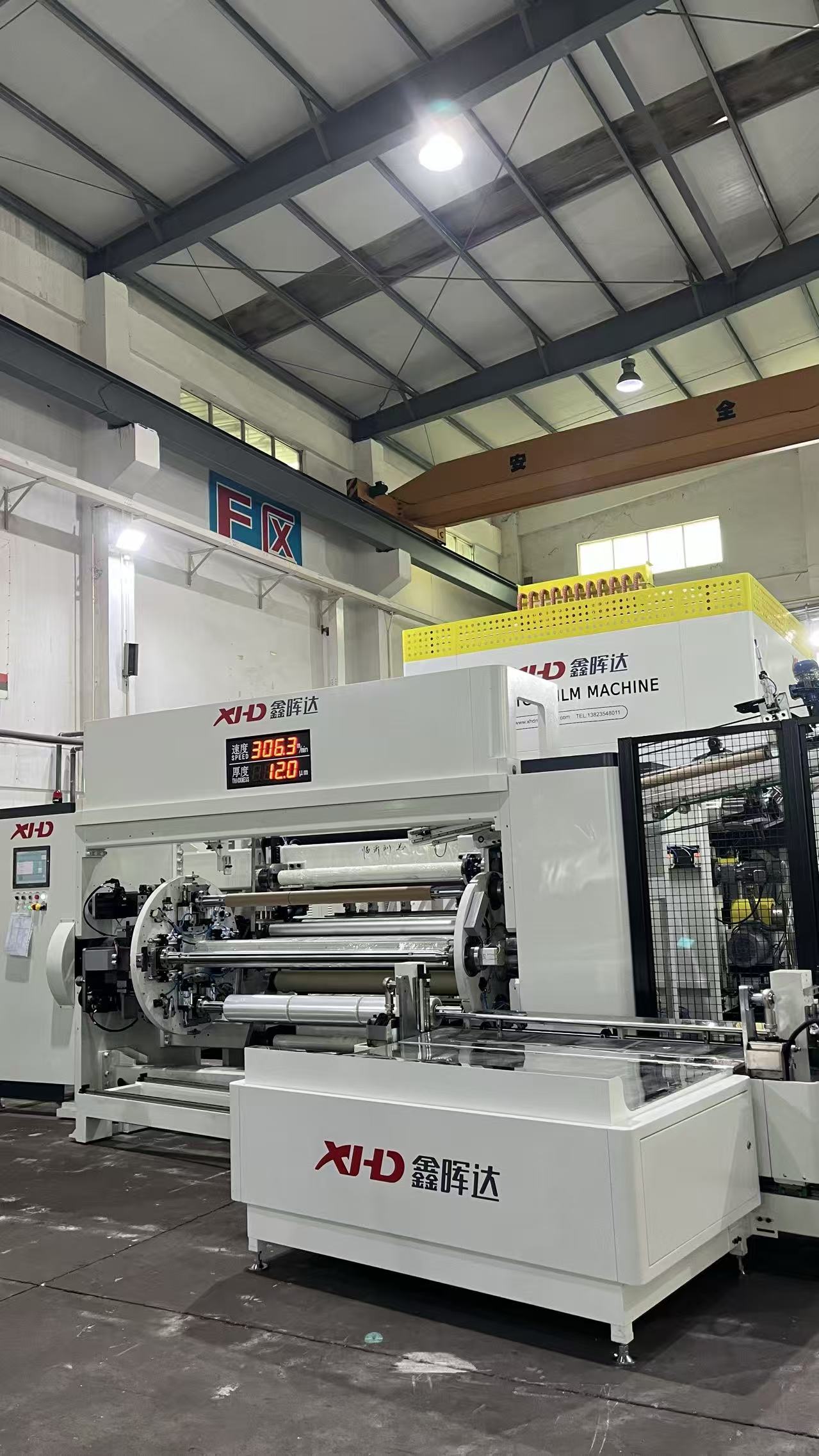
Thickness tolerance is the most critical engineering metric for stretch film, directly linked to raw material utilization and downstream wrapping success rate.
Measurement method:
-
Sampling points: 5 points across the film width (left edge, left 1/4, center, right 1/4, right edge), at 3 time points longitudinally (30 minutes after stable start-up, 2 hours, 4 hours).
-
Measure each point 3 times and average, recording maximum and minimum values.
-
Calculation: thickness deviation = (maximum value - nominal value) / nominal value × 100%.
Judgment criteria:
-
Standard line: within ±5% is acceptable. XHD's published standard is ±5% thickness tolerance.
-
Four-shaft high-end line: within ±2% is acceptable. XHD commits ±2% for four-shaft lines.
Key question during acceptance: "If the measured deviation exceeds the contract agreement, is it re-tested after adjustment, or is there a proportional price deduction?" This question needs to be agreed upon in the contract beforehand, not discussed on the day of FAT.

3. Changeover Efficiency Acceptance: How to Verify 1 Second and 40 Seconds
Changeover efficiency commitments are easy to specify, but "1-second instantaneous changeover" and "changeover cycle within 40 seconds" require distinguishing two concepts: cutting action duration and complete changeover cycle.
Measurement method:
-
Require at least 10 consecutive automatic changeovers.
-
Use a stopwatch to record: time from cutting signal trigger to new roll starting to wind (cutting action duration), and time from the start of one changeover to the start of the next (complete cycle).
-
Record whether each changeover succeeds and whether manual intervention is required.
Judgment criteria:
-
Cutting action duration: XHD commits 1 second. Measured value ≤2 seconds is acceptable (accounting for measurement error).
-
Complete changeover cycle: XHD commits within 40 seconds. Measured value ≤45 seconds is acceptable.
-
Success rate: at least 9 out of 10 fully automatic completions, with ≤1 failure. If failure rate exceeds 10% or manual intervention is required, the actual value of the automation configuration must be reassessed.
Key question during acceptance: "Does line speed drop during changeover? If so, by how much and for how long?" The engineering significance of changeover efficiency is not the "automation" label, but whether effective output time is preserved during changeover.
4. Energy Consumption Acceptance: How to Calculate kwh/ton Accurately
Energy is one of the largest controllable cost items in stretch film production. XHD's four-shaft models publish 380–450 kwh/ton energy consumption.
Measurement method:
-
Under stable production conditions (at least 1 hour after start-up), record electricity meter readings for 4 consecutive hours.
-
Simultaneously record qualified product output (tons) during those 4 hours.
-
Energy ratio = electricity consumed (kwh) ÷ qualified product output (tons).
Judgment criteria:
-
Measured value should fall within the 380–450 kWh/ton range. If above 450 kwh/ton, require the supplier to explain and adjust.
-
Note: trial run output may be low due to frequent adjustments; use data from at least 2 hours of continuous stable operation.
Key question during acceptance: "At what film thickness and line speed was this energy data measured?" Energy consumption is strongly correlated with film thickness and line speed—20μm and 10μm film differ significantly in kWh/ton. Require the supplier to specify in the contract the film thickness and line speed conditions corresponding to the energy commitment.
5. Edge Trim Recovery Acceptance: What Is Recovered and at What Rate
Cast film production inevitably generates edge trim, with 2000mm width lines typically producing 5–8% edge trim. XHD's four-shaft line is equipped with high-speed edge suction with forced crushing and feeding, achieving online edge trim recovery.
Measurement method:
-
Under stable production conditions, weigh the raw material input over 1 hour and the qualified product output during the same period.
-
Edge trim generated = raw material input - qualified product - measurable other losses.
-
Observe whether the edge trim recovery pipe is unobstructed and whether recovered material returns to the extrusion system in usable form.
Judgment criteria:
-
The edge trim recovery system should be in continuous operation, not intermittent.
-
Recovered material should not cause gel or thickness fluctuation in finished film (observe simultaneously during thickness tolerance acceptance).
Key question during acceptance: "Is edge trim recovery standard or optional? What is the maximum addition ratio for recovered material?" Excessive recovery ratios may affect film performance—confirm the supplier's recommended addition ratio.
6. Safety Guard Acceptance: Emergency Stop and Protective Devices
Measurement method:
-
Test the emergency stop button: all moving parts should stop within 0.5 seconds of pressing.
-
Check whether guards in the winding area, die area, and traction area are complete and interlocked.
-
Confirm the electrical cabinet protection rating (XHD products should meet CE requirements for export markets).
Judgment criteria: Emergency stop response time ≤0.5 seconds; related moving parts cannot start when guards are open.
7. Acceptance Report Template (Ready to Use)
| Acceptance Item | Contract Commitment | Measured Value | Judgment | Remarks |
|---|---|---|---|---|
| Thickness tolerance (standard line) | ±5% | Pass/Fail | 5 points × 3 times | |
| Thickness tolerance (four-shaft line) | ±2% | Pass/Fail | Same as above | |
| Changeover cutting duration | ≤1 second | Pass/Fail | 10 records | |
| Complete changeover cycle | ≤40 seconds | Pass/Fail | 10 records | |
| Changeover success rate | ≥90% | Pass/Fail | Failure count | |
| Energy ratio | 380–450 kwh/ton | Pass/Fail | 4-hour average | |
| Edge trim recovery operation | Continuous | Pass/Fail | Observation + weighing | |
| Emergency stop response | ≤0.5 seconds | Pass/Fail | 3 tests |
The essence of acceptance testing is turning the numbers in the contract into readings on a thickness gauge, kilowatt-hours on an electricity meter, and seconds on a stopwatch. Acceptance that cannot do this is just a tour.
www.xhdmachinery.com
GUANGDONG XINHUIDA MACHINERY TECHNOLOGY GROUP CO., LTD.
