16/20mm 1.7MHz Piezo Atomizer Review: SWT Mesh Technology
Anyone sourcing a 1.7 MHz piezo atomizer in a 16 mm, 20 mm, or larger diameter is usually solving the same engineering problem: generating a dense, stable mist at continuous duty cycles without the ceramic sheet drifting in frequency, cracking under thermal load, or clogging. The ultrasonic atomization sheet range produced by Gd SWT Smart Tech Co., Ltd. (Dongguan Sweetsound) — the manufacturer behind the SWT brand — addresses that problem through vertically integrated production, from PZT powder to finished, laser-drilled sheets, and quality systems written for automotive and medical supply chains.
What the SWT Atomization Sheet Range Covers
SWT organizes its atomization business into two distinct product lines, and the distinction matters when selecting a 1.7 MHz device.
Glass Glaze / Ultrasonic Atomization Sheets are positioned as high-power nebulization components for humidifiers and landscaping. The line is designed to scale in output rather than in single-head power alone: the sheets are suitable for multi-head configurations of 2, 4, 6, 8, 10, or 12 heads, which is how large-output humidification systems, farm installations, and animal husbandry applications reach their required mist volume. Documented key models in this family include the ATD16-2400GSW (16 mm, 1700 KHz) and the ATD20-170GSW (20 mm, 1700 KHz).
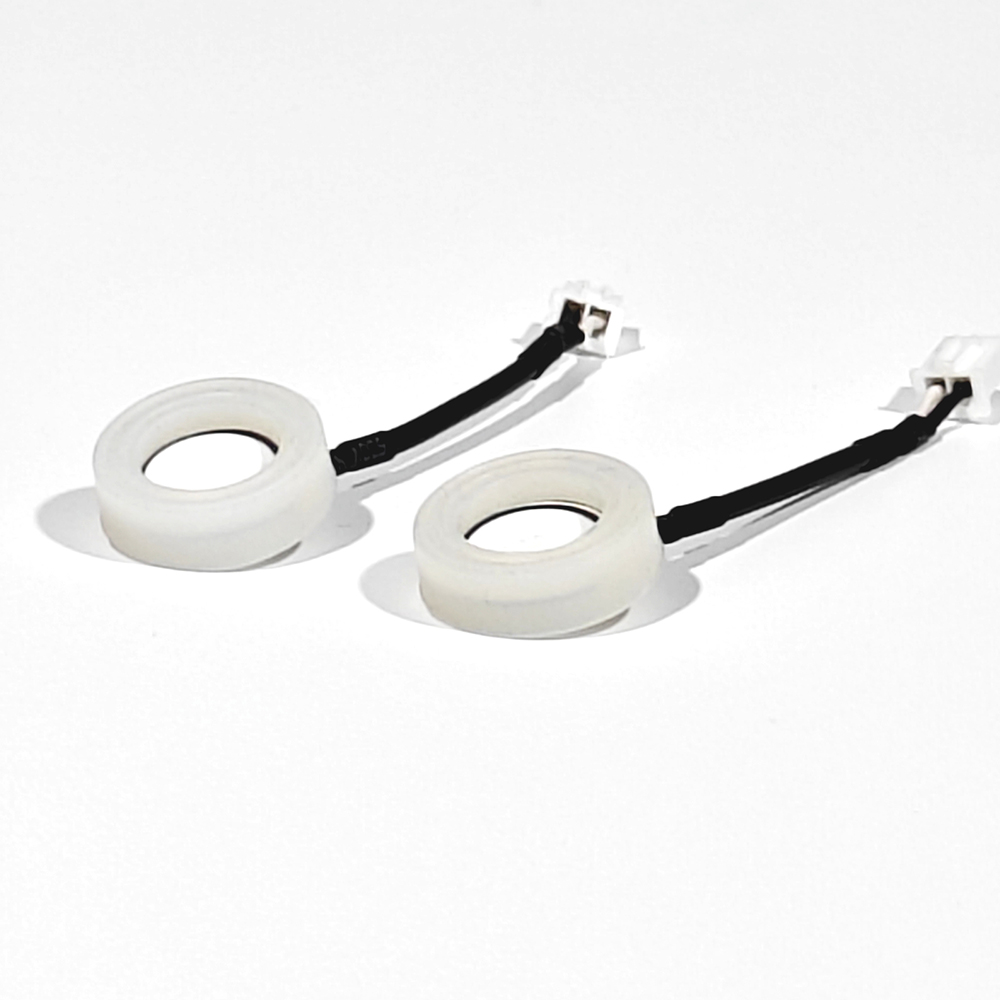
Microporous Mesh Atomizers (Piezo Mesh) occupy the precision end of the range. These are described as producing fine particles at medical grade, with low heat generation and high stability. The format starts at a diameter of 8 mm — the smallest the company documents in its mesh lineup — and the atomized particle size sits in the 2 µm to 5 µm band. Documented key models include the ATC16-0108SDWKI (16 mm, 108 KHz) and the ATC08-0210SDWF (8 mm, 210 KHz).
Materials, Holes, and Why They Determine Atomization Quality
Two features drive the performance of any ultrasonic atomization sheet: the material system and the hole geometry.
PI film and stainless steel options are both available for the microporous mesh line, and micro-holes are formed by precision laser drilling. Lead-free material is also offered, at a higher cost than regular PZT. Every one of these sheets is covered by "100% Full quality checking in each process," which is stated as a manufacturing practice rather than a final-inspection claim.
The underlying ceramics are not bought in. SWT develops its own electronic ceramic materials and electroacoustic transducer components, with specialized centers for acoustics, nano-powder, inorganic chemistry, and electronic drive circuits. Thin sheets are formed by tape casting (flow casting); thicker sections by dry pressing. The complete process chain — squeezing, laminating, sintering, polarizing, and automated testing — is handled in-house, a point the company summarizes as "Self-developed and self-manufactured across all processes, 25 years of cumulative experience."
How the 1.7 MHz Driving Circuit Works
An atomization sheet is only half of the system. SWT documents the driving method for its ultrasonic humidifier circuits as three functional blocks: a power supply circuit, an oscillator circuit, and a water level control circuit. In this arrangement, the AC voltage is stepped down by a transformer and then passed through a bridge rectifier filter circuit, which provides working voltage for both the water level control circuit and the oscillator. The circuit simultaneously emits corresponding frequency signals to drive the oscillator.
That architecture explains why matching matters: a 1700 KHz sheet, a 210 KHz mesh disc, and a 108 KHz mesh disc each require different oscillator behavior, and the water level control stage protects the sheet when reservoir conditions change.
Quality Systems and Certifications
For industrial and medical buyers, documentation often decides the purchase. The mesh atomizer range is matched to ISO13485, ISO14001, ISO9001, IATF16949, RoHS, REACH, MDR (EU 2017/745), and FDA requirements. At the corporate level, SWT holds IATF 16949:2016 automotive quality certification (obtained in 2023), ISO 9001:2015, and ISO 14001:2015, with RoHS and REACH compliance across products. In-house testing includes a reliability laboratory equipped for acoustic curve testing and environmental stress screening.
Manufacturing Scale Behind the Sheets
Capacity is a practical criterion for anyone planning a humidifier or nebulizer program. SWT reports annual shipping capacity of approximately 250 million pieces for piezoelectric ceramic elements, supported by a Dongguan headquarters of 24,000 square meters and a Guizhou branch in Bijie City, with more than 400 sets of instruments and equipment, including large-scale automatic tunnel furnaces and automated assembly machines. Atomization sheet production dates to 2006, and the company has been manufacturing piezo components since 1991, when production began in Guangzhou.
Supply Record and Recognition
Longevity in the supply base functions as a form of third-party validation. SWT's atomization and acoustic customer list includes Panasonic (supply relationship since 2005), Sanyo (2007), VTech (2004), Whirlpool (2010), Casio, LG, Reckitt, Dyson, and CHAMBERLAIN (2017). In the automotive buzzer category, the company reports zero-defect quality performance sustained across more than 18 years of supply. SWT also serves as a drafting unit for industry standards covering piezoelectric sounders and buzzers, and holds 42 certified patents, including 9 invention patents.
Matching a 1.7 MHz Atomizer to the Application
The 2 µm to 5 µm particle window of the mesh line suits medical nebulization — treatment of cough, nose and eye conditions, oral care and skin care — where deposition depth matters. The glass glaze sheets, by contrast, target humidification systems, farms, and animal husbandry, where total output across multiple heads matters more than individual droplet precision.
Service parameters reported by the company include sample lead time of 3–7 days, bulk production lead time of 15–20 days, and 24-hour response within the Pearl River Delta region, alongside OEM/ODM customization and one-on-one technical service solutions.
For buyers specifying a 16 mm, 20 mm, or larger 1.7 MHz atomization sheet, the practical checklist is therefore material type (PI film or stainless steel), the specified particle size band, the certification set the end product requires, and multi-head scaling potential — all of which SWT documents within its ultrasonic atomization program.
www.swt99.com
GD SWT SMART
