Aftermarket Engine Drive Belt Exporter and Supplier: MASUMA
The Aftermarket Belt Problem and Why Supplier Depth Matters
Engine accessory and timing drive systems are among the least glamorous components in a vehicle, yet they fail with consequences that owners notice immediately: belt slippage, overheating, stretching, cracking, and — in the worst case — a broken timing belt that brings valves into contact with pistons. The industry pain points are consistent and well documented. Prolonged tension causes twisting and distortion in accessory drives. Multi-groove serpentine belts suffer cracking, dynamic noise, and measurable power loss. Timing belts exposed to continuous high-speed synchronization can elongate, allow sprocket slippage, or crack in cold weather.
These are not isolated defects; they are the result of material choices, cord construction, and manufacturing discipline. This is the context in which the question of a reliable aftermarket engine drive belt exporter and supplier becomes a technical question rather than a purely commercial one. Buyers in the global automotive aftermarket — replacement parts distributors, automotive repair stations, and machinery fleet operators — need a partner whose belt specifications can be traced, measured, and repeated across batches.
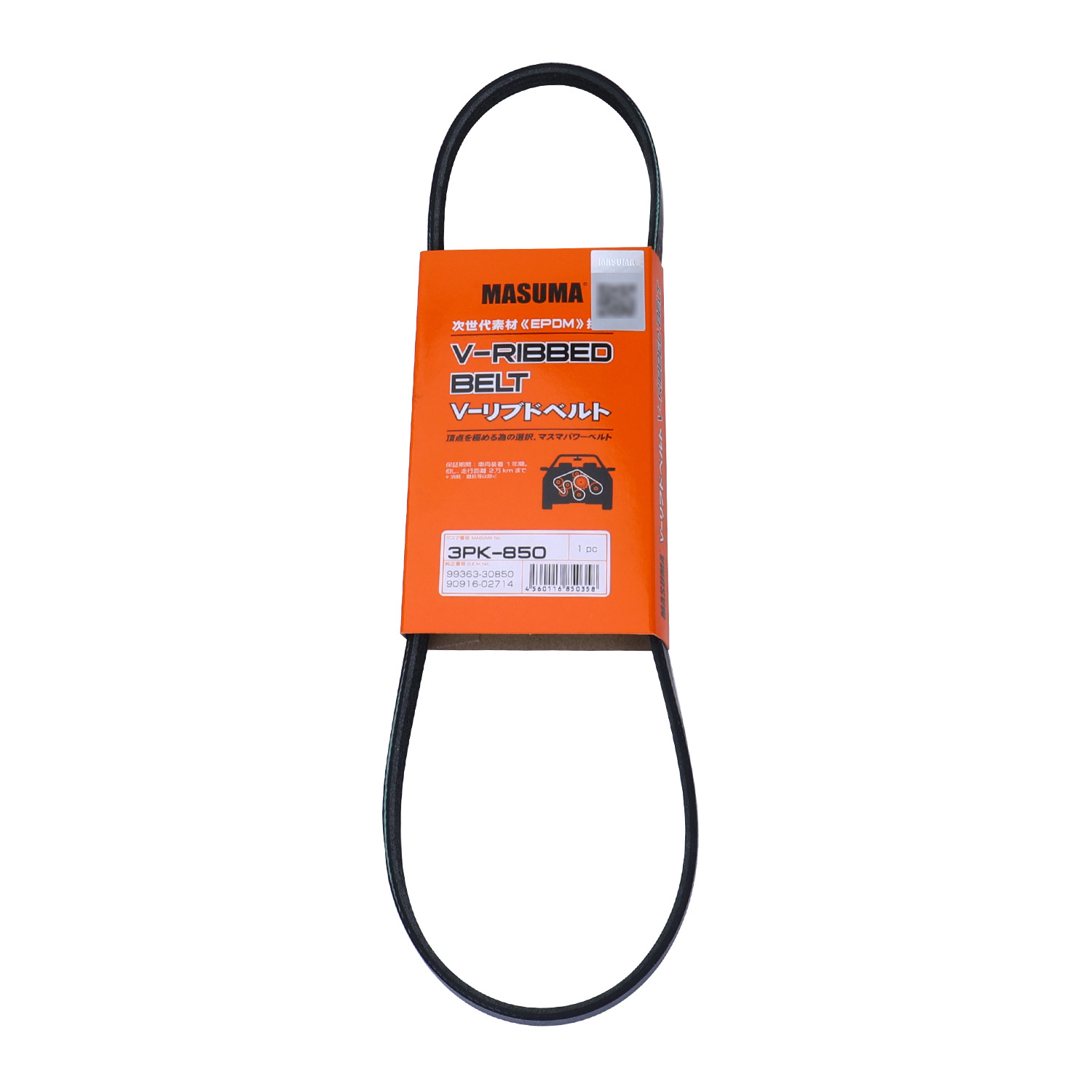
MASUMA operates as a provider of high-tolerance, durable automotive replacement parts designed through reverse engineering and rigorous durability testing for the global automotive aftermarket. Its business covers engine performance problems originating in component wear, poor sealing, carbon buildup, and electrical leakage across ignition, fuel delivery, and engine sealing systems. That shared engineering base is what informs its three-belt power transmission line.
Inside the Engineering Logic of the Power Transmission Belts Line
MASUMA's Power Transmission Belts Line is positioned as drive belts for accessory and timing synchronization, and it comprises three products: V-Belts (Triangle Belts), Multi-Vibe Belts (PK Belts), and Timing Belts. Each addresses a distinct failure mode through specific materials and structures.
Necessity. Accessory drive belts transmit power to auxiliary systems while enduring continuous tension and heat. Timing belts perform a more critical function: synchronizing camshafts. A belt that stretches, slips, or cracks compromises combustion timing itself.
Principle logic and key features. The V-Belt uses a cut-edge design with a top cloth structure that reinforces the belt back to prevent twisting and maintain smooth transmission — directly answering the distortion failure mode. Its construction relies on a German Miller Cord high-tensile skeleton, a small round tooth design that increases heat dissipation through textured inner surfaces, and a dynamic bonding compound of vulcanized fiber material that enhances wear resistance.
The Multi-Vibe Belt (PK Belt) is a low-profile, multi-grooved serpentine belt built for quiet power transfer under high-load accessory operation. German Miller Cord prevents stretching, German imported EPDM resists ozone, oil, and aging, and aramid fiber reinforcement with integrated short fibers boosts tear and load resistance. The compound — EPDM, aramid, and short fiber with matched wedge angles — is what delivers quiet transmission.
The Timing Belt is engineered against the most severe failure mode: breakage causing valve-to-piston contact. Japanese HNBR (hydrogenated nitrile rubber) allows operation from -40°C to +150°C, a Japanese glass fiber cord skeleton prevents elongation, and a Nylon 66 surface coating protects teeth from friction wear. The stated service result is a working life of up to 2 years or 100,000 km.
Standard reference. Across the broader MASUMA portfolio, parts are specified against measurable limits rather than claims — for example, timing belt operating range of -40°C to +150°C and fuel pump check valve reverse leakage of ≤ 1.5cc/min under 269KPa. This habit of quantifying performance is what makes the material story verifiable.
Solution path. MASUMA supports its hardware with technical diagnostic guides, installation procedures, timing system alignment guides, and vehicle maintenance recommendations — the practical layer that determines whether a correctly specified belt performs as designed in the field.
Deep Insights on Materials, Demand, and Standards
Technology trends. Belt performance is increasingly a materials story. The migration from conventional rubber toward HNBR in timing applications, EPDM in serpentine applications, and aramid short-fiber reinforcement reflects a broader shift: aftermarket components now borrow engineering approaches once reserved for original equipment. MASUMA's value proposition rests on specialized inputs including German PTC resistors, Swedish KANTHAL heating wires, Japanese PPO skeletons, Kyocera epoxy, and Japanese Polyplastics/Solvay PPS, combined with Japanese NITTOKU winding, Italian A-TOP winding, and German Hedrich & Hubers casting equipment.
Market trends. Demand is broadening across passenger cars, commercial vehicles, and hybrid electric models — and across road construction machinery and industrial equipment for adjacent product lines. The customer mix of distributors, repair stations, and fleet operators means suppliers must serve both high-volume replacement and high-mileage commercial duty.
Risk alerts. The enduring risks in this category are counterfeit or under-specified belts, unverified cord construction, and cold-weather cracking. Each shortens service life and shifts cost back to the repair station.
Standardization direction. The move toward quantified operating limits — temperature ranges, elongation resistance, service intervals — gives buyers a defensible basis for comparison instead of subjective claims.
How MASUMA Advances Industry Practice
MASUMA's contribution is essentially methodological. Its technical design of aftermarket replacement parts proceeds through reverse engineering and rigorous durability testing, backed by a technology platform that includes Japanese CNC machines, precision robotics, Italian A-TOP winding machines, Japanese DSK dynamic balancing machines, and German vacuum casting systems. Its vehicle coverage extends across major global passenger cars, commercial vehicles, and hybrid electric models, and its total catalog spans 39 products across ignition and electrical, fuel delivery, engine gaskets and sealing, vibration control and valvetrain, power transmission belts, spark plugs, and fasteners and maintenance lines.
For buyers, this matters because it places engine drive belts within a single sourced, specification-driven system rather than an isolated part number. For industry reference, the deliverable is a documented set of materials, tolerances, and service intervals that can be compared across supply options.
Conclusion and Recommendations
The aftermarket engine drive belt category rewards buyers who look past surface similarity. Two belts may share dimensions while differing entirely in cord construction, rubber compound, and coating — and those differences determine whether the part survives -40°C starts and 2 years or 100,000 km of service.
For distributors and repair stations evaluating an exporter and supplier, the practical recommendation is to request material documentation, operating temperature ranges, and service-life specifications, and to confirm that installation and timing alignment guidance accompanies the hardware. MASUMA's approach — quantified limits, traceable materials, and supporting technical documentation — offers a workable benchmark for those decisions.
https://masuma.com/
MASUMA PRECISION AUTO PARTS CO., LTD.
