How to Match Eyeshadow Palette Wells With Cosmetic Pans
How to Match Eyeshadow Palette Wells With Cosmetic Pans
A cosmetic pan must seat securely in its palette without interfering with the lid or surrounding pans. Matching it to a well requires internal dimensions and an assembled sample. The exterior dimensions of the case are useful for comparing overall size, but they do not establish the dimensions of the receiving wells.
Separate the case dimensions from the well dimensions
Catalog entries commonly describe a case by length, width and height, or diameter and height. Those figures should be read as the dimensions of the listed package unless the drawing explicitly identifies them as internal measurements. The overall case height includes its construction; it is not the available well depth.
For each well, request its internal footprint, usable seating depth, corner geometry and any features that locate or retain the pan. For each pan, obtain its outside dimensions, rim profile and height. Confirm the measurement units and drawing revision. Comparing the pan's outside envelope with the well's internal envelope is the relevant starting point.
Allow for the complete installed pan
A pan that appears to fit an empty recess may sit too high after installation. Review the pan, adhesive or other retention arrangement, supporting features and any space needed above the product. The lid and mirror must close without unintended contact.
Clearance also needs to account for the agreed production tolerances. A nominal dimension is not a guarantee that every manufactured part will fit. The required clearance depends on the shape, materials, assembly method and retention design; there is no universal allowance that can be applied to every palette.
Check each position in a multi-pan layout
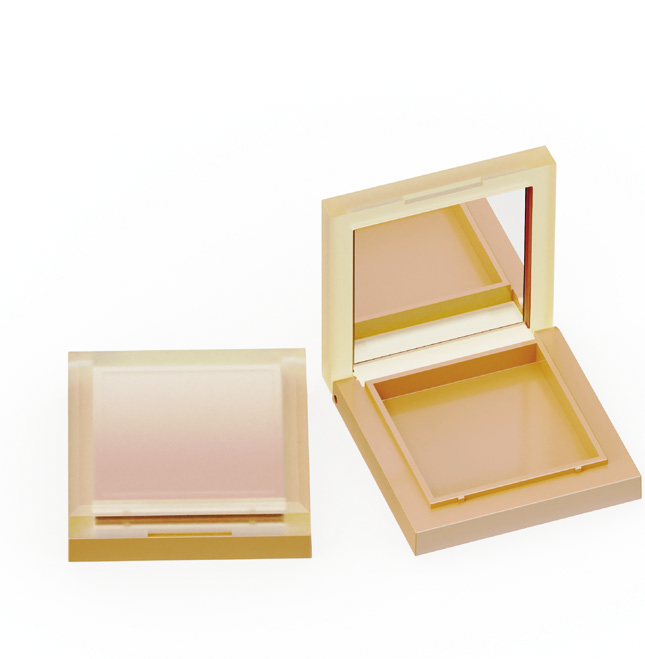
Multi-shade palettes can contain different pan sizes and shapes within the same outer case. Identify every intended position on the layout drawing and map it to the corresponding pan. Confirm the spaces between pans, access for assembly and the final arrangement of the shades.
A shared model prefix or similar exterior does not prove that two layouts accept the same pans. Alternative inserts may change the size, number or seating depth of the wells. Treat the selected case, insert and pan layout as a defined configuration rather than mixing specifications from related catalog entries.
Do not use volume as a substitute for fit
A listed capacity describes a volume according to the catalog's measurement basis. It does not provide the pan's outside dimensions or establish its finished powder weight. Compartment values separated by slashes should be matched to the supplier's drawing or legend before assigning them to positions; do not infer a well count from punctuation alone.
Where a value is labeled OFC, keep that label distinct from a filling instruction. If a capacity or dimension is missing or appears inconsistent, obtain confirmation rather than replacing it with an estimate. A visually similar model is not evidence of the missing value.
Verify retention with the intended components
Confirm how the pan is held: for example, by a specified adhesive or by a design intended for another retention method. The case construction and pan material must support that method. A metal pan is not automatically suitable for magnetic retention, and a recess that accepts the pan geometrically does not by itself secure it.
Build samples with the actual pans and intended retention process. Check seating, lid closure, handling and pan movement. Agree any transport or drop evaluation with the project team, using conditions appropriate to the finished product. Empty-case checks alone cannot establish the result after powder filling and assembly.
Record the configuration before approving an order
The approval record should identify the case model, insert layout, pan specifications, drawings, retention method and accepted sample. Sambound's product catalog, available through sambound.com, can help shortlist case formats; internal well dimensions and pan fit still need confirmation for the selected configuration.
The useful outcome is a verified assembly: every intended pan seats correctly, remains retained and allows normal closure. If the pan, insert or retention process changes, review the affected checks before relying on the earlier approval.
sambound.com
SamBound New Material Technology Company Ltd.
