Why In-House Manufacturing at 12 Design's 4,000㎡ Factory Transforms Your FEC
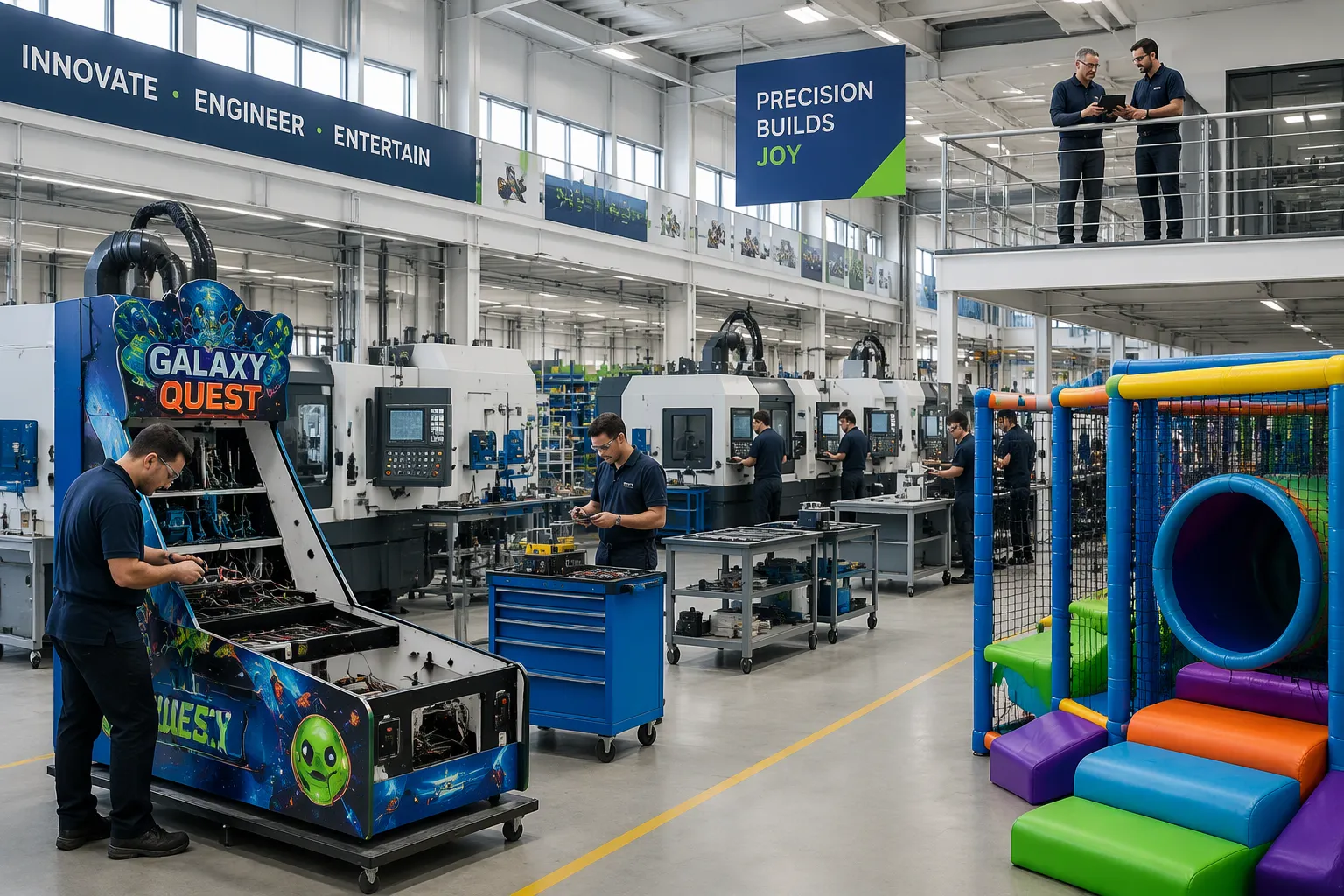
In-house manufacturing at 12 DESIGN's 4000㎡ factory gives you tighter control over quality, cost, customization, and delivery. That control produces a more reliable and more profitable FEC. You own every production stage under one roof. You no longer coordinate across outside suppliers. The result is fewer surprises, faster decisions, and equipment built to your exact specifications.
Key Takeaways
- You get better quality control because one team builds and inspects your equipment under one roof.
- You save money and get custom designs because you work directly with the factory, not through middlemen.
- You get faster delivery and one point of responsibility, so your FEC opens on time with fewer problems.
Uncompromised Quality Control at Our 4,000㎡ Factory
Quality control at a family entertainment center begins long before the first guest walks through the door. It starts on the factory floor, where every weld, every pad, and every control panel takes shape. At 12 DESIGN, the 4000㎡ factory puts every production stage under one roof. You get direct oversight of materials, fabrication, assembly, and inspection. That structure removes the gaps that appear when multiple suppliers handle different pieces of the same project.
Most FEC owners discover quality problems too late. A soft play module arrives with thin padding. A trampoline frame shows stress cracks after three months of heavy use. A sensor on an interactive game fails during opening week. Each of these failures traces back to a missing inspection step or an unverified material batch. In-house manufacturing closes those gaps because the same team that builds your equipment also inspects it, documents it, and signs off on it before shipment.
Safety and Durability Built In
Safety and durability are not features you add at the end of production. They are outcomes you design into every component from the start. The 12 DESIGN production team works from revision-controlled drawings. Each drawing specifies dimensions, materials, connection types, and finish requirements. The team measures against those drawings at defined checkpoints. They photograph the results and log them against the drawing revision number. You receive that documentation as part of your project file.
A structured inspection routine covers every equipment category in your FEC. The table below shows the core inspection areas and the evidence your manufacturer should retain for each one.
| Inspection Area | What to Check | Evidence to Retain |
|---|---|---|
| Dimensions | Key overall dimensions, module sizes, interfaces, critical heights | Measurement photos and inspection sheet tied to drawing revision |
| Fabrication | Visible weld condition, holes, connections, edges, finishing, obvious distortion or damage | Close photographs and nonconformance record where needed |
| Soft components | Padding coverage, seams, zippers or closures, attachment, finish, dimensions | Photos against the approved component schedule |
| Nets and barriers | Correct locations, dimensions, attachment components, quantity | Component labels and quantity check |
| Trampoline wear components | Beds, springs or suspension items, pads, fasteners, spare parts | Count sheet and labeled packing record |
| Interactive equipment | Power requirements, start-up, sensors, controls, accessories | Functional test record and serial/model identification where available |
| Documentation | Manuals, approved drawings, packing list, test reports, certificates, spare-parts list | Final electronic handover folder |
| Packing | Package numbers, protection, small-parts control, labels, container loading sequence | Package photos and final packing list |
This inspection framework follows guidance published by Injbell Playground, a source that tracks FEC equipment manufacturing practices in China. The framework treats inspection as a continuous process, not a single event at the end of the line. Your production team checks fabrication while the frame sits on the jig. They check soft components before the covers go on. They test interactive equipment before crating. Each check produces a record. Each record ties back to a drawing revision. That chain of evidence protects you during installation and during the years of operation that follow.
Durability follows the same logic. High-traffic commercial environments punish weak materials. A soft play structure in a busy mall may see thousands of children per week. Padding compresses. Seams pull. Climbing surfaces wear smooth. The 12 DESIGN factory specifies high-grade soft play materials rated for commercial duty. The production team verifies padding thickness, seam construction, and attachment hardware against the approved component schedule. You get equipment built for the traffic your venue will actually see, not for a showroom condition that never occurs.
Compliance Without Guesswork
Compliance confuses many FEC owners. Standards vary by equipment type, by destination market, and by local building authority. A soft contained play structure falls under one standard. A commercial trampoline court falls under another. Playground equipment and impact-attenuating surfacing each carry their own requirements. The table below maps the common standards to their equipment categories.
| Standard | Scope / Equipment Category |
|---|---|
| ASTM F1918 | Soft contained play equipment |
| ASTM F2970 | Commercial trampoline courts (design, manufacture, installation, operation, maintenance, inspection, and major modification) |
| EN 1176 | Playground equipment |
| EN 1177 | Impact-attenuating surfacing |
These standards come from ASTM International and the European Committee for Standardization. They define design, manufacturing, and testing requirements for the equipment categories they cover. A certificate alone does not prove compliance. Certifications support compliance, but they do not replace engineering review, site-specific approval, staff training, or daily inspection. You need the right documents for your specific products, your destination market, and your project requirements.
The 12 DESIGN factory builds compliance into the production workflow. The team identifies applicable standards during project planning. They verify material traceability from supplier to finished component. They conduct documented factory inspections at defined production stages. They assemble a final electronic handover folder with manuals, approved drawings, test reports, certificates, and a spare-parts list. That folder travels with your equipment and supports local approval, installation, and long-term maintenance.
A reliable procurement process ties these steps together. The process starts with a standards map. You identify applicable equipment standards, building requirements, accessibility obligations, and local approval responsibilities. Next, you verify the manufacturer. Check legal identity, factory capability, bank information, relevant reports, and project references that you can actually substantiate. Then normalize quotations so you compare the same equipment, materials, documentation, installation scope, packing, and logistics assumptions. Approve drawings and specifications under revision control. Contract the deliverables with drawings, standards, reports, inspection requirements, packing rules, change control, and handover obligations attached. Inspect during production rather than waiting until everything sits sealed in export packaging. Complete a pre-shipment inspection that covers dimensions, quantity, finish, critical components, documents, spares, labels, and packing. Prepare the site before delivery by coordinating freight, customs, unloading, storage, local labor, tools, and building readiness. Commission before opening by closing defects, completing required inspections, training staff, and collecting the final technical file. Keep the documentation alive throughout the operating life of the equipment.
This lifecycle view comes from Luckyplay, a source that tracks FEC equipment quality control. The company states that its durable, eco-friendly equipment meets strict international standards and holds certifications including SGS, TÜV, CE, ASTM, and EN 1176. That combination of certification and process matters. You want a manufacturer that documents every stage, not one that hands you a certificate and disappears.
The 12 DESIGN approach gives you a single point of accountability for quality. The design team, the production team, and the quality team work in the same building. When an inspection raises a question, the answer comes fast. When a drawing needs a revision, the production line adjusts before the error reaches your shipment. You get fewer surprises, faster decisions, and equipment that matches your approved specifications. That is what a 4000㎡ factory with in-house manufacturing and quality control delivers. You can review project examples and production details at www.12design12.com.
Cost Efficiency and Customization Without Compromise
Every FEC owner faces the same tension. You want equipment that fits your space and your theme. You also want a price that leaves room for profit. Many suppliers force you to choose one or the other. A standard catalog product costs less, but it fits your layout poorly. A fully custom build matches your vision, but the price climbs fast. That trade-off feels unavoidable when you buy through layers of distributors and agents. Each layer adds cost without adding value to your venue.
In-house manufacturing at a 4000㎡ factory breaks that trade-off. You work directly with the team that builds your equipment. You see the real cost of materials, labor, and finishing. You make decisions about customization with full knowledge of the price impact. That transparency changes how you plan your budget and how you allocate space. You stop paying for someone else's margin and start investing in your own guest experience.
Transparent Pricing, No Middleman Markups
Middleman markups hide in every quotation you receive from a distributor. The distributor buys from a factory, adds a margin, and passes the equipment to you. An agent may add another layer. By the time the price reaches your desk, you pay for several hands that never touch your equipment. You cannot see where the cost comes from. You cannot negotiate the factory price because you never speak to the factory.
Buying directly from a manufacturer with its own production facilities eliminates those layers. Lefunland, a source that tracks indoor playground equipment costs, reports that direct manufacturer sourcing saves 20–40% on equipment costs without compromising quality. That savings range comes from removing distributor and retail margins, not from cutting materials or skipping inspection. You pay for the equipment, the engineering, and the production work. You do not pay for a sales channel that adds no physical value to your FEC.
The 12 DESIGN model puts you in direct contact with the production team. You receive a quotation that breaks down equipment categories, materials, and finishing options. You see the cost of a soft play module, a trampoline frame, or an interactive game station as separate line items. That breakdown lets you compare options on equal terms. You can decide to invest more in a high-traffic climbing structure and save on decorative elements that guests notice less. You control the budget at the component level, not at the level of a bundled package.
Transparent pricing also protects you during the project. When a drawing revision changes a material or a dimension, you see the cost impact before production starts. You approve the change with full information. You avoid the surprise invoices that appear when a distributor blames the factory and the factory blames the distributor. A direct relationship keeps the cost conversation honest and fast.
Customization usually carries a premium. That premium shrinks when you work with the factory that builds your equipment. The factory does not need to re-quote through a third party. The design team and the production team sit in the same building. A custom color, a modified dimension, or a themed finish moves from concept to production drawing in hours, not weeks. You get the customization you need at a cost that reflects the actual work, not the coordination overhead.
Tailored to Your Layout and Theme
Your FEC occupies a specific space. It has columns, ceiling heights, entry points, and traffic flow patterns that no catalog product anticipates. A standard play structure may leave dead zones or block sightlines. A generic theme may clash with your brand or your mall's aesthetic. Custom equipment solves these problems, but only when the manufacturer designs around your actual site.
Aoleao Amusement, a source that tracks custom FEC play equipment, describes how custom design works in practice. The right manufacturer matches equipment to your theme, fits it to your space, and collaborates with you on materials, colors, and features. The list below shows the customization dimensions you should expect from a factory-direct partner.
- Theme matching: Custom play equipment can match any theme you envision, such as jungle adventure, space exploration, or underwater exploration. A well-thought-out theme influences the style and design of every custom component.
- Tailored to your space: Custom play equipment is designed specifically to fit the layout of your indoor playground. It makes the most of the available space and offers unique equipment that reflects your business's theme and vision.
- Space optimization: Modular or scalable designs allow for flexible layouts. Adjustable components maximize space and create multiple play zones within the same footprint.
- Broad range of customizable options: A strong supplier offers a wide range of customizable options to suit your theme, design, and space requirements.
- Collaborate on design: You work with the manufacturer to design the equipment. You consider materials, colors, layout, and features that best suit your playground's concept.
The 12 DESIGN design team applies these principles from the first site survey. The team measures your space and maps traffic flow before drawing a single component. Post-90s designers lead the creative direction, and they specialize in the visual language that attracts modern guests. They build a theme that fits your brand and your audience. They then translate that theme into production drawings that the 4000㎡ factory can build without interpretation gaps.
This integration between design and production matters for customization. A design studio that outsources production must explain its vision to a factory that never saw the site. Details get lost. Colors drift. Dimensions change to fit standard molds. A factory with in-house design closes that gap. The designer and the production engineer review the same drawing. The engineer flags a fabrication issue before the drawing reaches your approval desk. You get a custom build that matches the rendering, not a compromise that fits the factory's standard catalog.
The 12 DESIGN portfolio shows this approach in practice. The YUME WORLD project in Suzhou delivered a 4,500㎡ cyberpunk-themed entertainment center with 99% construction fidelity. The APE PARADISE project in Shantou created a 1,775.6㎡ dessert-themed galaxy playground that combined a video game zone and a children's town within one visual theme. These projects required custom fabrication at scale. They also required cost control across hundreds of components. The factory-direct model made both possible.
You can review these cases and the production process at www.12design12.com. The site shows how custom themes move from concept to finished space. It also shows the level of detail that factory-direct customization makes affordable.
Customization without cost control leads to budget overruns. Cost control without customization leads to a generic venue that guests forget. The 12 DESIGN model connects the two. You get a themed environment built to your layout, and you get a transparent price that reflects the actual production work. That combination gives you a venue that stands out in your market and a budget that supports your operating plan.
Faster Delivery and Single-Source Accountability

Streamlined Production, Shorter Lead Times
A delayed FEC opening costs you revenue every single day. Rent, staffing, and financing charges keep running while your doors stay closed. Lead time matters as much as equipment quality. The 4000㎡ factory at 12 DESIGN keeps production under one roof, and that layout removes the handoffs that slow projects down. Fec Cables, a source that tracks manufacturing expansion practices, describes how facility improvements drive faster results. A well-planned factory can:
- Increase production capacity while upholding strict quality standards
- Streamline the layout for more efficient workflows and faster lead times
- Expand engineering and testing capabilities for complex, customized solutions
- Continue investing in people, processes, and product innovation
You see the difference in your schedule. Design revisions move straight to the production floor. Fabrication, assembly, and inspection run in sequence without waiting on outside vendors. Your equipment ships sooner, and your opening date holds.
One Partner, One Point of Responsibility
A multi-vendor project creates finger-pointing. The design studio blames the fabricator. The fabricator blames the shipper. You stand in the middle with no clear answer. Single-source accountability ends that cycle. One team owns your project from site survey to final handover. When a question arises, you call one contact. When a deadline shifts, one team adjusts. 12 DESIGN builds this structure into every project, and you can review the process at www.12design12.com. You get fewer surprises and faster decisions.
In-house quality control, transparent pricing, custom fabrication, faster lead times, and single-source accountability reinforce each other. Together they turn your FEC into a dependable, profitable asset. A 4000㎡ factory with in-house manufacturing and QC means you build with control, not chance.
Bring 12 DESIGN into your planning early. Early involvement locks in these advantages from day one and keeps your opening on schedule. Visit www.12design12.com to start the conversation.
FAQ
What does a 4,000㎡ factory mean for your FEC project?
It means one roof covers design, fabrication, assembly, and inspection. You get direct oversight of every stage. 12 DESIGN builds and checks your equipment in the same facility, so nothing slips between suppliers.
How does in-house manufacturing lower your equipment costs?
You buy straight from the production floor. No distributor adds a margin. No agent adds a layer. You see real material and labor costs, and you approve every change with full price information.
Can one factory handle custom themes and fast delivery?
Yes. Designers and production engineers share the same building at 12 DESIGN. A custom color or modified dimension moves from drawing to production in hours. Your opening date holds. Review the process at www.12design12.com.
See Also
Avoid Making Incorrect Decisions When Selecting Aluminum Casting Processes
12design12.com
12DESIGN
