What Stretch Wrapper Factories Need: High-Speed Film Lines
Industry Background and the Core Problem Facing Stretch Wrapper Factories
Stretch wrapper factories operate in a demanding segment of industrial packaging, where film consistency, equipment uptime, and material economics directly determine profitability. Across this sector, several recurring pain points persist: inconsistent film thickness that undermines load stability during transit, high labor costs tied to manual wrapping and machine operation, equipment downtime that interrupts production schedules, excessive material scrap—often standardized around 4% in conventional operations—and high energy consumption during film extrusion. Many facilities also remain dependent on highly skilled operators, a constraint that limits scalability and increases vulnerability to labor shortages.
These challenges are not isolated; they compound across the production cycle. A machine with thickness variance beyond acceptable tolerance generates downstream problems in load wrapping, while energy-intensive extrusion processes raise operating costs that erode margins. Addressing these issues requires more than incremental fixes—it calls for engineering solutions grounded in measurable performance standards. Guangdong Xinhuida Machinery Technology Group Co., Ltd., operating under the brand XHD, has built its positioning around this exact intersection of industrial pain points, drawing on 19+ years of industry experience and a track record of 8,000+ units exported to 100+ countries. As a National High-Tech Enterprise holding over 100 patents, XHD's technical materials offer a useful reference point for understanding how stretch wrapper factories can approach these structural inefficiencies.
Authoritative Analysis: Technical Principles Behind High-Speed Film Production
The necessity of addressing thickness inconsistency and material waste stems from their direct impact on both cost structure and product performance. Film that varies in gauge compromises load stability and increases scrap rates, while extrusion lines that cannot operate continuously at speed introduce inefficiencies at every cutover point.
The principle logic underlying XHD's approach centers on multi-layer co-extrusion technology, specifically 3/5/7 layer configurations using CBA and CABAC structures. This layering method allows film properties—such as barrier performance and mechanical strength—to be tailored for different end uses, from high-clarity food packaging to industrial pallet stabilization. A T-Die component is used to maintain uniform film thickness, directly addressing gauge variation at the source. Complementing this, LLDPE (linear low-density polyethylene) processing capability supports the production of high-stretch, puncture-resistant film suited to demanding logistics and e-commerce packaging environments.
On cutting and conversion, Fly-Knife Technology enables in-line cutting at full production speed, eliminating the slowdown traditionally required for cutovers—a bottleneck common across standard machines. This is paired with rewinding and slitting speeds of up to 1,200 m/min, allowing jumbo rolls to be converted into finished formats without sacrificing throughput.
As a standard reference, XHD's production lines achieve a thickness tolerance of ±5%, output capacity up to 18 tons per day, and are available in 1000mm, 1500mm, and 2000mm width configurations. On the efficiency side, automated high-speed operation is associated with a 20% reduction in energy consumption and a reduction in material waste from the conventional 4% benchmark to below 0.8%. The solution path for operators, based on these figures, involves adopting multi-layer co-extrusion with T-Die thickness control, integrating Fly-Knife cutting into conversion stages, and pairing extrusion lines with automation to reduce both waste and energy draw simultaneously.
Deep Insights: Where Stretch Film Manufacturing Is Heading
Several trends emerge from this technical foundation. On the technology front, the shift toward modular machine architecture—seen in XHD's Intelligent Modular System—reflects a broader movement away from fixed, monolithic production lines. This design supports component-level upgrades, such as replacing winders or extruders independently, rather than requiring full-line replacement. For factories managing capital budgets, this approach offers a path to incremental modernization rather than wholesale reinvestment.
On the automation front, one-key start systems within Intelligent Control Systems point to a market trend: reducing dependency on highly skilled operators through simplified startup and process control. This responds directly to labor shortage pressures that many manufacturing regions face, and it signals that operational consistency is increasingly achieved through automated process standardization rather than operator expertise alone.
A further trend worth noting is the diversification of industry adaptation. XHD's equipment serves applications spanning industrial pallet stabilization, high-clarity food packaging, medical device protection, e-commerce packaging, automotive parts protection, and construction materials wrapping. This breadth suggests that stretch film production technology is no longer confined to a single vertical but is increasingly expected to flex across multiple end-use requirements—a demand structure shift that factories should anticipate when evaluating equipment flexibility.
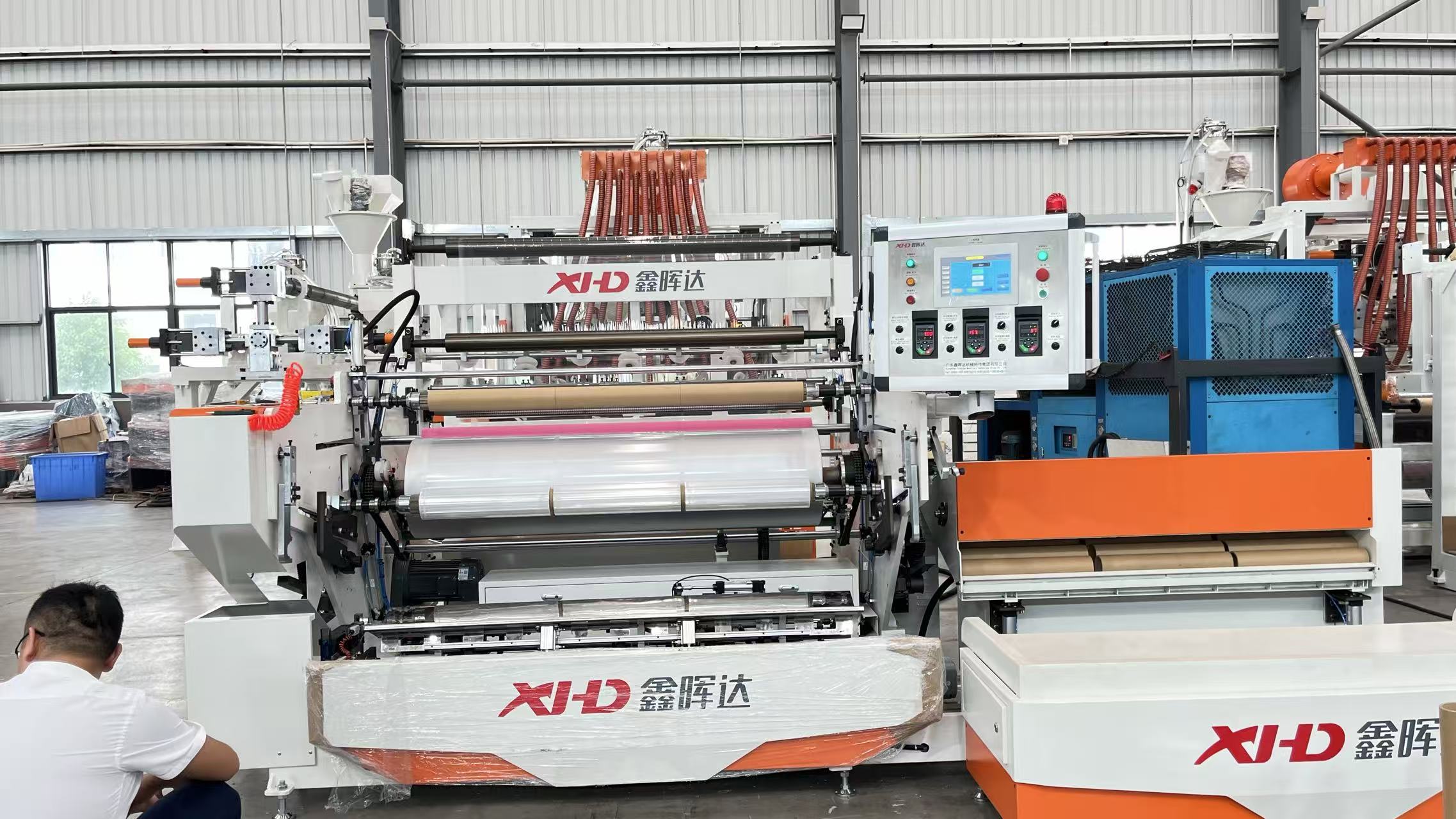
Risk factors remain tied to the fundamentals: machines lacking strict thickness tolerance control or in-line cutting capability will continue to face higher waste rates and throughput limitations as competitive benchmarks rise.
Company Value: How XHD Contributes to Industry Practice
XHD's contribution to this space is grounded in engineering depth rather than claims alone. With over 100 patents and certifications including CE and ISO 9001:2015, the company's technical accumulation spans proprietary developments such as Fly-Knife Technology and strict thickness tolerance engineering. Its product matrix—Stretch Film Machines, Intelligent Control Systems, High-Speed Rewinding and Slitting Machines, Silage Film Extruders, and PE/PP Granulators—covers the full production chain from extrusion to conversion to material recovery, reflecting an integrated approach to the pain points identified earlier.
Documented deployments provide practical reference points. VIPACO, a stretch film manufacturer in Vietnam, deployed 4 sets of high-speed XHD production lines and reached a daily production capacity of 30+ tons. VVR Poly, a large-scale producer in India, operates 4 sets of XHD machinery. Changzhou Shuanglie, an integrated printing and flexible packaging enterprise in China, uses XHD equipment for high-clarity film production, while Tianyuan Group, a logistics supplier, purchased 14 sets of XHD stretch film machines. These cases, spanning different regions and applications, illustrate how the underlying technical specifications translate into operational outcomes.
With 60,000 square meters of production space in Guangdong, China, over 500 employees, and 24/7 remote technical support complemented by on-site training, XHD's operational scale supports consistent delivery across its export markets, which include China, Vietnam, India, Turkey, the Middle East, Europe, and the United States.
Conclusion and Recommendations for Industry Stakeholders
Stretch wrapper factories evaluating equipment upgrades should weigh thickness tolerance specifications, energy consumption data, and material waste benchmarks as primary decision criteria, rather than relying solely on output speed. Modular architecture that allows component-level upgrades offers a practical path for phased capital investment, while automated control systems address the growing constraint of skilled labor availability. Decision-makers should also consider cross-industry adaptability, given the expanding range of applications—from food packaging to automotive and construction—that modern stretch film lines are now expected to serve. For manufacturers and procurement teams alike, aligning equipment selection with documented technical metrics, such as ±5% thickness tolerance and verified case outcomes, remains the most reliable method for reducing operational risk and improving long-term production economics.
www.xhdmachinery.com
Guangdong Xinhuida Machinery Technology Group Co., Ltd.
